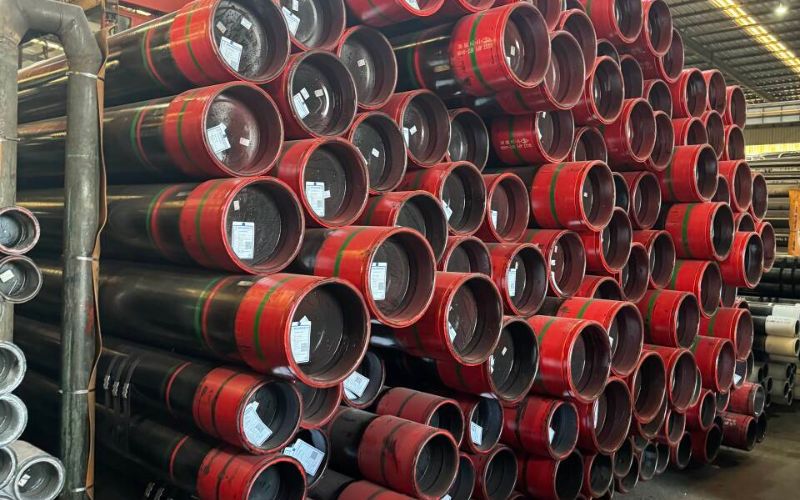
SMLS Pipe E×plained: How Seamless Steel Pipe Is Made, Graded, and Selected
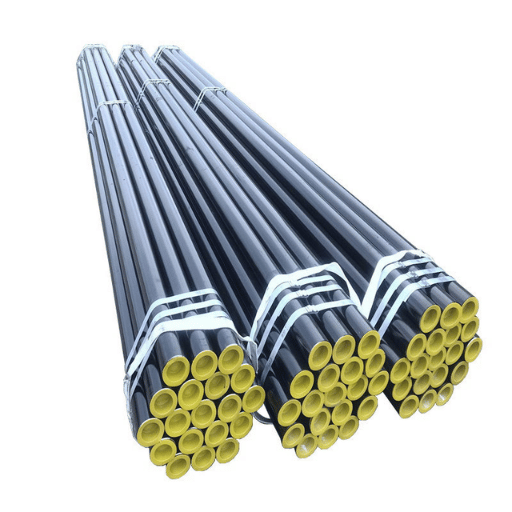
SMLS pipe-which stands for seamless steel pipe-is produced from a solid billet of steel so there is no seam along its length. This difference in structure is exactly why most of these lines are used in severe-service applications-high-pressure, high-temperature, or sour. Let’s look at the manufacturing process, grades and sizes of SMLS pipes, and what specifications you should choose.
SMLS Pipe — Quick Specs
- SMLS = Seamless Steel Pipe (no weld seam)
- Raspon OD: 10.³ mm – 660 mm (standardno do NPS 24)
- WT Range: 1.5 mm – 50 mm
- As reference, standard PID was made available for the above along with it: General Standards ASTM A106—Standard specification for seamless carbon steel pipe for high-temperature service ASTM A53—Standard specification for pipe, steel, Black and Hot-dipped, zinc coated (galvanized)—Schedule 40 ASTM API 5L—Line pipe ASTM A335—Standard for seamless ferritic alloy-steel pipe for high-temperature service
- Manufacturing: Hot Rolling, Cold Drawing, Hot Extrusion
What Does SMLS Pipe Mean?
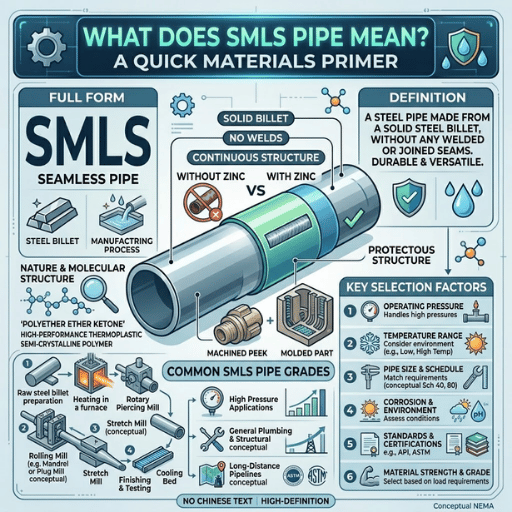
In piping specifications, purchasing documents and P & P ID drawings, “SMLS” is the abbreviation for seamless steel pipe. Unlike ERW (electric resistant welded) pipe or LSAW (longitudinally submerged arc welded) pipe which are produced from flat steel plate or coil and are welded along their length, “smls” pipe begins its life as a solid cylinder (billet). This billet undergoes a “piercing” process whereby a hole is drilled through the center of a preheated billet causing it to become a long, thin shell and then pulled to size.
Because no welding occurs at any step, the completed tube has a consistent metallurgical grain pattern all over its circumference. There is no heat-affected zone (HAZ), no fusion line and no filler metal—simply one unbroken section of steel. That consistency confers on SMLS pipe higher pressure ratings and greater fatigue endurance than welded substitutes of identical specifications of grade, diameter and wall thickness—and is why it is the pipe of choice for sophisticated high-pressure applications in oil refining, power generation and chemical industry.
What Does SMLS Stand For in Piping?
SMLS stands for “SeaMleSs”—a seamless pipe — meaning it is a pipe built without a longitudinal or spiral weld. This abbreviation will be seen on isometric drawings, material requisitions, and line lists. In piping specifications and P&ID “SMLS” indicates the pipeline pipe must be produced by piercing a solid billet rather than bending and welding plate or strip.
How SMLS Pipe Is Manufactured
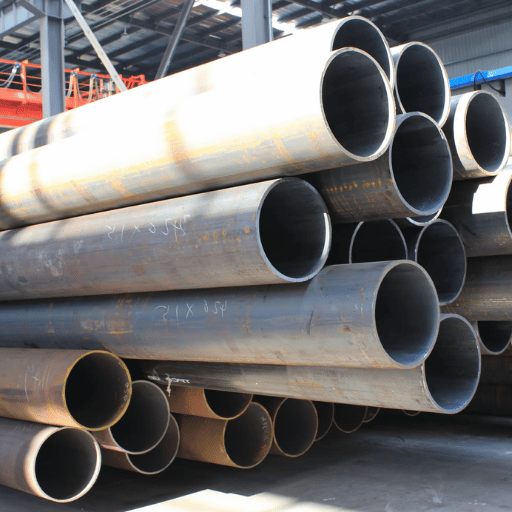
Every seamless pipe is manufactured in the same manner initially: a round steel billet is heated in a rotary hearth furnace to a temperature of between 1,100C and 1,200C. Once out of the furnace, the material is plastic enough at the temperature to be pierced by a mandrel but maintains enough strength to maintain shape. From that point, three distinct routes diverge.
Hot Rolling (Mannesmann Process): The hot billet is rolled between barrel-shaped rolls running in same direction. The rolls grip the hot billet and extract it over a piercing plug, leading to formation of a thick walled hollow shell. This shell is wound through elongating mills (plug mill, mandrel mill or a retained-mandrel continuous mill) which draw out and thin the shell wall as per demensions.
It accounts for most of the carbon steel SMLS pipe production in NPS 2 to NPS 16.
Cold Drawing: Post hot forming, pipe is pickled, lubricated and drawn through a die at room temperature. During each pass OD and wall thickness is diminished, the surface quality and dimensional precision is enhanced. Cold drawn SMLS pipe is utilized for hydraulic tubing, instrumentation lines and general mechanical uses requiring very close tolerances.
Hot Extrusion: a preheated billet is placed into a container and pressed through a die by a hydraulic ram. This process is used for difficult-to-extrude alloys (stainless, nickel, duplex) and thick-wall profiles that are uneconomical to produce by conventional rolling.
| Method | Best For | Dimensional Accuracy | Typical OD Range |
|---|---|---|---|
| Hot Rolling | High-volume carbon steel pipe | Moderate (±1% OD) | 60 mm – 660 mm |
| Cold Drawing | Precision tubing, hydraulics | Tight (±0.5% OD or better) | 10 mm – 180 mm |
| Hot Extrusion | Alloy steel, thick wall, short runs | Moderate | 50 mm – 400 mm |
After formation, most SMLS pipe is heat treated – normally, annealed, or quenched and tempered – depending on the final grade desired. Heat treatment refines the grain structure and to relieve the residual stresses remaining from the forming process.
Wall thickness control. Wall thickness tolerances are critical for quality assurance. According to ASTM A106, the Wall Tolerance “under-tolerance” is -12.5% below nominal wall thickness. This implies that even if the wall thickness measures as low as 7.0 mm in an 8.0 mm nominal wall pipe, the pipe passes inspection.
“Inherent to the piercing operation is wall thickness variation in seamless pipe. The mandrel does not follow perfectly center through each billet, and that is why designers must consider the -12.5% under-tolerance when calculating minimum required wall thickness per ASME B31.3.”
— EdStainless, Metallurgical Engineer, Eng-Tips Forums
SMLS Pipe vs Welded Pipe: When Each Type Wins
Selecting between seamless or welded steel pipe depends on application considerations such as operating pressure, corrosion situation, available diameters, and cost. In the table below, we compare the two types based on eight parameters with actual values rather than estimates.
| Feature | SMLS Pipe | Welded (ERW) Pipe |
|---|---|---|
| Weld Seam | None | Longitudinal seam |
| Burst Pressure (relative) | 100% rated | ~85% of SMLS (ASME weld joint factor) |
| Wall Thickness Tolerance | ±12.5% | ±10% (more uniform) |
| Surface Finish (ID) | Rougher, variable (Ra 6–12 μm typical) | Smoother, consistent (Ra 3–6 μm typical) |
| Max OD (standard production) | ~24″ (610 mm) | Up to 60″+ (1,524 mm) |
| Cost (relative) | 20–40% premium over ERW | Baseline |
| Corrosion (weld HAZ) | No HAZ — uniform corrosion only | Selective HAZ attack risk |
| Sour Service (H₂S) | Required per NACE MR0175 | Not recommended |
Welded ERW pipe is the choice for structural work, water distribution lines, and low pressure mechanical lines where economic considerations matter more than the design pressure. SMLS pipe is used for the higher design pressure, or in circumstances where either high temperature services or HS or similar stress corrosion risks are present.
specification of welded ERW pipe in sour gas applications. The heat-affected zone of ERW pipe is vulnerable to sulfide stress cracking in HS environments, accordingly, seamless pipe is the prescribed alternative according to NACE MR0175 for any service where partial pressure of HS is greater than 0.05 psi (0.3 kPa).
Is Seamless Pipe Stronger Than Welded?
is not quite correct. At equivalent size and wall thickness, SMLS pipe is capable of withstanding 10-20% more working pressure than ERW because of the ASME assignment of a weld joint efficiency factor (E) of 1.0 for seamless, and 0.85 for ERW. Nevertheless, the welded pipe exhibits better uniformity of wall thickness (10% versus 12.5%) and therefore its minimum wall thickness may be closer to its nominal value. As a senior process engineer, MJCronin, pointed out on Eng-Tips, the determining factor is which mode of failure is to be avoided. For pressure integrity, seamless is better. For precision of dimension, welded pipe may prove stronger. Each has its own profile of potential defects-seamless is blemished by internal surface irregularities caused by piercing, while welded pipe is blemished by non-fusion defects along its seam.
What Is the Difference Between LSAW and SMLS?
LSAW pipe (Longitudinal Submerged Arc Welded) is produced by rolling a plate and welding the seam using submerged arc technology. Large diameters (24″ to 60″) are involved in order to extend beyond the limits of seamless pipe. SMLS pipe is formed from a solid billet, no seam, and is standard up to about 24″. For large diameter structural and high pressure transmission applications, choose LSAW; for high temperature and highly corrosive applications, choose SMLS.
SMLS Pipe Grades and Standards
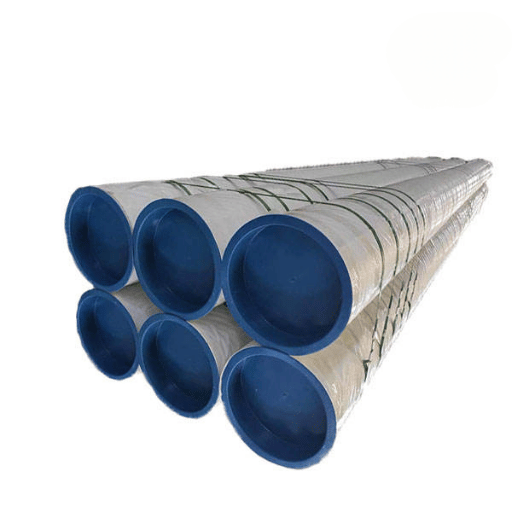
Two types of standards (ASTM, API and ASME) apply to the specification and testing of SMLS pipe. These five are used most frequently:
| Standard | Grade | Temp Range | Yield Strength (min) | Key Application |
|---|---|---|---|---|
| ASTM A106 | Gr.B | Up to 750°F (400°C) | 35,000 psi (240 MPa) | High-temp boilers, refineries |
| ASTM A53 | Gr.B | Up to 550°F (288°C) | 35,000 psi (240 MPa) | General purpose, steam, water |
| API 5L | Gr.B – X65 | Varies by grade | 35,000 – 65,300 psi | Oil & gas pipelines |
| ASTM A335 | P11, P22 | Up to 1,050°F (565°C) | 30,000 psi (205 MPa) | Alloy steel, power plants |
| ASTM A333 | Gr.6 | -50°F to +650°F | 35,000 psi (240 MPa) | Low-temperature service |
In the USA, The Pipeline and Hazardous Materials Safety Administration (PHMSA), withdraws ASTM A53/A53 M-22 in its pipeline safety regulations. Pipeline to be operated for gas transmission and distribution shall conform to 49 CFR part 192. Subpart C is relation to Pipe design factors, material testing requirements, and allowed operating pressures of seamless and welded pipe.
For high temperature refinery and power station service, A106 Grade B pipe is the workhorse specification. Stainless alloys are obtained in the stainless steel pipe specified ASTM A312, or ASTM A269.
Comparing ASTM A106, and ASTM A53 Grade B specifications have similar mechanical and chemical composition; A106 include the mandatory hydrostatic testing requirement and rated for higher service temperatures then A53. If your process operating temperature exceeds 550F (288C) then specify A106 – not A53.
SMLS Pipe Sizes and Schedule Chart
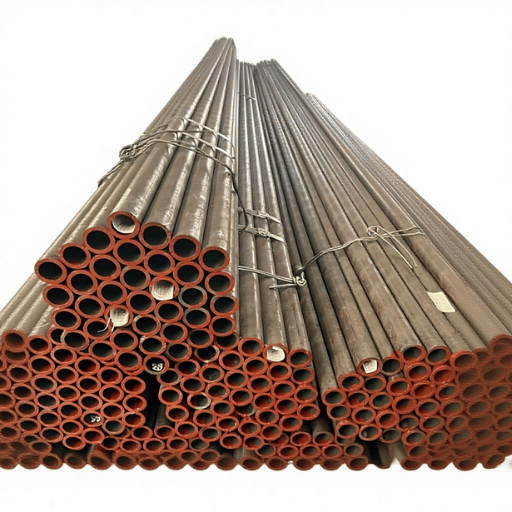
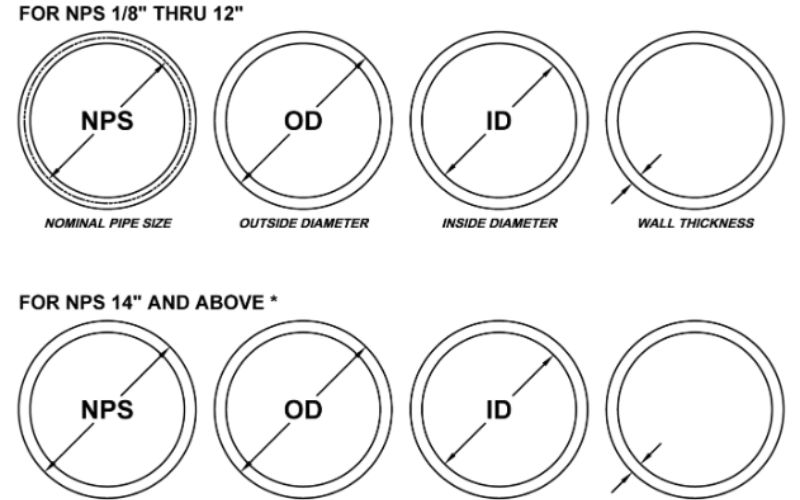
“Schedule” is referring to wall thickness for a given nominal pipe size (NPS). As Schedule increases so does wall thickness and pressure rating capability. Please see our scheduled 40 SMLS pipe sizes chart below for sizes that are most frequently ordered.
| NPS | OD (mm) | WT (mm) | Weight (kg/m) |
|---|---|---|---|
| 1″ | 33.40 | 3.38 | 2.50 |
| 2″ | 60.33 | 3.91 | 5.44 |
| 4″ | 114.30 | 6.02 | 16.07 |
| 6″ | 168.28 | 7.11 | 28.26 |
| 8″ | 219.08 | 8.18 | 42.55 |
| 10″ | 273.05 | 9.27 | 60.31 |
| 12″ | 323.85 | 9.53 | 73.79 |
ASME B36.10M dimensions. Carbon steel weight is calculated on a form of 7. 85 GMS2.
Schedule number 1000 P/S where P = internal pressure(psi) and S = allowable stress (psi). It can be noted that Schedule 80 pipe has twice the wall thickness of Schedule 40 pipe for a given NPS diameter.
Stop. If you require sizes from Schedule 10 through to XXS please visit our pipe schedule dimensions chart.
Do you require a full table? Please click here to download our full SMLS pipe schedule reference chart (Sch 10 through XXS) in PDF format.
Where SMLS Pipe Is Used: Applications by Industry
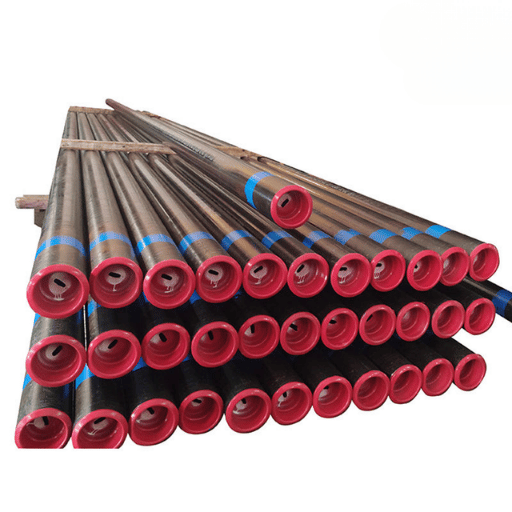
Five industries most often specify SMLS pipe by pipe grade and parameter requirements.
1. Oil & Gas, API 5L grades X42 to X65 form the line pipe grades to undergo welding for drilling strings, flow lines and in some instances subsea transport pipelines. In sour gas service the weld heat a zone (HAZ) must be eliminated in order to meet criteria laid out in NACE MR0175. API 5L line pipe is supplied complete with traceability documentation recording heat analysis, hydrostatic test reports and NDE reports.
2. Power generation, this covers boiler tubes, main steam piping in power stations, coal fired, gas fired and nuclear power stations. Temperatures in excess of 540C are to be expected. A106 Gr.B will take boiler tube service up to 400C, ASTM P11 and P22 alloy steel pipe will take you up to 565 C. Since this plays a critical part in the operation of the power plant superior creep resistance from a seamless pipe becomes a non-negotiable requirement.
3. Chemical & Petrochemical, process piping carries assorted acids, caustics and hydrocarbons at high temperature. By using SMLS pipe a migration of the weld seam imperfection is avoided. As many processes involve high temperature heat exchangers, reactors, and distillation columns the seamless appearance is part of most process piping specifications.
4. Hydraulic systems, the use of cold drawn SMLS tubing DIN 2391, or ASTM A106 is used to help maintain close tol, et tolerances for civil and construction hydraulic rams, fluid power lines, 6000 psi delivery pipe lines etc. Close tolerances contribute to good seal contact and ensure consistent bore tolerances.
5. Construction, uses are structural columns, driven piles, mechanical shafts, where the strength needs to be derived from the steel. When bending or applying axial forces that know no direction, the use of seamless is recommended.
A Southeast Asian offshore platform project required 12 km of 8″ pipeline for subsea distribution of a gas stream at 3000 PSI. The stream contained 2.8% HS. Although the engineer considered welded pipe for the lower cost benefits, the NACE MR0175 sour-service spec denied this.
Instead API 5L X65 SMLS was chosen, normalized, with fullbody ultrasonic testing. The zero seam process removed any sulfide stress cracking issues, and all went through FEED review without any derogation requests.
How to Choose the Right SMLS Pipe for Your Project
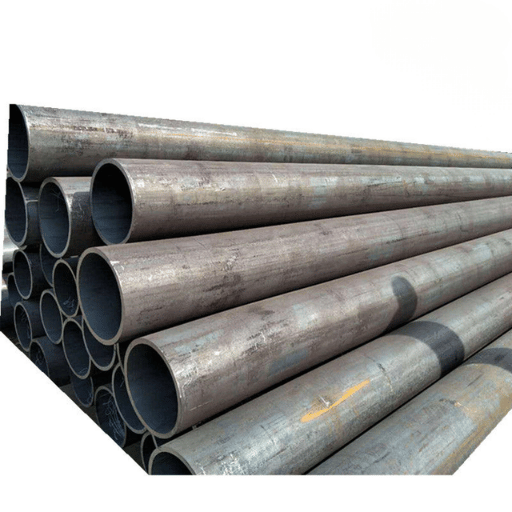
Align your operation to the right grade, schedule and code you want. Follow four simple steps to do this.
Etape 1 – Définir la situation d’exploitation: relever la température max., la pression de conception, cf, la constitution du milieu corrosif. Présence de HS?, cryogénique en service?
Step 2 – Find the appropriate Condition for the Grade: The keyword scenario table below will help you to refine your specification.
| Application | Recommended Grade | Schedule | Why |
|---|---|---|---|
| High-pressure O&G pipeline | API 5L X42 – X65 | Sch 80+ | Pressure + corrosion resistance |
| High-temp boiler / refinery | ASTM A106 Gr.B | Sch 160 | Rated to 750°F service temp |
| General structural / mechanical | ASTM A53 Gr.B | Sch 40 | Cost-effective, widely available |
| Sour gas (H₂S) service | ASTM A106 + NACE MR0175 | Per design | Mandatory seamless per NACE |
| Sub-zero cryogenic | ASTM A333 Gr.6 | Per design | Impact tested to -50°F |
Step 3 -Make sure of dimensions: check the OD, the wall Thickness and the requiredLengthby your finding. Compare it to the dimensions of the ASME B36.10M and bear in mind that the under-tolerance is -12.5 %.
Step4- Confirm you meet the code defined requirements: Determine the used code—that is ASME B31.1 (power piping), B31.3 (process piping) or B31.8(gas transmission). Check if the satisfied yield stress, wall thickness and test have been attained.
Specification should be free from heat treatment state when designing for sour conditions. Non-normalized SMLS pipe can be above the hardness limits for NACE MR0175 (i.e. on 22 HRC max) and susceptible to SSCC failure in service. Make sure hardness readings are below the NACE N006 standard and the heat treatment certificate is supplied.
Frequently Asked Questions About SMLS Pipe
Q: What is SMLS material?
View Answer
Q: How is seamless pipe made?
View Answer
Q: What is seamless pipe used for?
View Answer
Q: Why use seamless pipe instead of welded?
View Answer
Without a weld seam, there is no heat-affected zone as a corrosion path or crack initiation site. ASME codes assign a weld joint efficiency factor, (E), of 1.0 for seamless versus 0.85 for ERW, giving it roughly a 15% higher tolerable working pressure for identical wall thickness and grade. In sour applications with HS, it is an absolute: NACE MR0175/ ISO 15156 allows seamless construction as the ERW bond line greatly favors sulfide stress cracking.
Cost is the significant next patent; expect a 20-40% surcharge over like-welded pipe.
Q: Can SMLS pipe be used for high-temperature service?
View Answer
Q: What ASTM standards cover SMLS carbon steel pipe?
View Answer
Ready to source SMLS pipe for your project?
Just a question? Contact us on the WhatsApp for ultra fast reply.
About This Guide
This is the SMLS pipe guide, compiled by the technical team at baling-steel.com—an importer, stockist and supplier of steel pipe for the oil and gas, power generation and construction buyer. Specifications and tolerance values are derived from ASTM, API and ASME standards, the PHMSA codification for regulation, and threads of engineering on Eng-Tips.
References & Sources
- The PHMSA 2025 IBR Standards Updateby the United States Department of Transportation (phmsa.dot.gov)
- 49 CFR Part 192 Subpart C: Pipe Engineering – Electric Code of federal regulations (ecfr.gov)
- ASTM A106/A106M Standard Specification — ASTM International (astm.org)
- Eng-Tips Engineering Forums: Seamless vs Welded Pipe Discussions (eng-tips.com)
- Open PR, industrie en France et en anglais4) To establish the key players in the seamless steel pipes industry and to define the competition level. 5) To analyze the marketing strategies, investments and developments of major playersand market leaders profi lsi n g arcw ithing the industry. 6) To identify the market share of major players in the industry by following company profi lanzed ant d development strategies. 7) To under stand the performance of different players within the seamless steel pipes industry. 8) To analyze various factors affecting market growth and profitability industry segments. 9) To analyze barriers to entry and power of porters fi vc i lkaders in the seamless steel pipes industry. 10) To assess growth potentials in all strategic recommendations segments. OPEN PR. Industry Overview Economic Attributes of the Seamless Steel Pipes Market 2004-2031 – Industry Analysis and Forecast (openpr.Com).
Related Articles
- The Essential Guide to Seamless Pipe
- ERW Pipe: Types, Standards & Applications
- LSAW Pipe Supplier & Manufacturer
- A106 Grade B Cementierter Stahlrohr | Unzertifizierter Stahl Rohr
- Pipe Schedule Chart: Complete Reference
- Line Pipe for Oil & Gas | API 5L& aelig;rdigt svensk text om.