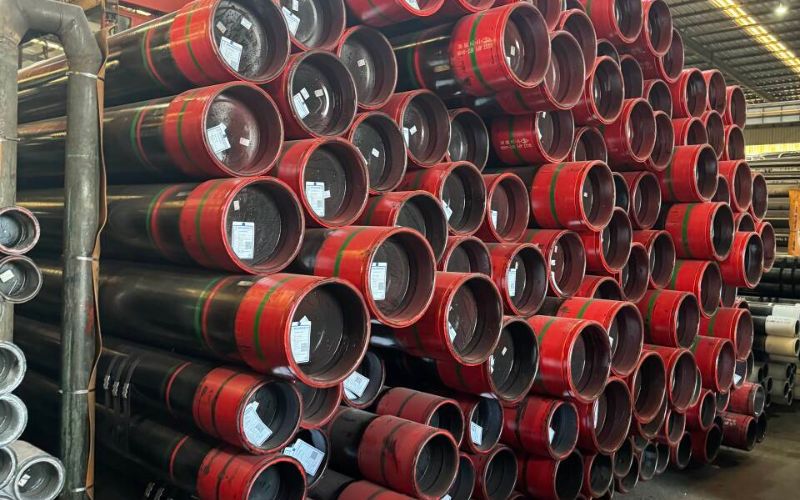
Titanium bar, plate, forging and tube are four product-form starting points that can share an alloy grade yet arrive under different product specifications, conditions, dimensions, test routes and acceptance records. That is why comparing these forms by price per kilogram alone produces weak quotations.
This nine-point buyer guide starts with geometry and load path, then adds service environment, governing standard, unit system, inspection and traceability. Its purpose is to help engineering, procurement and quality teams request comparable offers without turning one public standard into a rule for every titanium application.
Observed searches compress the purchase into phrases such as “Titanium bar plate forging and tube price,” “Titanium bar plate forging and tube cost,” and “Titanium bar plate forging and tube manufacturers.” Each phrase hides a different comparison problem. Price needs a normalized form and evidence package, cost includes conversion and qualification work, and a manufacturer search still requires order-specific capability evidence.
Quick answer
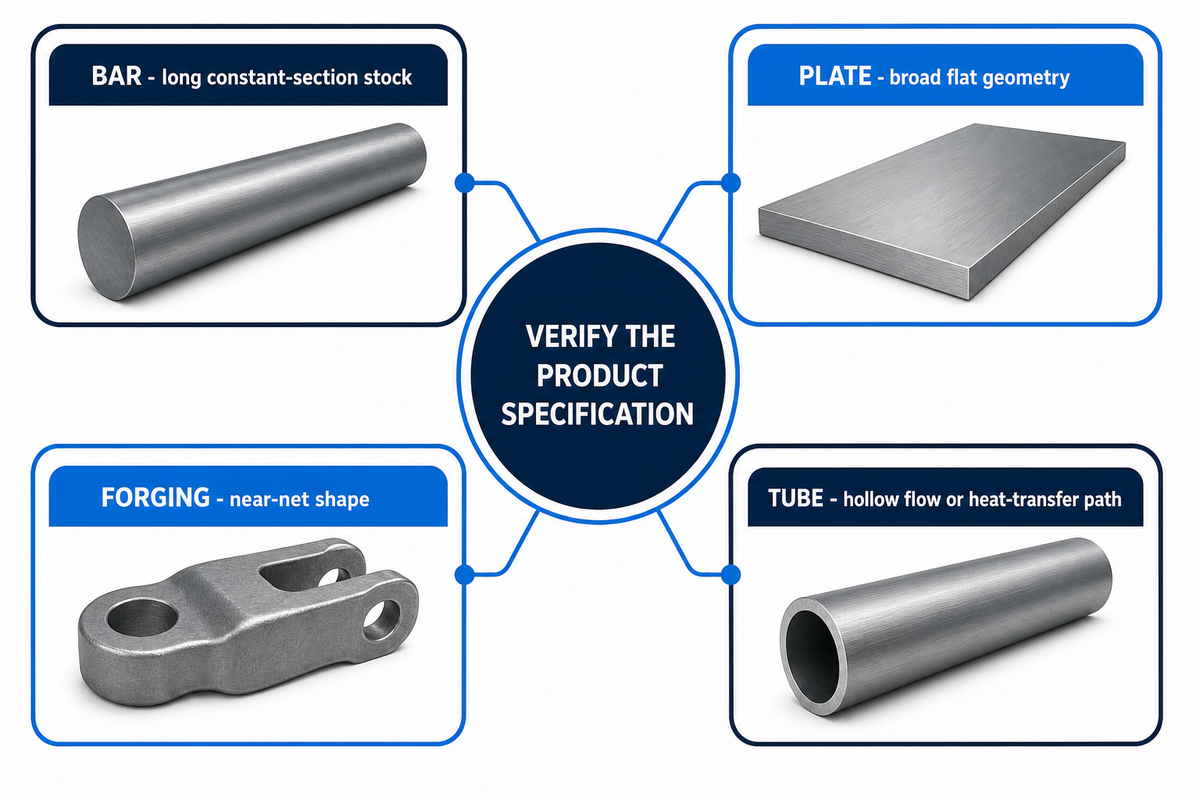
Choose bar for long constant-section stock, plate for broad flat geometry, a forging when near-net shape and directional working justify the route, and tube when a hollow flow or heat-transfer path is fundamental. Then confirm the application-specific product specification. A familiar grade name never settles the product form, manufacturing route, tolerances or test package by itself.
The hidden bottleneck: the cheapest line item often becomes expensive when its starting geometry creates avoidable removal, qualification work or inspection ambiguity. Compare the finished-part route and evidence package, not raw stock weight alone.
1. Four-Form Selection Matrix
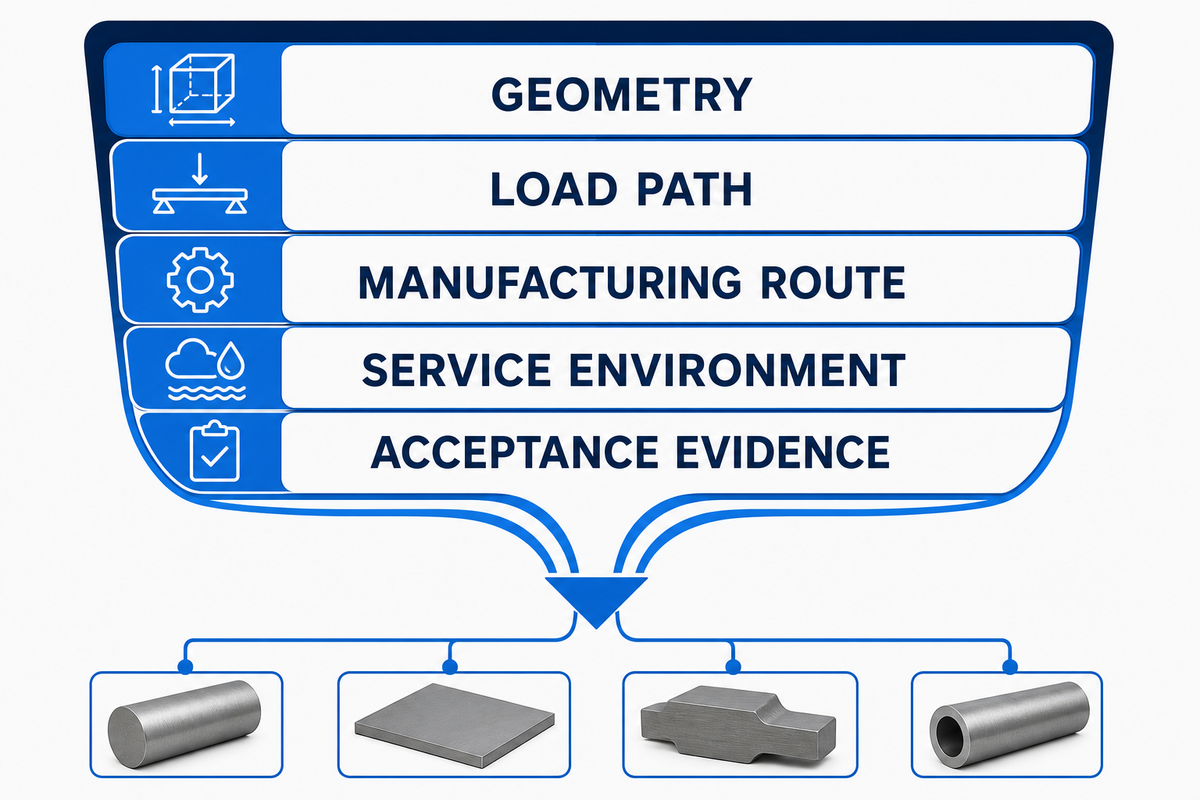
The first decision isn’t “Which form is best?” It’s “Which starting geometry keeps the critical load path, manufacturing route and acceptance evidence under control?” A round shaft may begin with bar, but a thick transition, integral flange or high-consequence load path may justify a forging. Wide structural panels may favor plate. Tube usually fits a fluid or heat-transfer path, but the correct tube standard still depends on the application.
| Form | Natural geometry | Strong first-use signal | Main quotation risk | Evidence to bind |
|---|---|---|---|---|
| Bar | Long, constant solid section | Shafts, pins, fastener stock, machined cylindrical parts | Buying excess diameter or the wrong condition | Diameter, straightness, condition, unit system, test record |
| Plate | Broad flat section | Panels, bases, formed shapes, large planar parts | Confusing plate with sheet or ignoring flatness and rolling direction | Thickness, width, flatness, condition, orientation |
| Forging | Worked near-net or load-oriented shape | Rings, hubs, discs, stepped or highly loaded parts | Paying for tooling or minimum quantity without a route benefit | Drawing, forging route, stock allowance, tests, lot definition |
| Tube | Hollow section | Heat transfer, fluid service, structural hollow members | Applying a heat-exchanger standard to an unrelated service | Outside diameter, wall, route, end condition, application standard |
Use the matrix to shortlist a route, not to freeze it. The finished drawing, material-removal envelope, quantity, service environment and qualification burden may reverse the first choice. This is why a defensible request for quotation carries both design inputs and the evidence expected at delivery.
2. Titanium Bar: Start With Section and Condition
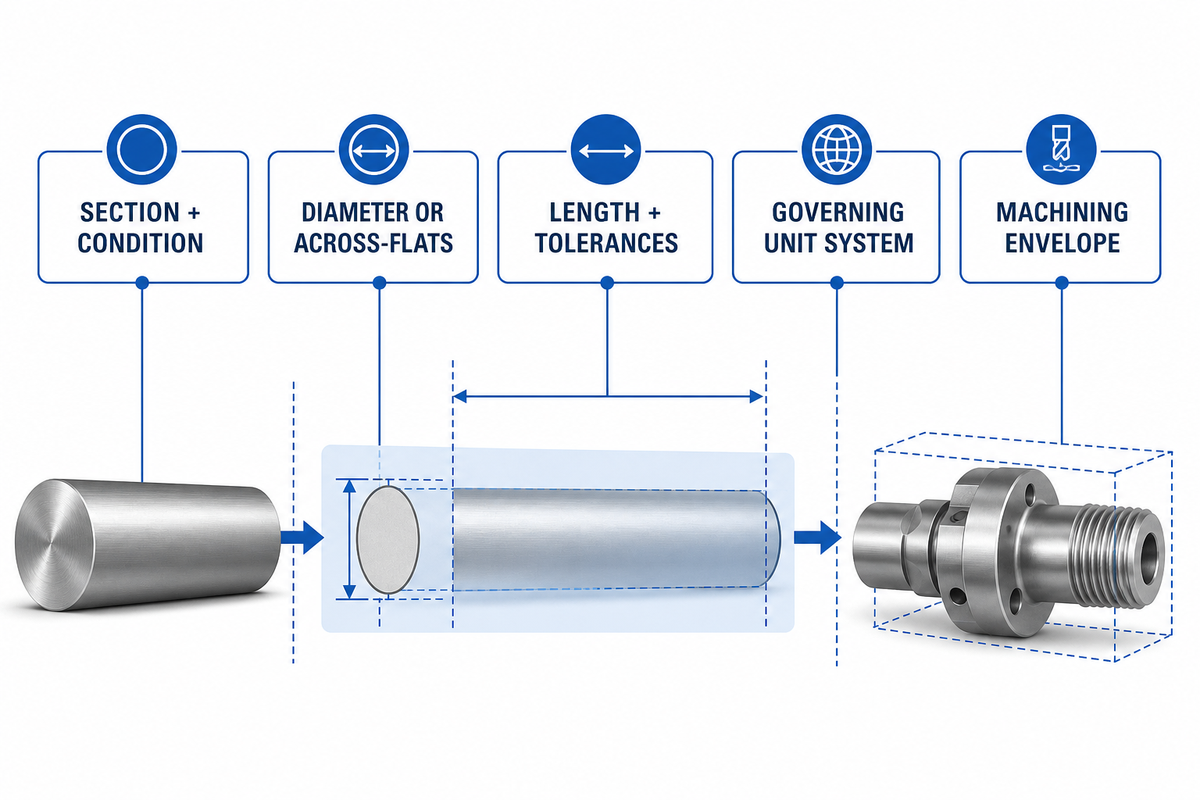
Titanium bar fits parts that can be produced economically from a constant solid section: shafts, pins, tie elements, fastener blanks and many turned components. Public ASTM B348/B348M material identifies annealed bar and billet as its product family; the version list showed B348/B348M-25 as active when this guide was researched.
That scope does not turn “ASTM B348” into a complete order. State the alloy grade, diameter or across-flat size, length, condition, surface requirement, dimensional tolerances, quantity and governing unit system. Also distinguish bar from billet in the request. Suppliers may quote a technically related starting product that carries a different machining allowance or inspection basis.
Before choosing an oversized bar, compare the buy-to-fly route. Extra stock can appear safe while increasing cycle time, tool exposure and scrap value. A signed manufacturing article on titanium machining constraints explains why heat control, spindle connection and dynamic response must be considered together. The practical lesson for buyers is simple: a large machining envelope is a process decision, not just a material purchase. Once the stock form and grade are fixed, metal CNC machining from Zhenling is an enquiry route for drawing review; confirm the titanium grade, stock condition, machining feasibility and inspection scope before treating it as an approved production route.
3. Titanium Plate: Control Thickness, Flatness and Forming Route
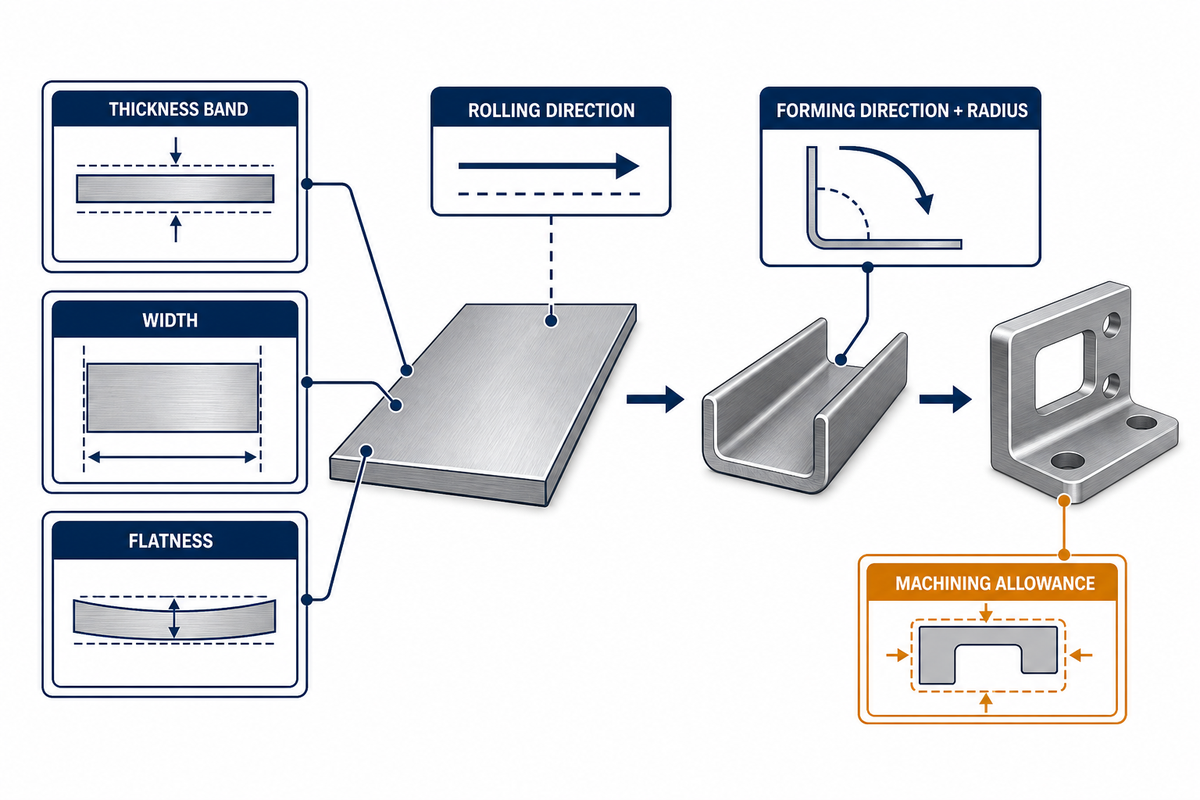
Plate is the natural starting point for broad flat parts, bases, panels and shapes that will be cut, formed or machined from a planar envelope. ASTM B265 covers strip, titanium sheet and plate; the public version list identified B265-25 as active. The shared specification family does not make those three forms interchangeable. Thickness band, width, flatness, edge condition and the supplier’s product-form classification still matter.
For a formed plate route, give the supplier the forming direction, minimum radius, thermal-processing or stress-relief expectations, final machining allowance and the features that can’t move. If rolling direction affects the engineering review, put it on the drawing or request instead of leaving it in email.
A named Spirit AeroSystems case reported forming titanium plate rather than removing most of a large block. That case shows why plate can reduce waste and machining for a suitable geometry; it doesn’t prove that plate is the lower-cost answer for every part. Treat such examples as route prompts. Ask each supplier to state the proposed starting stock, major process steps and expected material-removal envelope for your drawing.
4. Titanium Forging: Buy the Route, Not the Label
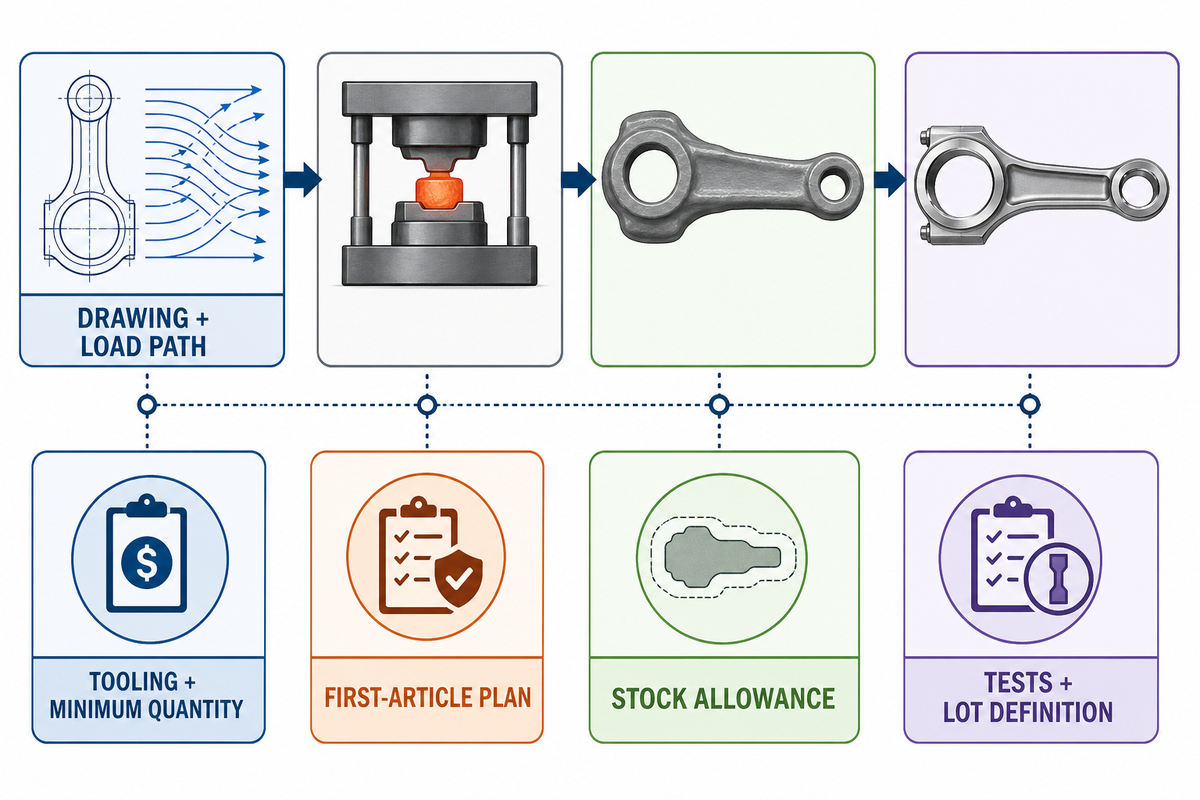
A forging becomes attractive when worked geometry, near-net shape, integral transitions or a defined load path justify more process development before machining. ASTM B381 covers titanium and titanium-alloy forgings, and its public version list identified B381-26 as active during research.
The public ASTM B381 abstract says nondestructive-test requirements are specified by the purchaser when required.
That sentence matters because “forging certificate included” isn’t a complete inspection instruction. State which examination is required, its applicable standard, coverage, acceptance criteria, reporting format and whether a qualified third party is involved. If no additional examination is required, say so deliberately rather than assuming every quotation uses the same package.
Forging isn’t automatically stronger, cheaper or more reliable than every machined-bar or formed-plate route. FPD general manager Jeff Speicher reported geometry-dependent unit-price reductions after the shop adopted a new press route, while a separate aerospace case favored formed plate. These examples point in opposite directions because geometry, volume and downstream work differed. Request a route-specific commercial explanation: tooling, minimum quantity, first-article plan, stock allowance, expected machining reduction and lot definition.
Patents can reveal upset, draw and multi-axis forging sequences. They don’t prove that a supplier currently runs that route, owns suitable equipment or can meet your drawing. Capability evidence must come from the proposed producer and order-specific records.
5. Titanium Tube: Application Standard Comes First
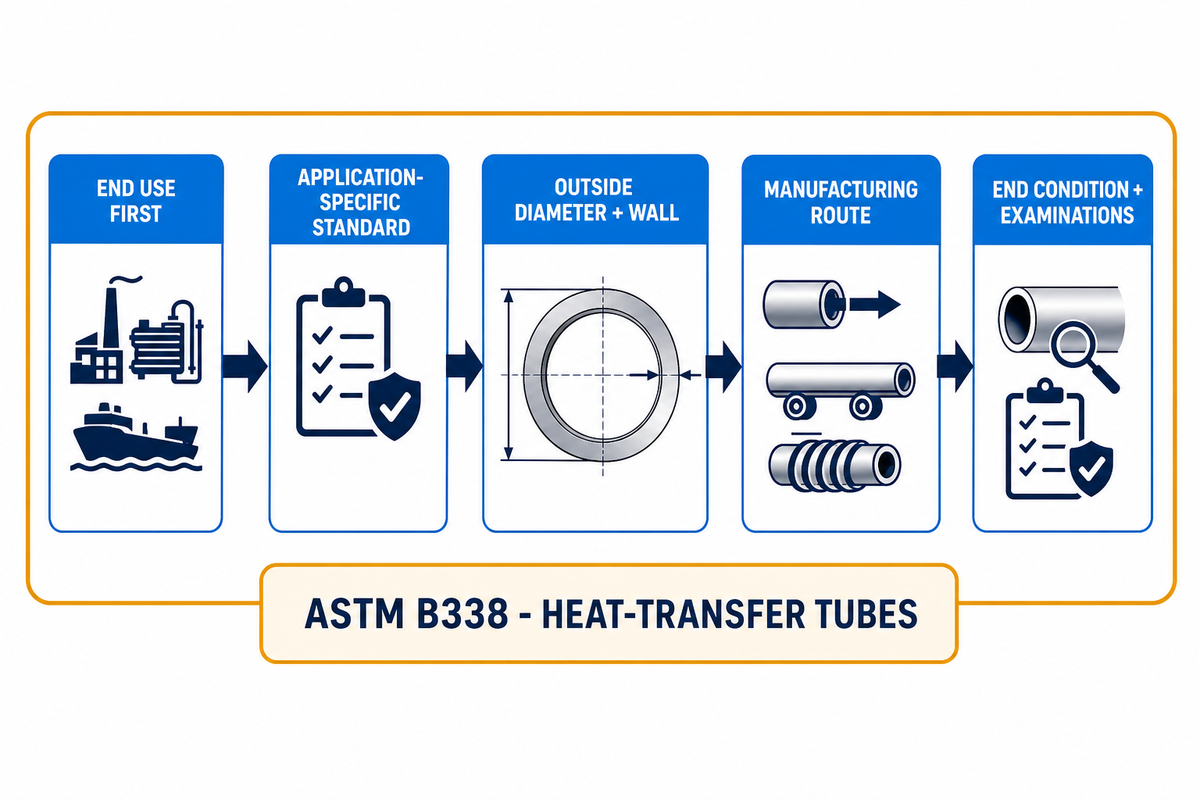
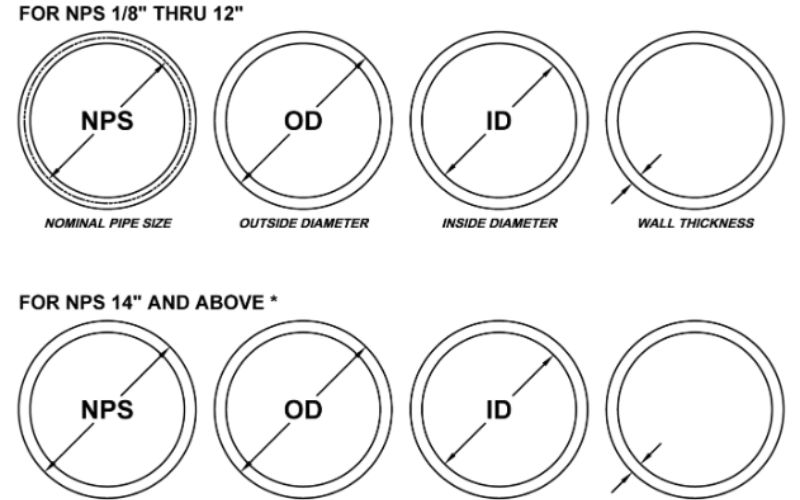
Titanium tube is selected when a hollow path is fundamental to heat transfer, fluid service or structural geometry. Unlike a forging route, tube selection begins by confirming terminology: outside diameter, wall thickness and application often separate tube from pipe more reliably than a casual product name. This pipe-versus-tube guide explains the dimensional language, but the product specification for titanium still has to be named in the order. If project documents switch to nominal pipe terms, use the pipe schedule chart only to normalize nominal size and wall language; don’t apply a schedule assumption to tube.
The scope boundary is critical. ASTM B338 is for titanium and titanium-alloy tubes used in condensers, evaporators and heat exchangers. Its public materials distinguish welded and non-welded manufacturing routes and show route-related test families. It is not evidence for every aerospace, structural, regulated-device or general fluid-service tube.
The route also affects what must be reviewed. A published tube patent can document piercing, elongation and sizing from solid billet, but it can’t demonstrate a seller’s capacity or a finished tube’s compliance. Ask for order-specific process and inspection evidence from the proposed producer.
6. Grade, Product Form and Product Specification Are Separate Decisions
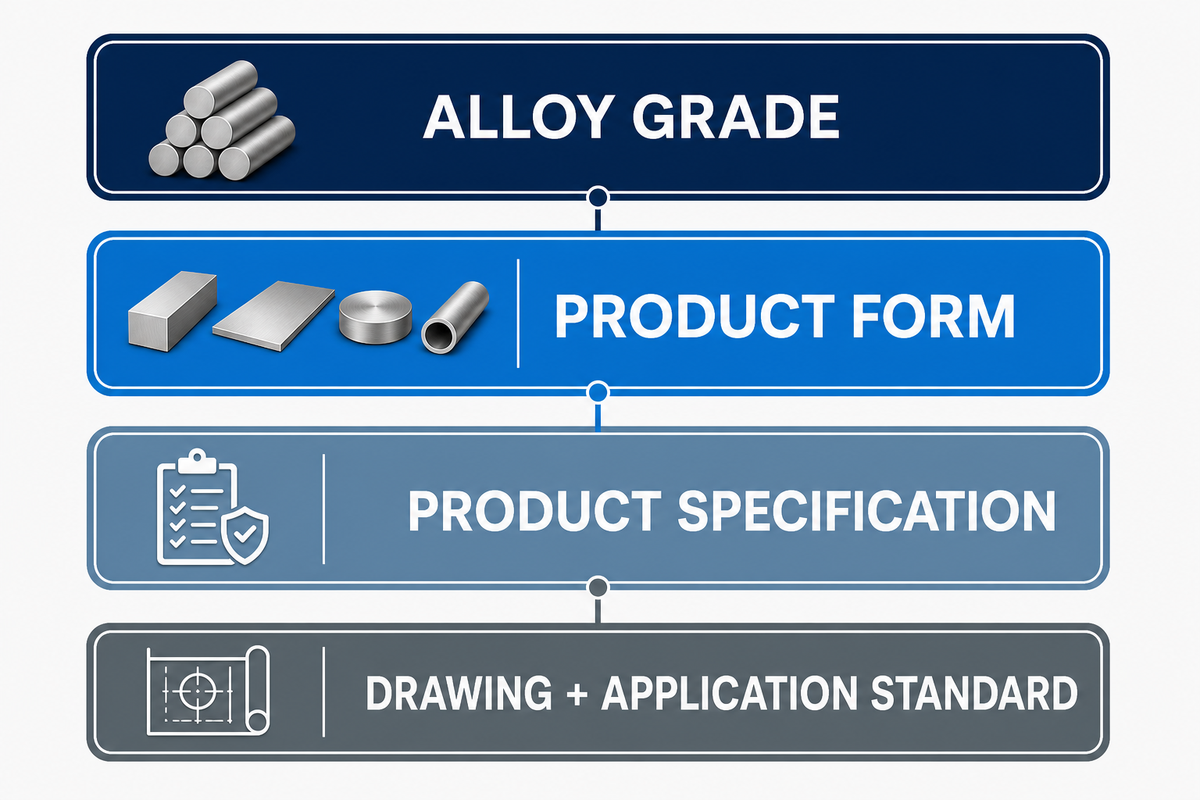
“Grade 5 titanium” answers only part of a buyer’s question. The same alloy designation may appear across several product families, but each family can have different dimensional rules, conditions, sampling, tests and delivery language. A broad non-ferrous metal category can organize material families, but it doesn’t define an orderable alloy grade. Product form describes starting geometry. The product specification defines a controlled delivery route. The drawing and application standard define the finished requirement.
A material screen may compare commercially pure titanium such as Grade 2 with Ti-6Al-4V when high strength is part of the design case. That doesn’t make Grade 2, titanium Grade 2 or a “high strength-to-weight ratio” catalogue phrase a substitute for engineering review. Chemical processing, oil and gas, aerospace, regulated-device and other industrial applications can impose different corrosion, temperature, pressure and evidence requirements. Phrases such as “excellent corrosion resistance” must be converted into named media, concentration, temperature and design criteria. The same caution applies to nickel or zirconium alternatives and to any claim about service at high temperatures.
Keep these fields separate in the request:
- State the service and critical function: load, pressure, temperature, media, fatigue or corrosion concerns that engineering has identified.
- Name the product form—bar, plate, forging or tube—with the exact sub-form where needed.
- Specify the alloy grade and condition; don’t let a familiar grade name silently set thermal-processing or delivery condition.
- Confirm the governing product specification and edition required by the contract rather than copying an old page title.
- Identify functional drawing dimensions and tolerances instead of applying one tight general tolerance to everything.
- State whether inch-pound or SI values govern. Don’t combine converted values until the specification’s unit rule has been checked.
This separation prevents a common quote comparison error: four suppliers appear to quote the same alloy, but one offers plate, one bar, one a rough forging and one a finished hollow product under unrelated acceptance terms. Those are four different commercial routes.
Search results and catalogues use overlapping language. Translate those discovery terms into order fields before comparing suppliers:
| RFQ category | Discovery language buyers may encounter | What the order must state |
|---|---|---|
| Stock geometry | round bar, bar stock, titanium billet, titanium sheet, fitting | Exact form, sub-form, stock size, condition and finished route |
| Grade shorthand | various grades, commercially pure titanium, Ti-6Al-4V, 6Al, 4V | Alloy designation, condition, product specification and substitution rule |
| Forging route | forging titanium, hot forging, cold forging, forged titanium alloys, forged titanium parts, custom forged | Proposed route, tooling, lot, stock allowance and qualification evidence |
| End market | aerospace industry, automotive industries, chemical processing, oil and gas, industrial applications | Actual service, design owner and applicable industry requirements |
| Critical components | jet engine, engine parts, aerospace components, structural parts, high-performance | Drawing, load case, critical characteristics and application standard |
| Regulated device use | medical applications, implant, biocompatibility, regulated components, device applications | Device specification, regulatory owner and order-specific ISO 13485 scope |
| Service environment | high pressure, harsh environments, extreme heat, near room temperature, corrosion-resistant | Media, temperature, pressure, duration, failure modes and design criteria |
| Material behavior | formability, ductility, metallurgy, temperature control, melting point | Required property, test method, condition and acceptance value |
| Supplier evidence | titanium industry, quality titanium, custom titanium, titanium components, supplier and manufacturer | Applicable AMS document, AS9100 or AS9120 scope where required, and product-specific quality standards |
The table is a translation tool, not a list of automatic requirements. An AS9100, AS9120 or ISO 13485 certificate can be relevant to a quality system, but it is not proof that a particular titanium product complies with the drawing. Likewise, the broad phrase “applications of titanium” does not define a purchasable item.
7. Inspection, Certificates and Heat Traceability
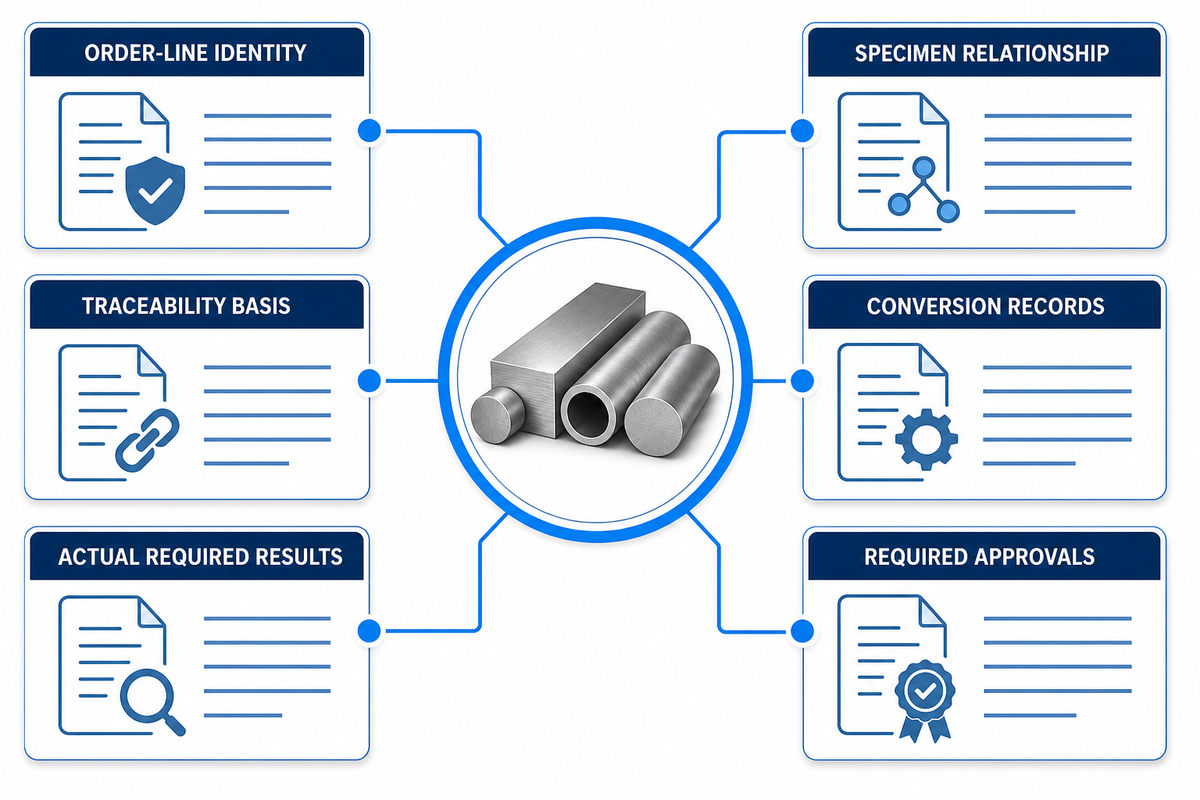
A document called a “mill test certificate” is useful only when it can be tied to the ordered line item and the contract says what the record must contain. Baling Steel’s general pages on material test certification and professional inspection show why certificate review and inspection planning are separate activities. For titanium, the exact package must come from the governing product specification, end-user quality clauses and purchase order.
Product-Form Evidence Passport
- Match identity to the order line, form, grade, condition, quantity and material marking.
- Define the traceability basis as heat, lot or another identification method permitted by the applicable contract.
- Request actual chemistry, mechanical results and examinations required by the purchased specification, not a generic “pass” statement.
- Where required, show how specimens represent the supplied size, lot and processing state.
- Attach required thermal-processing, conversion or subcontracted-operation records.
- Include repeat or additional testing when a governing quality clause requires it after conversion.
Do not turn the passport into a universal certificate rule. Some permitted Certificate of Compliance regimes may not require heat or lot traceability. Conversely, aerospace or end-user clauses may demand far more than heat-number matching. The request should say which traceability basis, actual values, attachments and approvals are required for this order.
Likewise, never assume that ultrasonic, surface or other nondestructive examination applies to every form and size. State the examination standard, applicability, coverage, acceptance criteria and report requirement. A supplier can then price the correct work instead of adding it after award.
8. Copy This Eight-Field RFQ Checklist
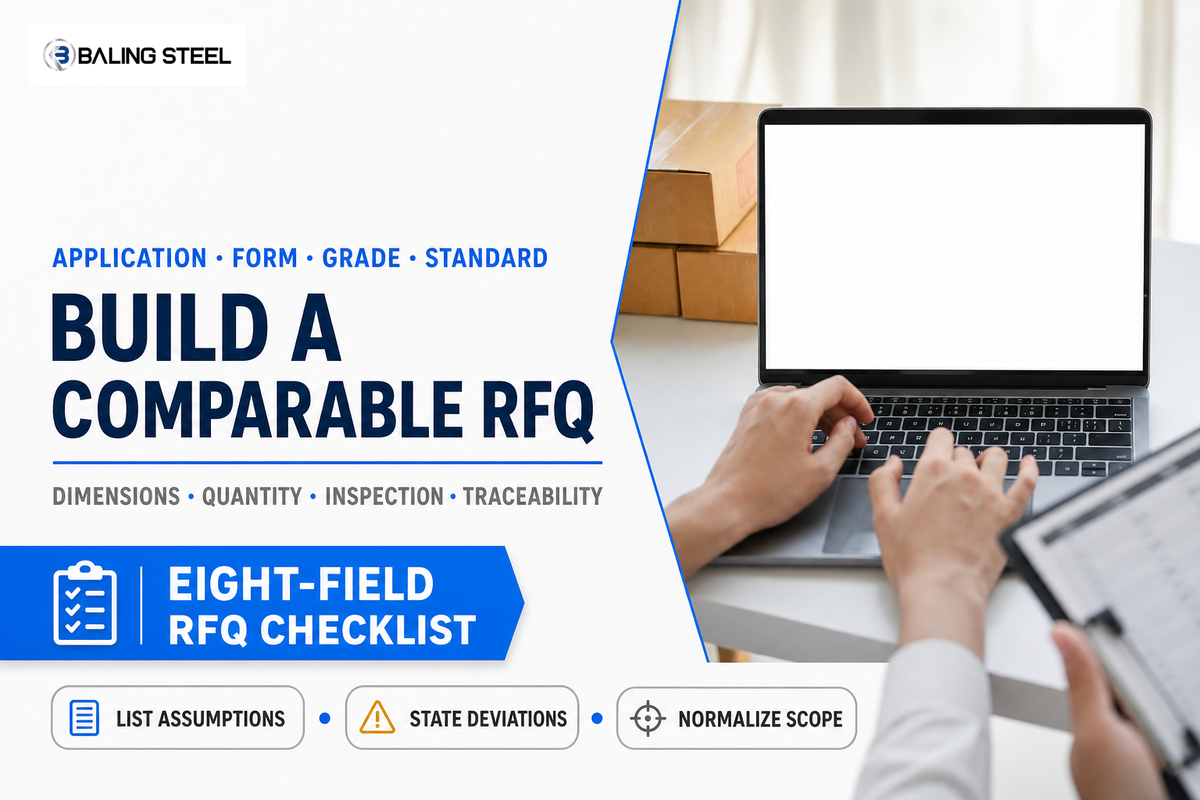
Send the same eight fields to every bidder. If you’re building the initial supplier list, the Beiyu Titanium product-form catalogue can help buyers see how commercial suppliers group available forms; verify every proposed grade, size, process and certificate directly against your order rather than treating a catalogue as acceptance evidence.
- Application and service environment: finished-part function, design responsibility, temperature, pressure, contact media and any identified degradation risks.
- Product form and proposed route: required starting form, or permission for the bidder to propose bar, plate, forging or tube with a route explanation.
- Grade and condition: alloy designation, thermal-processing or delivery condition and any substitution rule.
- Dimensions and unit system: drawing revision, stock dimensions, finished criticals, governing units and conversion rule.
- Product and application standards: exact standard numbers, required editions and precedence when documents conflict.
- Quantity and delivery split: prototypes, first article, production quantity, lot size, release schedule and packaging constraints.
- Inspection and acceptance: required tests, sampling, coverage, acceptance criteria, inspection stage, witness points and report format.
- Define traceability and evidence through the identity method, actual result fields, specimen relationship, conversion history and required attachments.
A tube line could be written as 25.4 mm outside diameter × 1.5 mm wall × 3,000 mm length; a plate line as 10 mm thickness × 1,200 mm width × 2,400 mm length; a bar line as 50 mm diameter × 1,000 mm length. Service fields might show 150°C and 1.6 MPa, while a drawing could identify ±0.10 mm as one critical tolerance. Inspection coverage such as 100%, a 500 kg release lot, a 3 mm machining allowance, or 10 pcs first article plus 200 pcs production must come from the actual engineering and quality plan.
| Comparison field | Evidence source | Example entry — format only | Stop condition |
|---|---|---|---|
| Product form | Drawing and product specification | Tube; bidder may propose forging with explanation | Quoted form differs without a route statement |
| Stock dimensions | Drawing revision | 25.4 mm outside diameter × 1.5 mm wall × 3,000 mm length | One bidder omits wall or length |
| Service point | Design input | 150°C and 1.6 MPa | Supplier assumption conflicts with design input |
| Critical tolerances | Drawing characteristics | ±0.10 mm dimension and Ra 1.6 μm surface | Quotation applies only general tolerances |
| Unit system | Contract precedence | SI values govern | Converted inch-pound values are mixed into acceptance |
| Quantity split | Purchase schedule | 10 pcs first article plus 200 pcs production | Price assumes one undivided production lot |
| Inspection scope | Quality plan | 100% coverage plus 2 pcs test samples | Method, coverage or acceptance rule is missing |
| Delivery split | Release schedule | 4 releases × 50 pcs | Quoted lead time assumes a single release |
| Machining allowance | Approved route and drawing | 3 mm stock allowance | Allowance is absent or changes finished yield |
Add one commercial line beneath the checklist: “State exclusions, assumptions and proposed deviations in the quotation.” That sentence exposes silent differences before a low headline price reaches the comparison sheet.
9. Stop Conditions Before Price Comparison
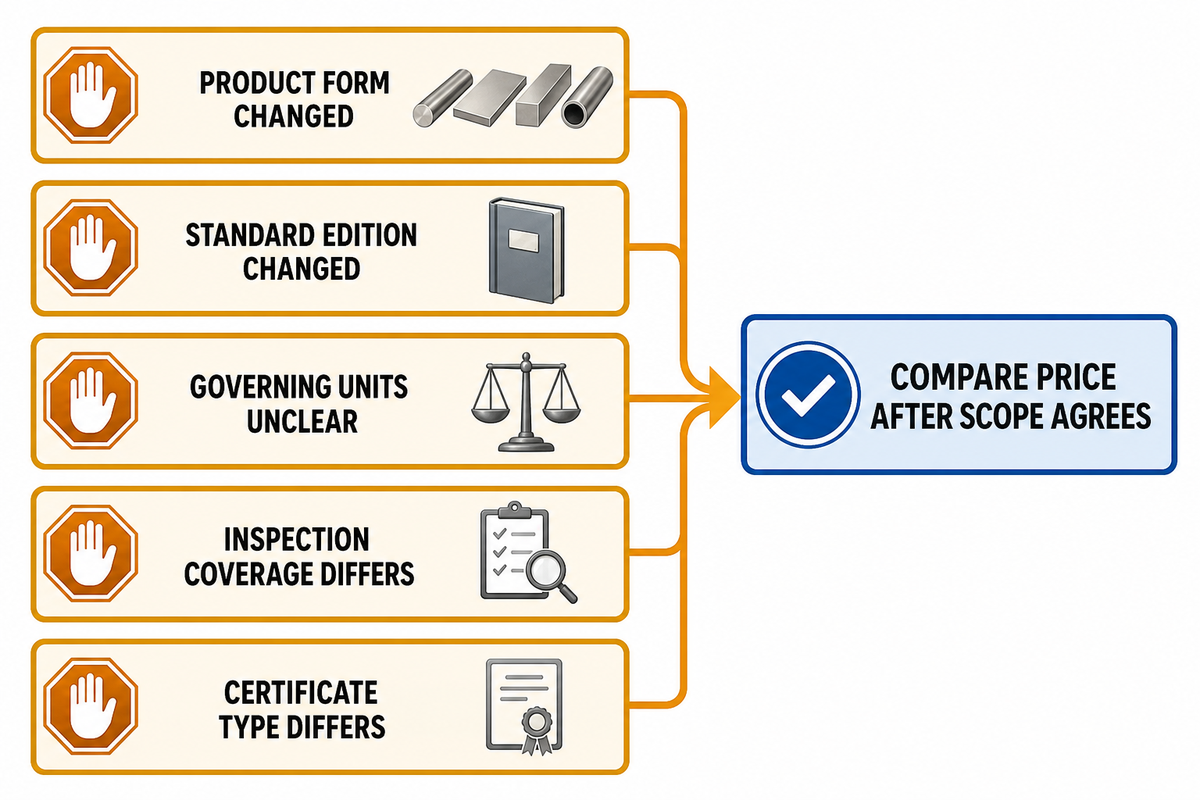
A purchasing team should stop the commercial comparison when any quotation leaves a route-defining field open. The point is not to delay award. It is to avoid ranking non-equivalent offers and discovering the missing requirement after tooling, material reservation or first-article work has begun.
Minimum Irreversible Work Rule
Do not authorize tooling, material cut, thermal processing or production until the product form, grade, condition, dimensions, unit system, governing standards, inspection plan and traceability basis agree across the drawing, purchase order and supplier quotation.
If one document controls in a conflict, state the precedence explicitly.
Stop and clarify when a bidder changes plate to bar, bar to billet, rough-forging allowance, tube manufacturing route, standard edition, condition, governing units, inspection coverage or certificate type. Also stop when one price excludes testing that another supplier included. Those differences may be valid proposals, but they need their own line in the comparison.
Market indicators can still help with timing and negotiation. They cannot make different product forms or evidence packages commercially interchangeable. The U.S. Geological Survey notes that about 95% of titanium consumption is associated with titanium dioxide pigment, which is a warning against using broad titanium demand headlines as direct evidence for bar, plate, forging or tube quotations. Form-specific trade series and mill-product indexes may show direction, but the purchase comparison still has to normalize the order fields.
Frequently Asked Questions
Is Grade 5 titanium the same in bar, plate, forging and tube?
No. The alloy designation may be related, but the delivered product form, specification, condition, dimensions, manufacturing route and test requirements can differ. Put the grade and product specification on separate request lines. Then confirm that the selected standard actually covers the form and end use being purchased.
Is a titanium forging always better than machining from bar or plate?
No. A forging may reduce material removal or support a useful worked geometry, but it can also add tooling, minimum quantity and qualification work. Compare the full route for the drawing. Bar machining or formed plate may be lower risk when geometry, volume and acceptance requirements don’t justify forging.
Does ASTM B338 cover every titanium tube?
No. Its public scope is limited to condenser, evaporator and heat-exchanger tubes. Other services may use different application-specific standards, tolerance rules and evidence packages. State the end use first, then name the governing product standard, manufacturing route, dimensions, examinations and acceptance criteria.
What should be included with a titanium request for quotation?
Include the application, service environment, product form, proposed route, grade, condition, dimensions, governing units, standards and editions, quantity, delivery split, inspection plan, acceptance criteria and traceability package. Ask bidders to list exclusions, assumptions and deviations so the final comparison uses equivalent commercial scope.
References and Source Notes
- ASTM B265 public scope and version list — strip, sheet and plate.
- ASTM B348/B348M public scope and version list — bar and billet.
- ASTM B381 public scope and version list — forgings and purchaser-specified examinations.
- ASTM B338 public scope and version list — condenser, evaporator and heat-exchanger tubes.
- U.S. Geological Survey titanium statistics and information — market-category boundary.
- Spirit AeroSystems titanium plate-forming case — bounded manufacturing example.
- A Systems Approach for Successful Titanium Machining — coupled process constraints.
- Machine shop titanium forging case — self-reported FPD commercial example.
- US10435775B2 and US4991419A — process-route disclosures only.