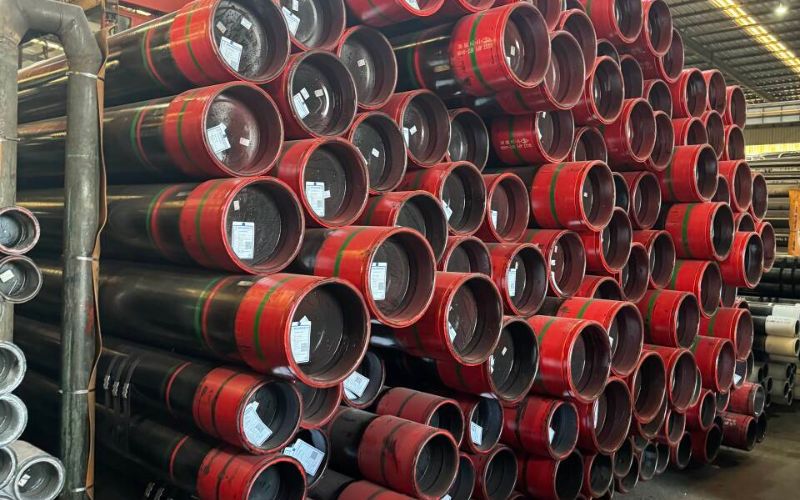
Well pipe casing is the static structure at the heart of every drilled well – whether it is drawing water for a subdivision home from 150ft or taking the heat to the surface from 15,000ft deep. Without the casing, the borehole collapses, the aquifer becomes contaminated, and abutment pressures between zones spill over into each other. A discussion of water-well PVC casing and oil and gas steel casing in one paragraph is necessary because the logic for choosing material, size, grade and depth remains exactly the same – regardless of what pressures you are trying to bring to the surface.
Quick Specs
| Common Materials | Carbon Steel (API 5CT), PVC (ASTM F480) |
| Steel Size Range | 4½”–20″ OD |
| PVC Size Range | 2″–16″ OD |
| Steel Grades (API 5CT) | J55, K55, N80, L80, P110 |
| Standard Lengths | R2: 25–34 ft / R3: 34–48 ft |
| Max Depth (PVC) | ~300–600 ft (varies by SDR class) |
| Max Depth (Steel) | 20,000+ ft (oil/gas wells) |
| Key Standards | API 5CT (11th Ed. + 2025 Addendum), ASTM F480, ASTM A53 |
What Is Well Pipe Casing and Why Every Well Needs It
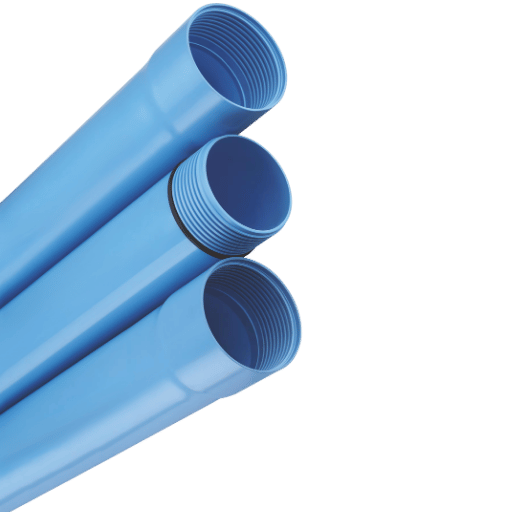
Well casing is a pipe made from either PVC or steel installed inside a drilled borehole which provides; structure, contamination barrier, zone isolation, and pressure containment to a wellbore during all operational phases. As noted in the SPE Petroleum Engineering Handbook, the casing provides four functions that no other piece of the well can replace and that are essential for a good borehole:
- Structural support — standing geological pressures that would otherwise collapse the underground borehole once casing is cemented in place.
- Sealing the well casing pipe against surface pollutants and preventing cross-contamination between underground water zones.
- Zone isolation — maintaining pressure differences between formations and preventing uncontrolled flow.
- Containing downhole pressure during drilling, completion, and production — the critical safety function that prevents blowout.
Minimum state regulations, California Department of Water Resources (DWR), impose requirements on corrosion resistant casing and grout so the groundwater quality is protected, similar provisions are also made by the other American authorities on the subject.
What Type of Pipe Is Used for Well Casing?
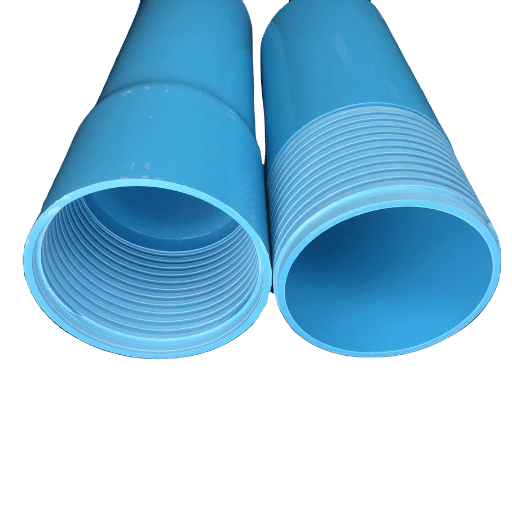
Two bulk materials dominate: PVC (polyvinyl chloride) and carbon steel. PVC casing (ASTM F480 specifications) is mostly used in domestic and agricultural water wells because typical depths do not exceed 600 ft and bottom-hole temperature does not rise above 140′ F. Steel casing is used in geothermal, gas, and deep oil wells because the pressures and temperature gradients are much steeper. Fiberglass (FRP) casing is used within the CC water industry in some highly corrosive environments.
Types of Well Casing Strings: Surface, Intermediate, Production, and Liner
Single tube wells seldom use only a single string of casing. Deep wells combines several strings of decreasing diameter, with each cemented at its appropriate stratum; considerations of best casing practices also require the casing program to limit its diameter progression so that the drill bit can always pass through the last installed casing. The MMS (Webster 1995, p. 278) defines the four main casing intervals for oilfield wells as:
| Casing Type | Typical OD | Depth Range | Primary Function |
|---|---|---|---|
| Conductor | 18″–30″ | 40–100 ft | Support surface soil, contain drilling returns |
| Surface | 13⅜”–20″ | 300–2,000 ft | Isolate freshwater aquifers (most heavily regulated) |
| Intermediate | 9⅝”–13⅜” | 4,000–12,000 ft | Control abnormal pressure zones, prevent lost circulation |
| Production / Liner | 4½”–9⅝” | Total depth | House production tubing, isolate pay zone |
Two or three strings of casing are sufficient for most water wells. A showup to 200ft would be a single 6″ PVC, everything else will probably be the same size. Oil and Gas wells typically require 3 or 4; each string must fit inside the previous inch or even half an inch, and to reach a new depth the drill must pass through the last-string, explaining the step-down diameter rule of the casing program.
Finally, minimum depths of surface casing for protecting the drinking water source are different in every jurisdiction. Check your local or state jurisdiction to ensure that you aren’t endangering your permit status.
Steel vs PVC Well Casing: How to Choose the Right Material
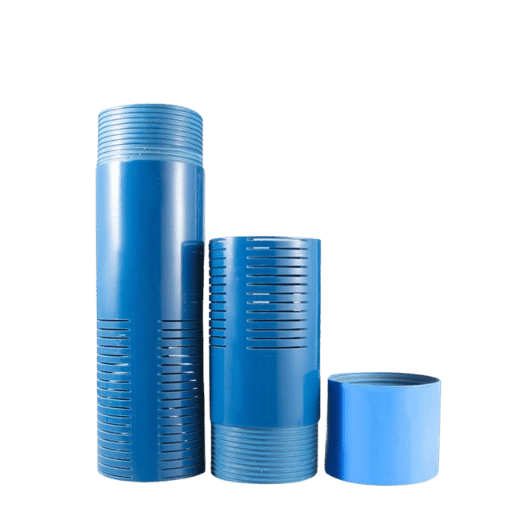
Deciding on whether to use steel or PVC well casing pipe depends upon three factors: well depth, temperature of operation and the fluid being produced. Each material possesses engineering advantages that make it ideal in certain conditions and “fail” when used beyond their most appropriate work envelope.
| Property | Steel (API 5CT) | PVC (ASTM F480) |
|---|---|---|
| Max Depth | 20,000+ ft | ~300–600 ft (varies by SDR class) |
| Temperature Limit | 800°F+ (grade-dependent) | 140°F (ASTM D1785) |
| Corrosion Resistance | Low (mild steel rusts in 8–60 years) | High (immune to rust and most chemicals) |
| Cost (6″ casing) | $20–$130+/ft | $12–$22/ft |
| Weight | Heavy (requires rig for installation) | Light (two workers can handle 20-ft joints) |
| Potable Water Cert | Not certified | NSF 61 / NSF 14 certified |
| Typical Application | Oil/gas wells, deep water wells, geothermal | Residential/agricultural water wells |
The 300-Foot Rule: A Material Selection Framework
- Water well, depth < 300 ft; PVC Schedule 40 (ASTM F480, Class 200) Collapse pressure ratings are used with sufficient safety margin.
- Water well, depth 300-600 ft PVC SDR 17 or steel ASTM A53. Must assess soil condition and static water level prior to going to PVC at this depth.
- Oil/gas well, any depth Steel API 5CT. J55 minimum for standard conditions; L80 for HS environments.
- ‘Geothermal well, > 140F Steel or fiberglass. PVC softens above 140 F and falls apart. ‘
For a residential water well in Ohio (dodging all geometry, building code, siting factor, and budget common sense), a DIY contractor is drilling a 180depth well in clay and sandstone. PVC Schedule 40 (ASTM F480, Class 200) at that depth experiences about147 PSI of external collapse load pressure- comfortably below the project site geology. TheSteel specification would add878 to the project budget-with no tangible benefit.
PVC also suffers from none of the rusting problems commonly experienced by steel at aggressive groundwaters: in fact a field contractor on R/Water Wells Drillings identify the actual couplings on a steel casing rusting through in a matter of less than8 yearsof corrosive groundwater activity.
Increasing the PVC casing depth rating or placing it in too hot of a well (greater than 140F) PVC is degraded by heat and can lose as much as 50% of its pressure rating, or even deform permanently under such thermal loading. If you know that your well location has geothermal activity or is near hot springs, just go to steel regardless of depth.
Well Casing Sizes and Wall Thickness: Specification Reference
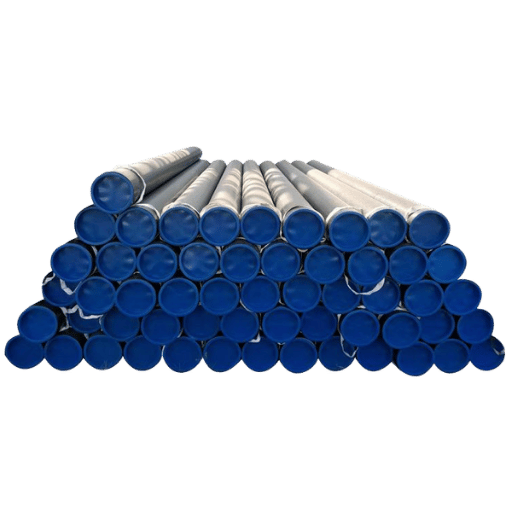
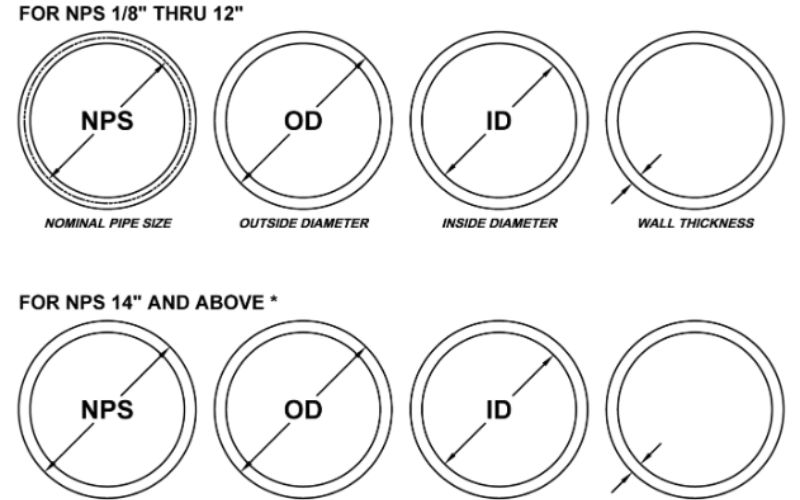
Choosing a well casing size depends on three items; the size of the submersible pump or production tubing the casing must accommodate, the hole diameter the bit creates and the annulus volume required for cement circulation. Normal sizes conform to either API 5 CT for steel casings or ASTM F 480 for plastic casings.
| Nominal Size | OD (in) | Common Wall (in) | Weight (lb/ft) | Typical Use |
|---|---|---|---|---|
| 4½” | 4.500 | 0.250–0.290 | 9.50–11.60 | Production casing, shallow wells |
| 5½” | 5.500 | 0.244–0.304 | 14.00–17.00 | Production casing |
| 7″ | 7.000 | 0.272–0.408 | 20.00–29.00 | Intermediate/production casing |
| 9⅝” | 9.625 | 0.312–0.472 | 32.30–47.00 | Intermediate casing |
| 13⅜” | 13.375 | 0.380–0.514 | 48.00–68.00 | Surface casing |
| 20″ | 20.000 | 0.438–0.635 | 94.00–133.00 | Conductor/surface casing |
For PVC water well casing Westlake Pipe & Fittings has stock 2″ through 16″ in IPS and CIOD Dia. standard. Standard Classes are Schedule 40, SDR 17, SDR 21, SDR 26, and SDR 32.5. They all have different wall thickness and collapse pressure ratings.
You will need to use the Westlake Well Casing Depth Calculator to determine the Best match of your specific well depth and soil type with the correct SDR class.
What Is the Standard Size for a Well Casing?
However there is not one “standard” size. The most common for residential water wells is 6-inch PVC pipe because it will take most 4-inch submersible pumps with room for the wiring. For oil and gas wells – 9-inch intermediate casing and 5-inch production casing would be one of the most commonly ordered pairings.
The sizing always goes backwards from the fit inside the casing with the pump, the tubing, the packers, and the annular space needed to allow for a good cementing job.
API 5CT Casing Grades Explained: J55 Through P110
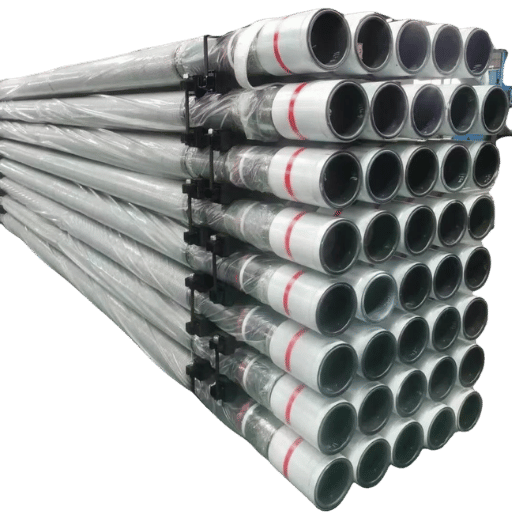
The API Specification 5CT specifies the mechanical properties, chemical content and manufacturing demands for steel casing and tubing used in oil and gas wells. The specification is in 11 th Edition (December 2023) having Errata 2 (August 2024) and Addendum 1 (2025) which enhances the quality requirements for manufacturing.
| Grade | Min Yield (MPa / ksi) | Max Yield (MPa / ksi) | Min Tensile (MPa / ksi) | H₂S Sour Service |
|---|---|---|---|---|
| J55 | 379 / 55 | 552 / 80 | 517 / 75 | No |
| K55 | 379 / 55 | 552 / 80 | 655 / 95 | No |
| N80 (Type 1) | 552 / 80 | 758 / 110 | 689 / 100 | No |
| L80 | 552 / 80 | 655 / 95 | 655 / 95 | Yes (NACE MR0175) |
| P110 | 758 / 110 | 965 / 140 | 862 / 125 | No |
📐 Engineering Note
J55 and K55 has the same chemical composition and yield strength range (379-552 MPa). The only difference is the higher tensile strength of K55 (minimum of 655 MPa as compared to J55 = 517 MPa). This higher tensile strength has been achieved through controlled heat treatment techniques during manufacturing. In case of surface casing where the axial tension loads are high, higher safety margin of K55 is available and not with J55. For sour service environments where hydrogen sulphide exists, NACE MR0175/ISO 15156, L80 is the mandatory choice if using J55 or N80.Using J55 or N80 for sour conditions results in sulfide stress crack which causes casing failure or burst leading to catastrophic failure.
What Is the Best Casing for a Well?
Not all wells are suited for the same grade of casing. For shallow water wells under 300 feet, PVC Schedule 40 is the most affordable and durable choice – it is entirely rustproof and has received NSF 61 certification to contact potable water. In the context of oil and gas wells, J55 or K55 casing will suffice for most typical depths. Deep wells with more than 10,000 feet or encountering high-pressure zones need N80 or P110. Any hydrocarbon presence in a well, even in trace amounts, such as Hydrogen Sulphide, mandates L80 grade tubing and casing – the yield limit of 655 MPa (compared to N80s 758 MPa) is designed explicitly to avoid sulfide stress cracking.
“In the presence of sour gas, the choice of grade is not an exercise in cost sacrifice, but one of safety. L80 was developed because higher strength steels (J55, P110) came at the cost of exposing themselves to sulfide stress cracking in HS. If your logs quantify even mildly hazardous concentrations of hydrogen sulphide, the decision between J55 and L80 is already made.”
An operator drilling in West Texas is exposed to HS at 8,500 feet, in a Permian Basin well. Choosing J55 casing, though it can technically bear the downhole pressure, would see the casing fail due to sulfide stress cracking after approximately 18 months. Knowing the specification demands L80 (NACE MR0175 compliant), an imperceptibly greater 15-20% price increase over J55 is incurred. That added dollar figure maps straight onto a workover Pigulah+ no longer at the operators disposal.
Casing vs Tubing: Key Differences in Well Construction
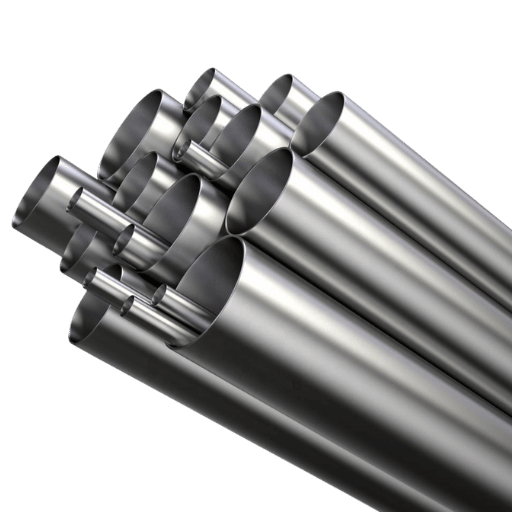
Casing and tubing are both steel pipes used for a well, but with entirely separate roles and separate lifetime expectations. Casing is cemented into borehole as a permanent shell. Producing tubing forms a removable inner conduit that conveys flow to the surface.
| Feature | Casing | Tubing |
|---|---|---|
| OD Range | 4½”–20″ | 1.050″–4½” |
| Position | Cemented against formation | Inside last casing string |
| Removable? | No (cemented in place) | Yes (workover operations) |
| API Standard | API 5CT | API 5CT |
| Function | Structural support + zone isolation | Fluid conduit + corrosion protection |
A production packer near the borehole bottom seals annular space between casing and tubing. This demountable shell enables operators to effect tubing replacement on a relatively light, offshore rig, rather than having to redrill using a heavy service rig every time the casing integrity matures. See our comparison table explaining casing versus tubing for further reference.
How Well Casing Is Installed: Step-by-Step Process
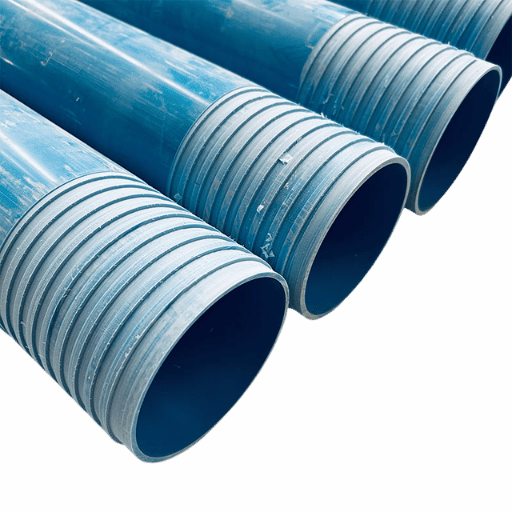
Exactly how the casing is installed can mean a well produces safely for thirty years or fails after just a few. U.S. EPA well drilling procedure technical references specify that this six step process consistent for water and oil/gas wells:
- drilling the hole, by spec boring a 2-4″ hole larger than casing OD to allow circulation of cement slurry in the annular space during cementing;.
- lowering the casing string joint by joint (“running” casing), either to TV or TG with API threaded connections, or to PVC with solvent weld or threaded couplings;
- centralizing the casing with centralizers at key depths to prevent bridging against the borehole wall, ensuring even cement coverage along the entire circumference;
- circulating cement slurry down inside the casing string and up the annulus through the casing shoe, whereby creating a “plug” behind the slurry pressurizes the shoe and an indication of the separate is achieved;
- standing on cement (WOC), allowing the cement to bond to the borehole at least 12-24 hours (cement depending), no other operations are conducted during this period;
- ultimately pressure testing the casing and cement arrangement by bringing the interior pressure up to the range at which the formation pressure is maintained so as to ensure there are no flow problems/back leakage;
In cases where centralizers are not included evenly spaced up the casing string, they are omitted entirely, or are spaced too far apart, the casing will sit against one side of the borehole, cement will build up only in channels around the casing leaving unfilled microannuli “channels” around the whole casing closer to the borehole. These channels, also called
“Microannuli”, constitute the direct pathway for fluids to migrate from one zone to another, causing the abandonment of the intended reservoir and preventing successful hydrocarbon production. Industry practitioners report microannulus channeling as the major factor in sustained casing pressure (SCP) issues in existing wells in production.
A municipally owned water utility that supplies a CDP (central Texas) subdivision with potable water finds coliform bacteria present in a nearby monitoring well. Investigation reaches the conclusion that the failing joint in a 15 year old PVC casing at 240ft below ground level (#156815841) has permitted cross contamination from an older observation well below the primary drinking water intake aquifer and above a brackish formation. Cost of repair: $18,000 is and $45,000 is to line the existing bore with a reinforced PVC liner sleeve, or have the whole bore redrilled and abandoned.
Can You Replace the Casing on a Well?
The partial replacement of casings by slipping in a reinforced grade of PVC casing sleeve inside the existing bore line is a standard repair technique for steel rust worn in steel water well casings. Experienced operators on Reddit subject /r/WaterWellDrilling publicly describe slipping in 4″ and 5″ PVC pipe liners into damaged steel bores regularly. These liners can only be inserted down existing bores where the sealed casing is relatively easy to remove, which is with integrity damage to the prior cemented casing.
Well Casing Pipe Cost: Pricing Factors and Procurement
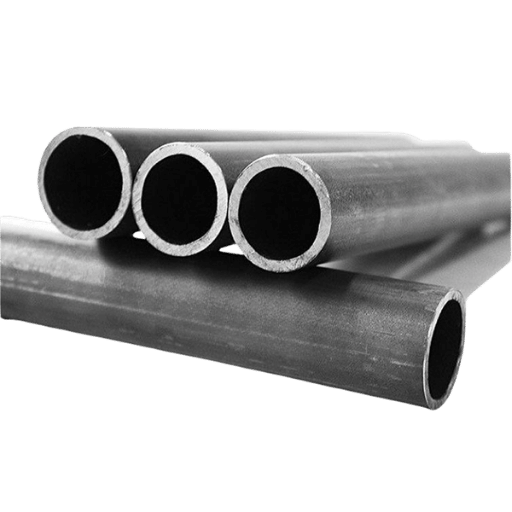
Cost estimates for well casing pipe are highly variable based on material, internal diameter, grade and most importantly source channel. The price ranges quoted here are valid as of April 2026 and are typically subject to worldwide steel market swings:
| Casing Type | Size | Price Range ($/ft) |
|---|---|---|
| PVC Schedule 40 | 4″ | $8–$15 |
| PVC Schedule 40 | 6″ | $12–$22 |
| Steel (ASTM A53/A106) | 6″ | $20–$35 |
| Steel (API 5CT, J55+) | 7″–13⅜” | $30–$130+ |
April 2026. Steel casing prices are closely indexed to futures contracts for HRC, global demand for steel swings accordingly. Engage your steel tube vendor with the following costs quotes for budget sensitive projects as they may change rapidly.
Five factors account for variation in casing pipe prices: (1) material/grade- L80 sour service pushing a 15-20% premium over J55; (2) diameter/wall thickness- heavy wall pipe for a given diameter costs more; (3) thread design- premium connections (VAM, TenarisHydril) at $5-$15/ft over BTC; (4) volume- a full truckload at 8-12% less per foot compared to broken loads; (5) origin- domestic U.S. mill casing at a 20-40% premium over imported product, but impervious to anti-dumping duties that can add unknown charges on imported pipe.
OCTG Market Outlook: What’s Changing in Well Casing (2025–2030)
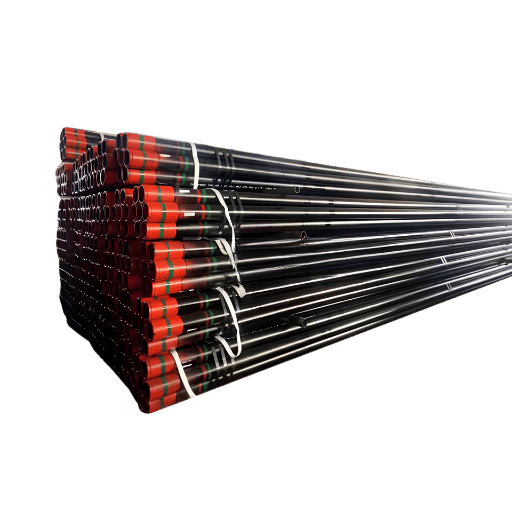
Global demand for oil country tubular goods (OCTG) hit an estimated $57.71 billion in 2026 and is forecast to reach $107.26 billion by 2035. 7.13% CAGR in the global OCTG market has been forecast (closed analyst report, 2018). Market share of the CNGeating segment- 49%. 7.8 billion USD in 2025 for 360 Research Reports..
Three changes in the well casing supply chain are influencing purchasing decisions today:
- Tighter API 5CT 11 th Edition requirements (2023-2025)- As of 2025 the latest API 5CT Addendum 1 enhances manufacturing specifications for steel casing and tubing. Mills unable to meet these will not be able to attain API monogram and will impact the number of suppliers and lead time to fulfill certified pipe.
- Picking the pieces- demand for OCTG is accelerating as rig counts are recovering and total footage per wellbore is improving (Grand View Research). U.S. OCTG market improving at 5.2% CAGR through 2033.
- Growing demand for corrosion-resistant alloy (CRA) casing- Deepwater and sour-gas projects are leading an increase in the requirement for CRA-lined or solid CRA casing. CRA is small proportion of tonmages so far, but gains are outpacing carbon steels where subsea in Gulf of Mexico or North Sea).
- Book the prices of standard grades(J55/K55) before Q3 2026 if your projects are confirmed – rig count recovery has typically led to casing prices rising 8-12% within 6 months.
- Quick booking of CRA-lined casing for deepwater or sour-service projects- Lead times are 16-24 weeks for CRA pipe. They are 6-8 weeks for carbon steel
Frequently Asked Questions About Well Pipe Casing
Q: How thick is well casing pipe?
View Answer
Q: How much does well casing pipe cost per foot?
View Answer
Q: Is PVC well casing safe for drinking water?
View Answer
Q: How long does well casing last?
View Answer
Q: What is the difference between Schedule 40 and Schedule 80 well casing?
View Answer
Q: Do well pipe casings go bad?
View Answer
Need Steel Casing Pipe for Your Project?
Baling Steel supplies API 5CT casing in J55, K55, N80, L80, and P110 grades and with a certificate of each mill to request a quote for the size, grade and quantity you require.
About This Guide
Baling Steel manufactures and exports API 5 CT steel casing and tubing from our manufacturing facilities in China. All specification data within this guide has been taken from API, ASTM, and SPE specifications, the pricing information from the 2016 industry standards (updated periodically). We include PVC casing specification information as a matter of integrity as honest guiding material specification reference guides should reflect all viable options even if the most honest offer is not our product.
References & Sources
- API Specification 5CT, Casing and Tubing (11th Edition) – American Petroleum Institute
- API 5 CT 11th Edition, Addendum 1 (2025) – American Petroleum Institute
- Well standards – DWR Bulletin 74 – California Department of Water Resources
- Well Drilling Procedure – CO2 Injection Well Casing Specification – Environmental Protection Agency
- Casing (borehole) – Wikipedia, citing SPE Petroleum Engineering Handbook (2007)
- Troubleshooting Water Well Problems – Alberta Agriculture & Forestry
- OCTG Market Forecast & Size Insights 2026-2035 – Business Research Insights
- Oil Country Tubular Goods (OCTG) Market Trend & Growth – 360 Research Reports
Related Articles
- The Complete Guide to Casing and Tubing – Full reference for OCTG product specifications
- Steel Casing Pipe: Specifications, Sizes, and Applications – In-depth steel casing reference
- Drill Pipe Selection Guide – Drill string specifications and grade selection
- Conductor Pipe Specifications and Sizing – Surface-level casing for wellhead support
- FBE Coated Pipe for Corrosion Protection – Fusion-bonded epoxy coating applications
To be checked by the Baling steel Engineering department. Last revised in April 2026.