Updated: August 2026
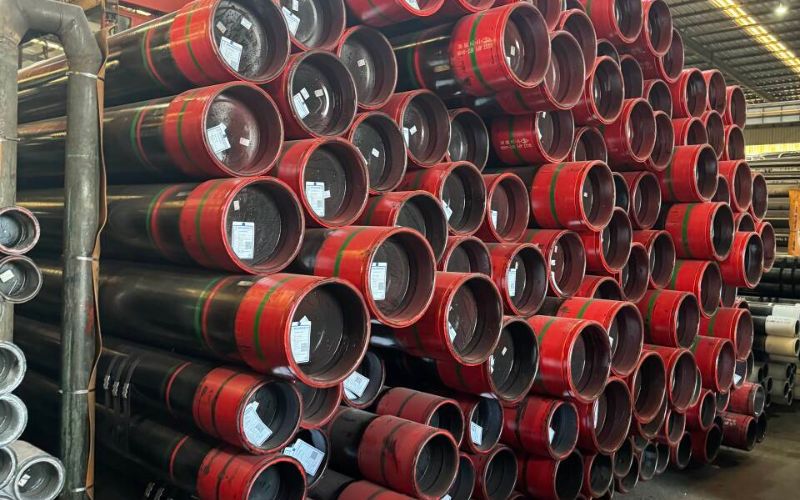
Black steel material is not a single generic grade. This phrase can indicate a black-pipe option in a product standard, uncoated reinforcing steel, an as-rolled mill-scale surface, or a purposefully blackened finish. In each case, safe selection still begins with product form, service, governing specification, edition, grade, dimensions, manufacturing route, and required evidence.
Black steel material needs a product form, standard edition, grade, dimensions, manufacturing route, evidence package, and surface-protection plan. Color alone verifies none of them.
- “Black” has four bounded product or surface meanings.
- Product form and service select the specification family.
- Mill scale isn’t a complete corrosion-control system.
- Tests and documents follow the order, standard, code, and quality plan.
What Black Steel Material Actually Means
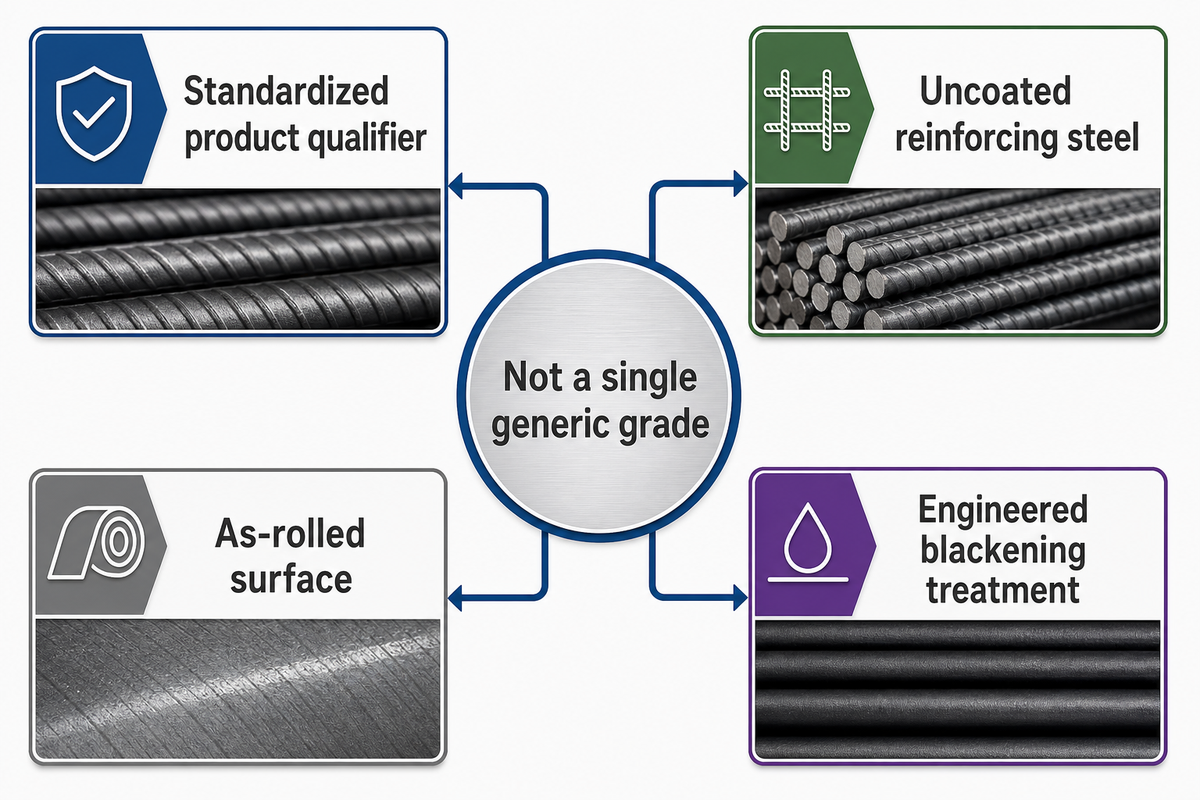
Black steel material is a valuable commercial description only once its context is established. It doesn’t by itself communicate carbon content, yield strength, toughness, wall tolerance, weldability, or corrosion resistance. Four constrained definitions appear in shop-floor discussions, and each guides different purchasing decisions:
- A standardized product qualifier. ASTM A53, for example, explicitly distinguishes black pipe from zinc-coated pipe within its pipe scope. A complete order still needs category, grade, size, and other applicable options.
- Uncoated reinforcing steel. “Black bar” commonly differentiates standard uncoated rebar from similar but protected or corrosion-resistant types. Structural considerations for concrete design, chloride exposure, cover, and durability remain a separate engineering scope.
- An as-rolled surface. Hot processing can leave a dark gray or blue-black oxide scale. That appearance is a surface condition, not a material certificate.
- An engineered blackening treatment. Black oxide or another conversion/finish process may be applied intentionally. The drawing and finish specification must identify it; the color can’t reveal the base grade.
This cross-form reference guide covers pipe, tube, plate, shapes, bar, and fabrications. Rebar design and controlled finishing remain separate scopes.
- Name the product form and service.
- Cite the standard, edition, and grade.
- Specify surface protection separately.
- Use color as a grade test.
- Assume “black” always means mill scale.
- Transfer one product standard to another form.
What kind of steel is black?
Many products purchased under this description are carbon steels with no galvanizing, but the phrase “black” is not a chemistry family. Dark plate, ASTM A53 black pipe, uncoated rebar, and a blackened component can be produced to separate standards with different properties. Require a complete material specification before comparison.
Why the Surface Looks Black—and What Color Cannot Tell You
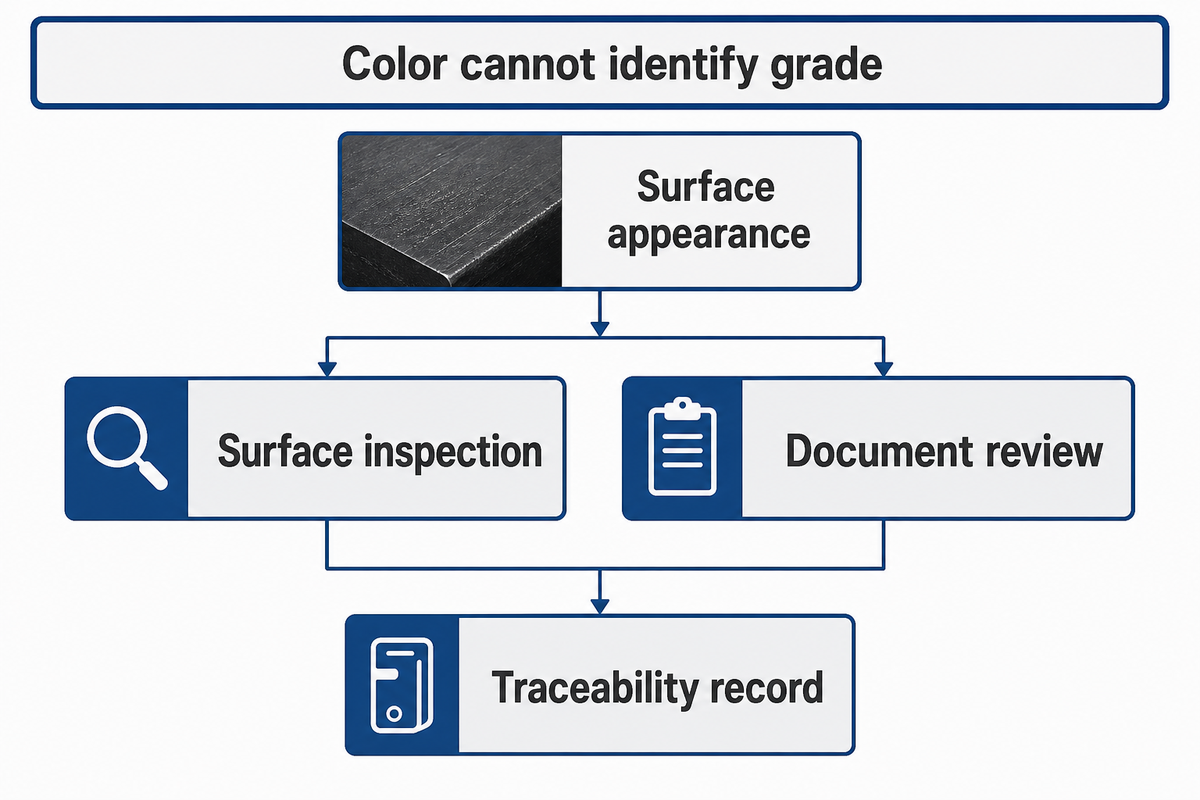
A black steel surface often looks dark because hot processing creates oxide scale, yet color can’t identify the material beneath it. Temperature history, storage, oil, cleaning, lighting, and weathering alter appearance, while an intentionally blackened part can look similar even though its finish route is entirely different.
Color-Is-Not-a-Grade Rule
Surface appearance is an inspection clue, never a substitute for the designation and traceability record. A dark surface can’t confirm alloy chemistry, strength, impact performance, pressure suitability, dimensional tolerance, weld procedure, coating adhesion, or service life.
Consider a buyer comparing two quotations for a dark round section. One supplier priced pipe to a piping specification; the other priced structural tubing to a shape standard. The photographs looked interchangeable, but the scopes, dimensional rules, evidence, and intended services weren’t. Surface inspection and document review must therefore remain separate gates: inspect rust, loose scale, pitting, oil, and damage, then match markings, identity, the purchase order, inspection document, and required results.
Common Black Steel Specifications by Product Form
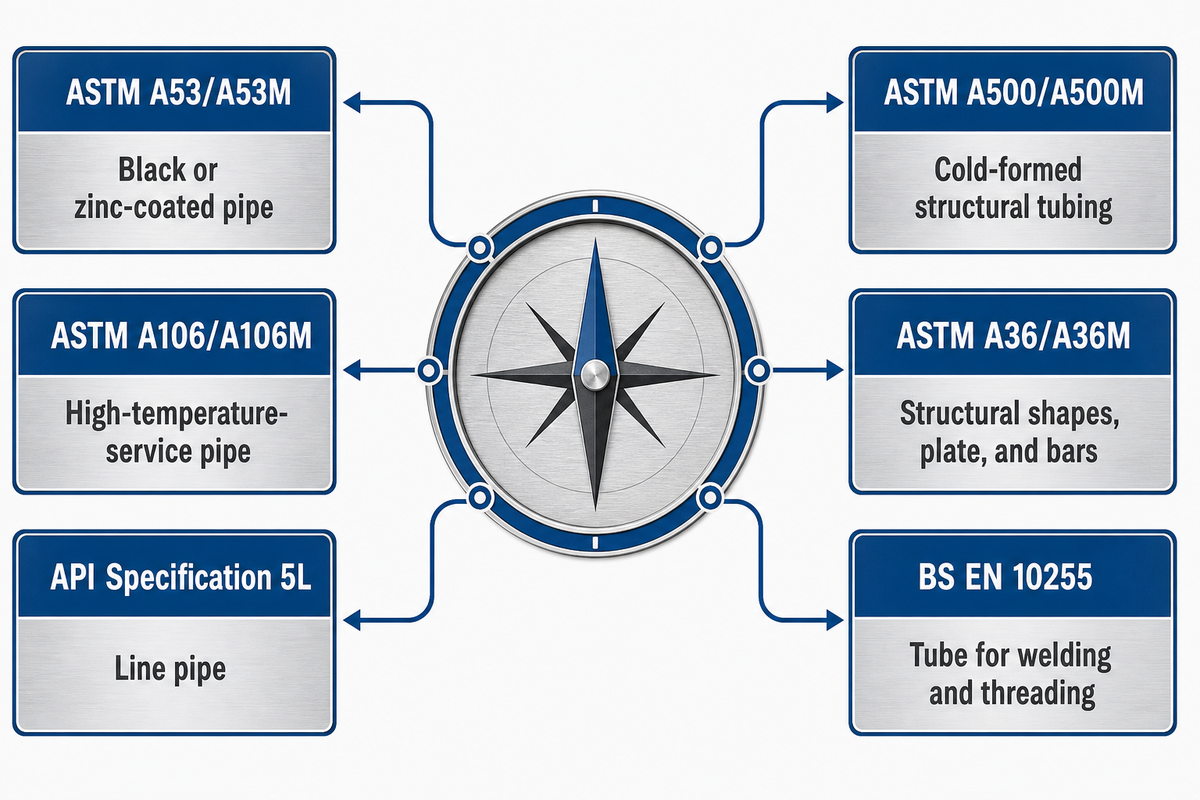
Common black steel specifications belong to distinct product forms and services; the word “black” does not make them interchangeable. The six frequently searched routes—ASTM A53, ASTM A106, API 5L, ASTM A500, ASTM A36, and EN 10255—are starting points, while the purchased edition and project requirements control.
| Product type / specification | Product-form clue | Use it to ask | Verify before selection | Boundary |
|---|---|---|---|---|
| ASTM A53/A53M | Black or zinc-coated pipe | Pipe category, grade, size, ends, and service | Edition, ordered options, tests, marking | Not a structural-tubing or plate specification |
| ASTM A106/A106M | Carbon-steel pipe made without a longitudinal weld | High-temperature-service pipe requirements | Grade, dimensions, tests, project code | “Black” does not establish temperature or pressure suitability |
| API Specification 5L | Line pipe | Pipeline product level, grade, route, and options | Applicable edition and purchaser requirements | Line-pipe scope; not a generic black-pipe substitute |
| ASTM A500/A500M | Cold-formed structural tubing | Round or shaped structural sections | Grade, shape, dimensions, tolerances | Structural tubing is not pressure pipe |
| ASTM A501/A501M | Hot-formed structural tubing | Hot-formed round or shaped sections | Grade, form, dimensions, current scope | Product-specific, not a universal black-steel route |
| ASTM A36/A36M | Structural shapes, plate, and bars within scope | Common structural carbon-steel products | Product, thickness, design code, supplementary needs | Not a blanket pipe designation |
| BS EN 10255 | Non-alloy steel tubes suitable for welding/threading | Tube series, finish, dimensions, intended system | National adoption, options, project requirements | Do not translate directly into an ASTM grade |
| Reinforcing-bar route | Uncoated “black bar” | Rebar grade, geometry, coating status, design exposure | Governing concrete/rebar standard and project design | Requires reinforcement-specific durability review |
| Drawing/process route | Intentional black oxide or other blackening | Base grade plus controlled finish process | Finish specification, pretreatment, sealing, acceptance | Finish does not change the base designation |
| Project-specific route | Sheet, coil, plate, bar, or fabricated assembly | Applicable product standard and drawing | Form, grade, condition, dimensions, tests | Never select from surface color alone |
Standards evolve. API announced the release of Specification 5L, 47th Edition, on June 2, 2026. API says the specification establishes requirements for manufacturing, inspection, testing, marking, and traceability and adds new requirements across more than 15 topic areas. That is a reason to place an edition on a 2026 request, not a reason to apply API 5L to unrelated products. For pipe definitions and use boundaries, read the black steel pipe guide; buyers who need supplier product detail can then review the black steel pipe range.
Is black steel the same as carbon steel?
No. Carbon steel is a broad composition family. Black steel is a context-dependent product or surface description. Many black pipe, dark hot-rolled plate, and uncoated structural products are carbon steel, but carbon steel can also be pickled, blasted, painted, galvanized, plated, or otherwise finished. A buyer needs both identities: the material designation tells what the product is; the surface/protection specification tells how it must arrive and perform after exposure. For a narrower terminology comparison, see black steel and mild steel.
Properties That Actually Control Performance
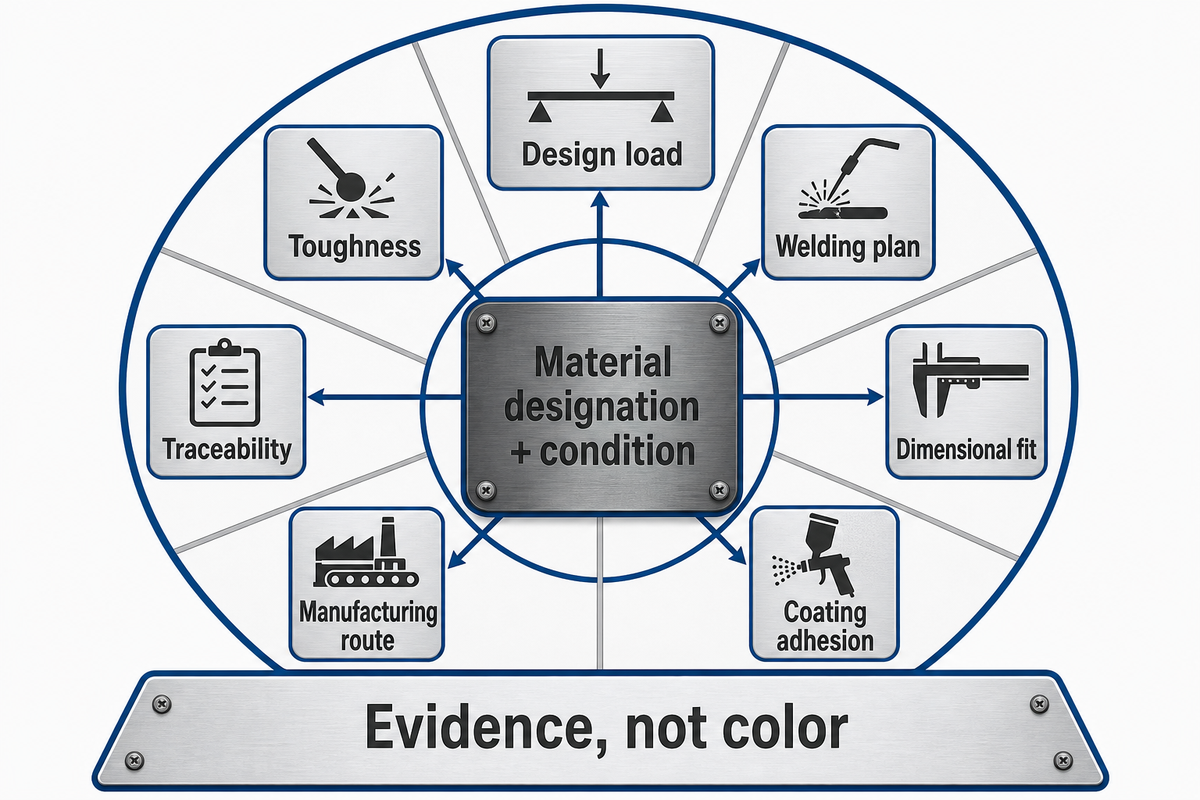
Black steel properties become decision-ready only when the comparison names grade, product form, thickness or wall, manufacturing condition, relevant test direction, and governing edition. Without those fields, yield behavior, toughness, weldability, dimensional tolerance, and surface condition can’t be transferred safely from one quotation or product family to another.
| Selection question | Evidence to request when applicable | Why color cannot answer it |
|---|---|---|
| Will it carry the design load? | Specified grade, dimensions, design basis, mechanical results | Strength belongs to the designation and condition |
| Is toughness required? | Project temperature, impact requirement, applicable test record | A dark surface cannot establish low-temperature behavior |
| Can it follow the welding plan? | Chemistry, carbon-equivalent basis, thickness, qualified procedure | Weldability is chemistry- and procedure-dependent |
| Will it fit? | Drawing, dimensional standard, tolerances, inspection plan | Color gives no dimensional acceptance limit |
| Is the route acceptable? | Welded/non-welded/formed route and ordered options | Different routes can share a dark surface |
| Will the coating adhere? | Surface condition, preparation grade/profile, coating data | Visual darkness is not a cleanliness/profile measurement |
| Can the delivery be traced? | Marking and inspection document required by the order/specification | Appearance cannot bind results to a heat or lot |
Don’t assume that every shipment includes every test or a particular certificate level. State the required inspection document, testing, marking, and traceability in the purchase order when the applicable standard, code, and quality plan call for them.
Illustrative unit-lock check
Sample P-17 Order is a hypothetical unit-control example: 114.3 mm outside diameter, 6.0 mm wall, 6 m length, −20 °C to 120 °C, 4.0 MPa design pressure, and 50 μm profile. The entries below show complete syntax, not recommended design values; replace each one with buyer-approved data.
| RFQ field | Hypothetical complete entry |
|---|---|
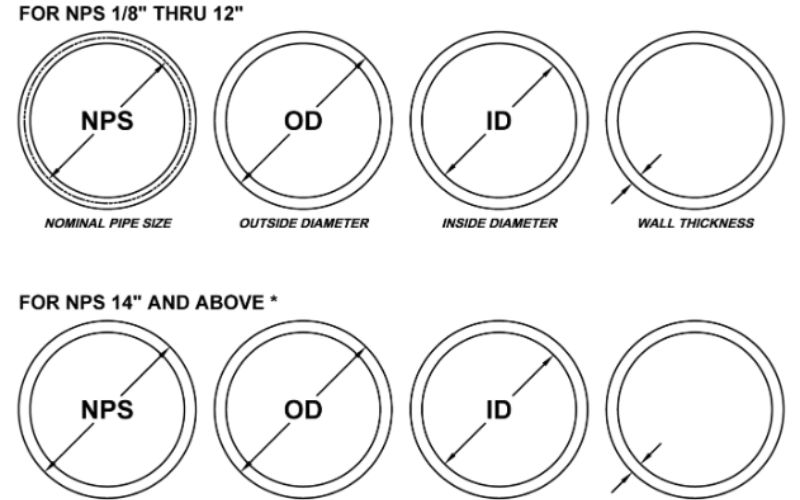
| Pipe geometry | 114.3 mm outside diameter × 6.0 mm wall |
| Cut length | 6 m nominal; +10 mm / −0 mm |
| Plate example | 12 mm × 1.5 m × 6 m |
| Temperature window | −20 °C minimum / 120 °C maximum |
| Design pressure | 4.0 MPa (about 580 psi) |
| Surface profile target | 50 μm when required by the selected coating data sheet |
| Coating thickness field | 200 μm total dry-film target when project-approved |
| Shipping mass field | 2 tons maximum per approved package |
Black Steel vs Mild Steel, Galvanized Steel and Stainless Steel
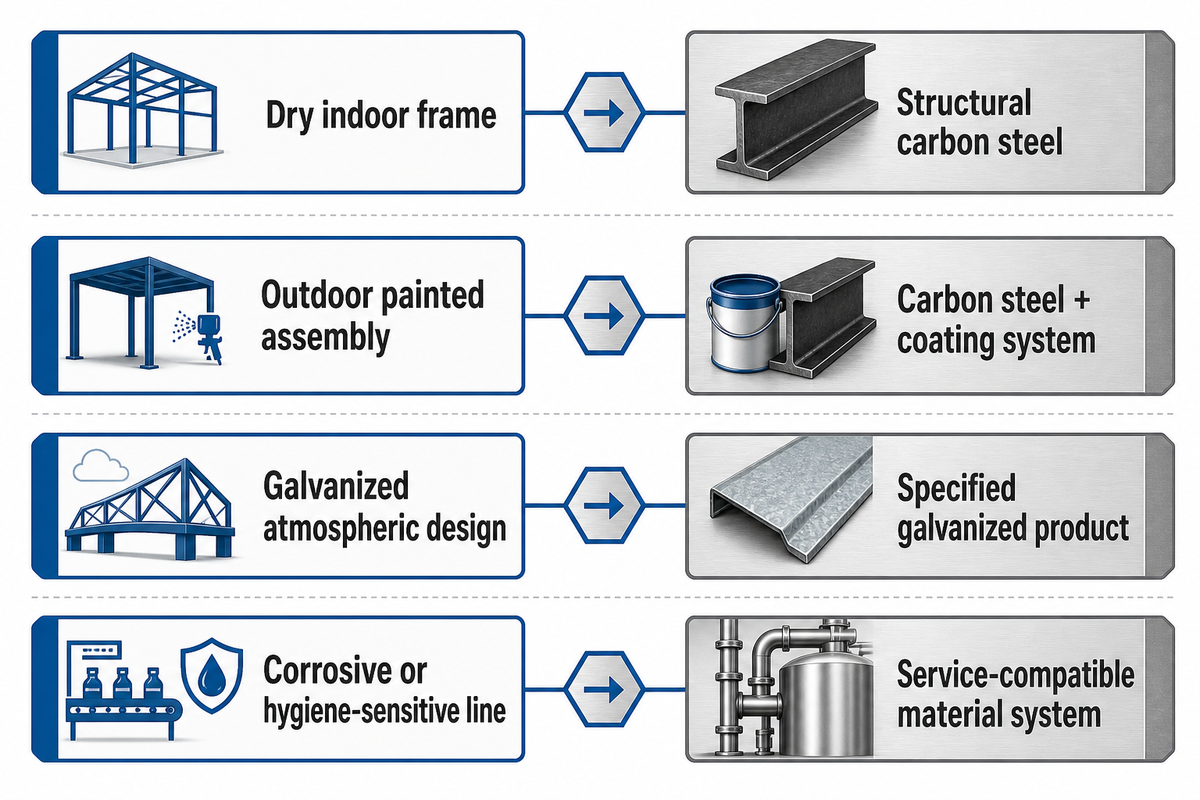
Black steel, mild steel, galvanized steel, and stainless steel can’t be ranked by one universal “best” order. Mild steel can overlap with black products, galvanizing adds zinc protection, and stainless is a separate alloy family. The starting route follows environment, code, fabrication, maintenance, and life-cycle needs.
Sample P-17 Order can’t enter this matrix until its service medium and cleaning duty are defined; its dark incoming surface and hypothetical dimensions don’t decide the route.
| Service case | Starting route | RFQ control | Limitation / not suitable for |
|---|---|---|---|
| Dry indoor frame | Specified structural carbon steel | Load, form, grade, finish | Not automatic approval for wet or chemical exposure |
| Indoor utility pipe | Applicable black-pipe specification | Fluid, pressure, temperature, code | Not selected from trade name alone |
| Outdoor painted assembly | Carbon steel plus specified coating system | Preparation, profile, coating, inspection | Bare mill scale is not the protection system |
| Atmospheric exposure with galvanized design | Specified galvanized product | Coating route, repair, fabrication sequence | Check temperature, chemicals, and weld/repair details |
| Corrosive or hygiene-sensitive process line | Service-compatible, code-approved material system | Medium, cleaning, temperature, pressure, alloy grade | No material family is universally immune to corrosion |
| Buried or immersed service | Engineered material/protection system | Soil/water chemistry, coating, cathodic strategy | Bare black steel is generally not a complete durability plan |
| High-temperature piping | Code- and service-specific pipe route | Design temperature/pressure, grade, code | Ordinary structural steel is not an automatic substitute |
| Architectural dark finish | Base grade plus controlled finish | Appearance sample, pretreatment, sealer, care | As-rolled variation may not meet cosmetic intent |
| Reinforced concrete in aggressive exposure | Engineer-selected reinforcement system | Chlorides, cover, cracks, coating/alloy strategy | “Black bar” alone does not resolve durability |
For buyers separately evaluating a supplier’s product range, BalingSteel’s stainless steel pipe product page is a commercial product reference, not a material-selection approval. Verify the alloy grade, service medium, code, cleaning regime, temperature, pressure, and project evidence independently.
Is black steel stronger than stainless steel?
Not as a general rule. Both labels cover many grades and product forms. A particular carbon-steel grade can exceed a particular stainless grade on one measured property and trail it on another. Compare named grades in the delivered condition, at the relevant thickness and temperature, using the property required by the design. Corrosion resistance, fabrication, cleanliness, and life-cycle maintenance can matter as much as nominal strength. For a broader comparison, see the separate black steel versus stainless steel guide.
Corrosion, Coatings and Surface Preparation
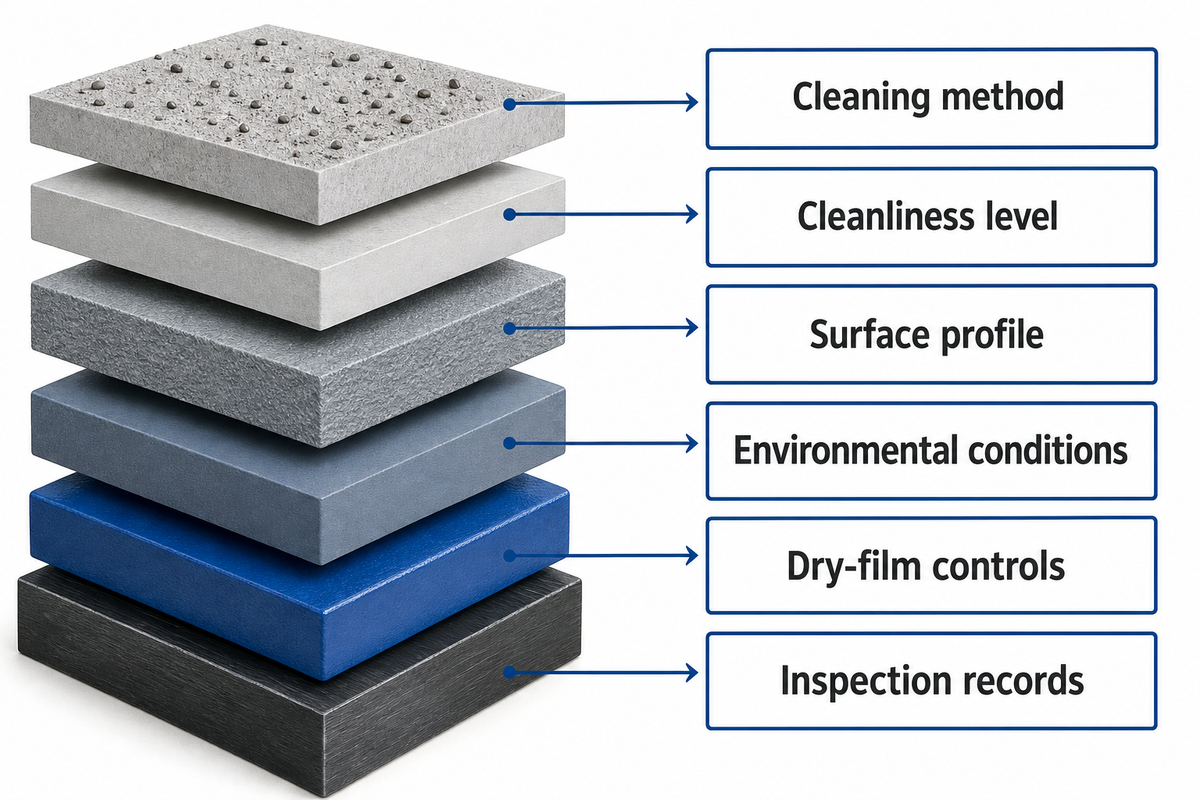
Black steel corrosion performance depends on exposure and the specified protection system, not on its initial dark appearance. Bare carbon steel can rust when moisture, salts, or chemicals reach it; mill scale can remain under some preparation grades, but it isn’t a complete durability specification. For the pipe-specific rust question, see Does Black Steel Pipe Rust?
Preparation is graded and system-specific. The contract specification and the coating product data sheet should identify the required cleaning method, cleanliness level, surface profile, environmental conditions, stripe-coat or edge treatment where needed, dry-film controls, and inspection records. Some surface-preparation grades can permit tightly adhering material; higher-cleanliness grades remove more. That’s why “always remove all scale” and “leave all scale” are both unsafe universal rules.
Write the coating system and preparation grade into the contract before fabrication; the steel’s color can’t carry that decision.
When not to select bare black steel
Picture an outdoor fabricated frame quoted simply as “black steel, painted.” One shop may price light cleaning and a single shop coat; another may price a graded blast, defined profile, compatible primer/topcoat system, edge treatment, and inspection records. Those offers aren’t comparable even if their steel grade matches. For condensation, marine salts, burial, chemicals, hygienic cleaning, inaccessible maintenance, or appearance-critical work, document the environment and protection system, including cut edges, welds, field repairs, drainage, crevices, transport storage, and inspection access.
Welding and Fabrication Checks Before Selection
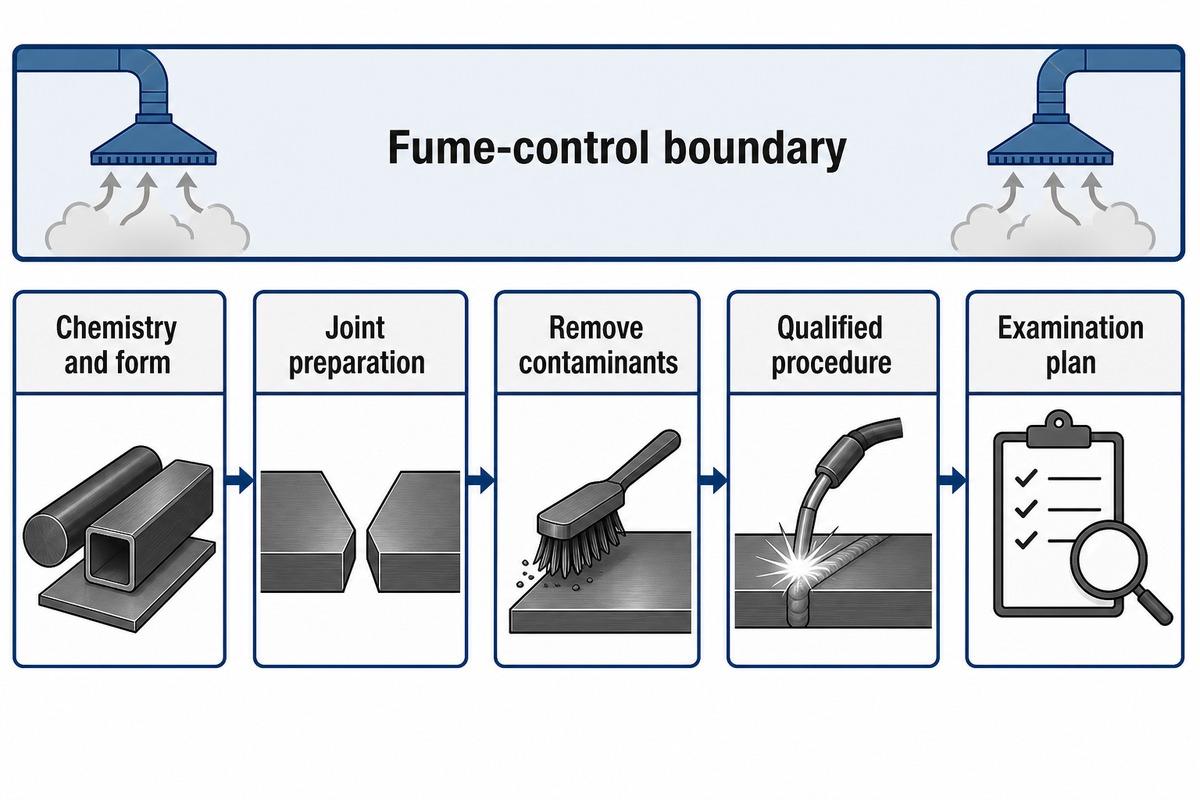
Black steel products don’t share one welding procedure because weldability follows chemistry, form, thickness, restraint, joint design, consumables, procedure qualification, and service. Pressure, high-temperature, cyclic, low-temperature, and sour-service work can add different controls, while a dark surface establishes none of the required parameters or acceptance limits.
Joint preparation is also contextual. Remove oil, paint, rust, moisture, or other contaminants as required by the procedure. A reviewed dissimilar-metal troubleshooting case recommends local scale removal near the joint, but that narrow advice isn’t proof that every mill-scaled product needs identical preparation. The qualified procedure and acceptance criteria control.
A second purchasing trap appears when an ordinary structural request is reused for a high-temperature pipe spool. Both may arrive dark, yet the piping case brings a service code, temperature and pressure design, pipe-specific grade, route, testing, and traceability, plus its welding procedure and examination plan. Reusing the structural designation because it “looks like the same type of steel” bypasses the controls that make the piping material acceptable. Separate the service routes before the quotation, not after fabrication.
Surface color can’t identify welding-fume hazards. Confirm the base metal and any zinc, paint, plating, oil, intentional blackening, stainless alloy, or other coating; then apply the workplace procedure for consumables, ventilation, respiratory protection where required, and confined-space conditions. This material-selection guide doesn’t replace a job-specific exposure assessment or safety data.
The Black Steel Order Definition Map: A Decision Framework
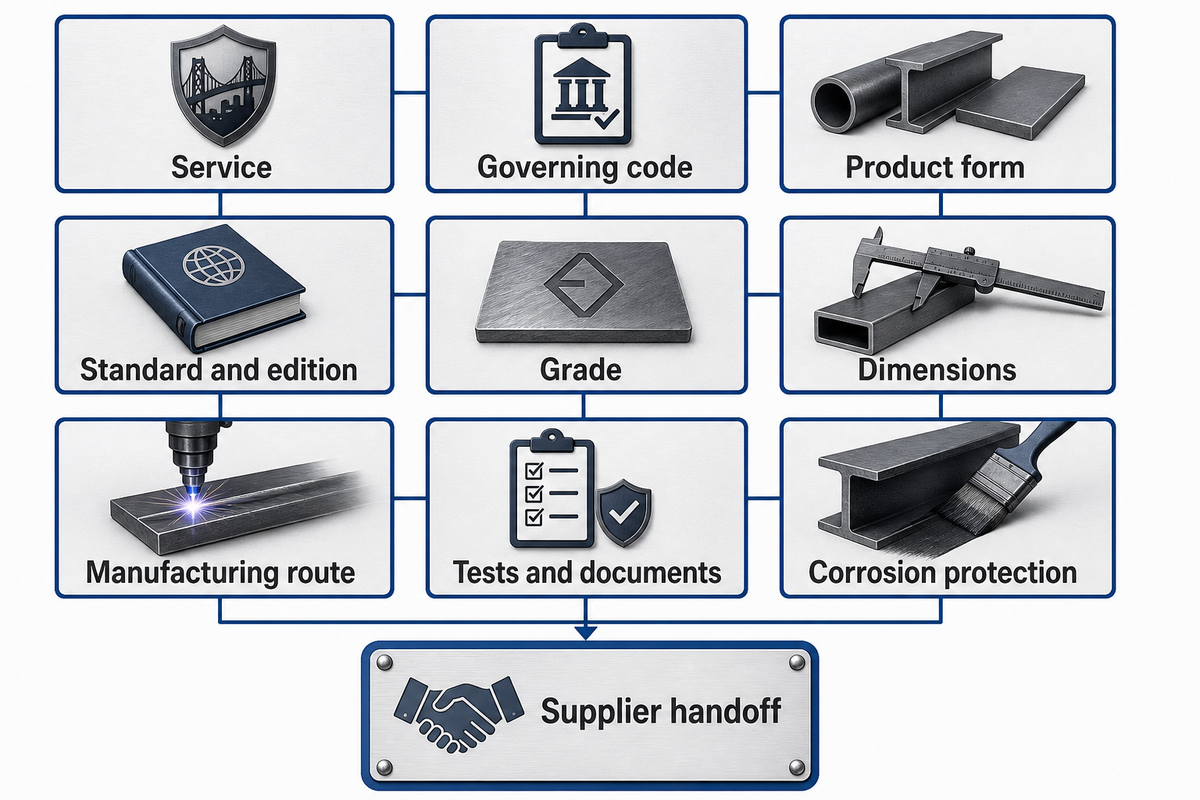
The Black Steel Order Definition Map turns an ambiguous color description into an auditable request by binding service, product identity, geometry, route, evidence, and protection. Complete its nine fields before asking suppliers to quote; the resulting record lets engineering, quality, procurement, and fabrication review the same material definition.
Sample P-17 Order closes the worked example: the buyer still adds the approved code, grade, route, evidence, and protection system.
Black Steel Order Definition Map
Nine controlled fields replace an appearance-based request with a traceable material identity.
| Field | Record | Decision prevented |
|---|---|---|
| 1. Service | Medium, loads, temperature, pressure, environment, life | Selecting from a generic application list |
| 2. Governing code | Design, construction, owner, and jurisdictional rules | Using a product outside its approved route |
| 3. Product form | Pipe, tube, plate, shape, bar, sheet, or assembly | Treating standards as interchangeable |
| 4. Standard and edition | Full designation and applicable revision | Quoting against an unspecified revision |
| 5. Grade | Named grade/class and ordered options | Assigning properties from color |
| 6. Dimensions | Size, wall/thickness, length, tolerances, ends | Receiving a nominally similar but unusable product |
| 7. Manufacturing route | Welded/non-welded/formed route and condition | Assuming route from appearance |
| 8. Tests and documents | Applicable inspection document, tests, marking, traceability | Expecting evidence that was never ordered |
| 9. Corrosion protection | As-delivered surface, preparation, coating/finish, repairs | Mistaking mill scale for a durability system |
Use an if/then sequence: if service isn’t defined, stop material selection; if form is known, choose the matching standard family; if the environment can corrode the substrate, specify the protection system; if welding is required, flow chemistry and procedure needs into the order; if traceability matters, state the document and marking package before quotation.
Black Steel Evidence Chain
Six grouped RFQ lines carry all nine map fields into a supplier handoff.
Copy-ready supplier handoff
| RFQ line | Information to send |
|---|---|
| Duty | Service conditions and governing code |
| Identity | Product form, standard/edition, and grade |
| Geometry | Dimensions, tolerances, ends, and quantity |
| Route | Manufacturing condition and fabrication needs |
| Evidence | Applicable tests, inspection documents, marking, and traceability |
| Protection | Surface condition, preparation, coating/finish, and repair method |
Current-edition note for 2026 requests
Exact-query search history is an editorial-intent signal, not proof of steel-market growth. The practical 2026 action is narrower: cite the applicable standard edition and ask the project engineer to review changes. API’s June 2026 announcement for Specification 5L, 47th Edition illustrates why edition control matters for line-pipe orders.
BalingSteel states that it operates an independent laboratory with chemical, mechanical, impact, and related testing resources. Treat this as an attributed company capability statement, not as third-party certification and not as proof that an unreviewed delivery lot passed a particular requirement. Bind every project requirement to the quotation, purchase order, applicable inspection document, and lot-specific evidence.
Ready to request a traceable proposal? Send the nine map fields with drawings and quantity, review BalingSteel’s manufacturing background, and compare the scope with its published project list. That gives teams one definition.
Black Steel Material FAQ
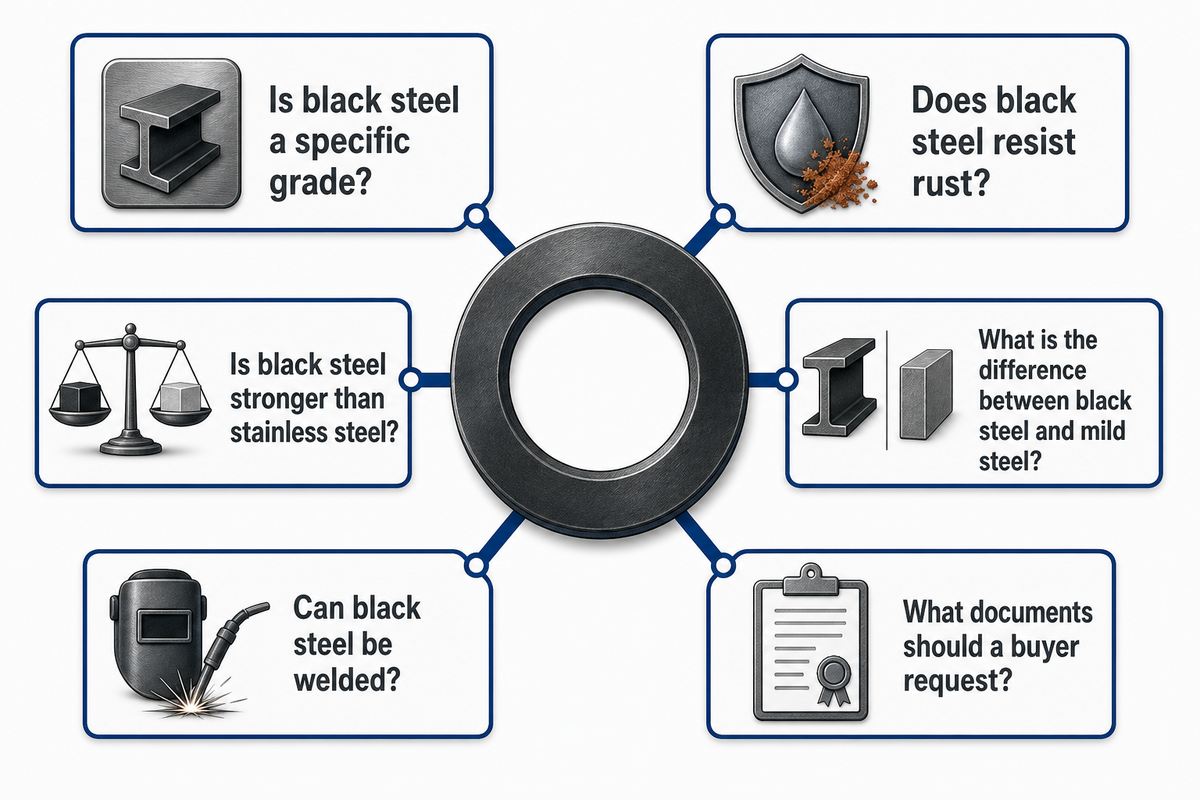
Is black steel a specific grade?
Answer
Does black steel resist rust?
Answer
Is black steel stronger than stainless steel?
Answer
What is the difference between black steel and mild steel?
Answer
Can black steel be welded?
Answer
What documents should a buyer request?
Answer
References & Sources
- ASTM International, Steel Standards
- ASTM International, A53/A53M-24 Scope
- ASTM International, A106/A106M-26 Scope
- ASTM International, A500/A500M-23 Scope
- ASTM International, A501/A501M-21 Scope
- BSI, BS EN 10255 Technical Delivery Conditions
- Federal Highway Administration, Uncoated Black Bar Terminology
- International Organization for Standardization, Black Oxide Coating on Iron and Steel
- American Petroleum Institute, Specification 5L, 47th Edition Announcement
- Association for Materials Protection and Performance, Surface Preparation Standards Summary
- The Fabricator, Preparing Structural Steel Surfaces for Painting
- The Welder, Dissimilar-Metal Welding Preparation Case
- Occupational Safety and Health Administration, 29 CFR 1910.252
Reviewed against public scope summaries and technical guidance. Purchased standards, project codes, drawings, and engineering review remain controlling.