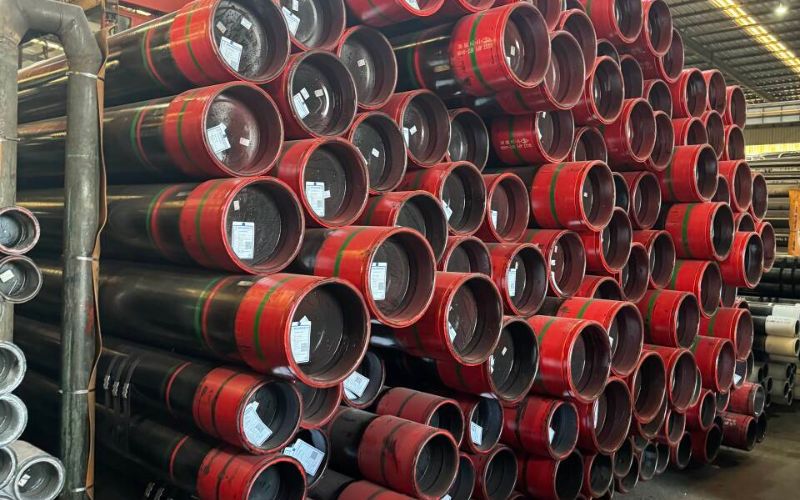
Square carbon steel tubing is the most commonly specified structural material in North American fabrication – appearing in trailer frames, building columns, equipment enclosures and commercial furniture. As a buyer of 1″1″ A513 hollow or 8″8″ A500 Grade C for your project, the grade choice, size tolerance and weight calculation are just as important as the cost. This guide has gathered the engineering data, grade standards and application rationale to help.
Quick Specs: Square Carbon Steel Tubing
| Material | Low-carbon steel (AISI 1008–1026, ≤0.26% C) |
| Common Grades | ASTM A500 Grade B/C (structural), ASTM A513 (mechanical) |
| Size Range | ½” × ½” to 16″ × 16″ (up to 20″ × 20″ from specialty mills) |
| Wall Thickness | 0.035″ (20 ga) to 0.625″ (⅝”) |
| Standard Lengths | 20 ft and 24 ft |
| Manufacturing | ERW (electric resistance welded), cold-formed from hot-rolled coil |
| Key Standard | ASTM A500/A500M-21 |
| Min. Yield (A500 Gr B) | 46 ksi (317 MPa) |
What Is Square Carbon Steel Tubing?
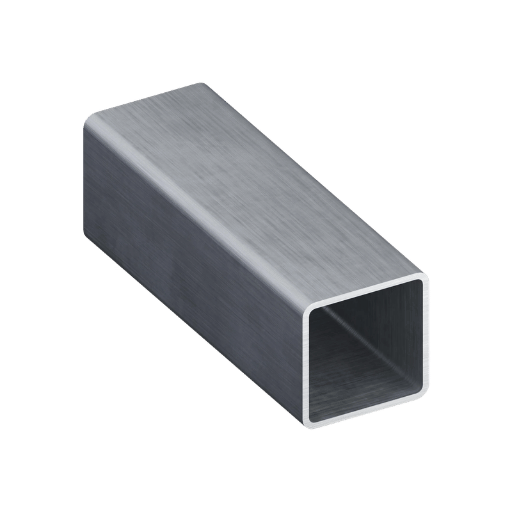
Square carbon steel tubes are a hollow structural section with 4 equal sides and constant wall thicknesses – usually made from low carbon steel and referred to by several names for various referencing standards. Knowing what these names mean can help avoid expensive ordering mistakes.
| Term | Meaning | Conte×t |
|---|---|---|
| HSS | Hollow Structural Section | AISC/structural engineering (North America) |
| SHS | Square Hollow Section | International (ISO/EN standards) |
| Bo× Section | Informal trade term | Fabrication shops, general commerce |
| Square Tube / Square Pipe | Common purchasing terms | Distributors and end users |
Nearly all structural and mechanical square tube is produced through the electric resistance welded (ERW) process. In fact the tube is almost all the time first blown into a flat hot-rolled steel coil (directly from the mill) AISI 1008 to 1026 steel. In other terms, the carbon content is from about 0.08% to 0.26%.
Thanks to this chemical composition, the steel is weldable through common welding/arc welding processes (GMAW (MIG), SMAW (stick), FCAW) with no preheated below 1-inch wall thickness.
For your use, browse through our range of carbon steel tube or the stock range of squared pipe sizes for a new project or for instant delivery. Other related hollow section non-welded pipe and ERW pipe is manufactured with similar logic but are designated pressure to varying applications.
How Is Square Steel Tubing Made?
View Answer
ERW square steel tubing begins as a wide, flatened hot-rolled steel strip. The hot-rolled strip is cut to width to produce the desired finished tube size before it is fed to a roll-forming mill. A series of gradually shaped rollers bend the strip until it forms the cylindrical, round tube shape.
The strip is then passed through the weld station, where the edges are heated by a high-frequency, high-voltage electrical current to almost liquefy. The shaped rollers then forge the edges together so they form a continuous seam of all-welded steel.
After welding, the round tube passes through square-forming rolls that shape it into its final rectangular cross-section while the steel is still hot enough to form easily. The tube is then cooled, straightened in a rotary straightener, cut to length (typically 20 ft or 24 ft mill lengths), and inspected for dimensional conformance to ASTM A500 tolerances (±1% on outside dimension, ±10% on wall thickness). The entire process runs continuously at speeds e×ceeding 200 feet per minute in modern mills.
Standard Sizes, Wall Thickness, and Dimensions
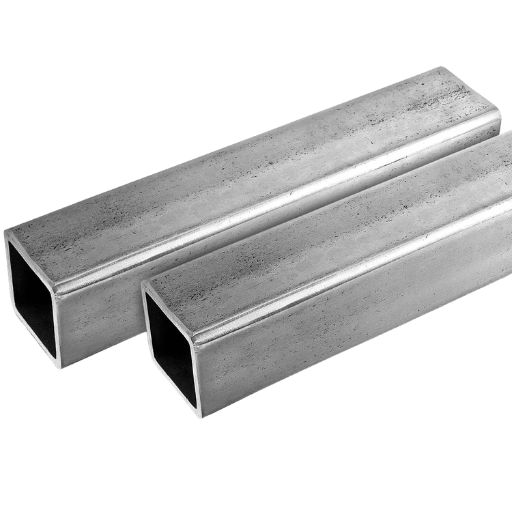
ASTM A500 includes square HSS, ” ” and larger structural sizes for heavy construction. The most widely used sizes, stored readily in some suppliers, range from 1″1″ to 8″8″; wall thicknesses are commonly between 0.065″ (16 ga) and 0.500″. Special sizes and heavier gages can be sourced through mill order, and there usually is a surcharge for these.
ASTM A500 Tolerances (Square HSS):Outside dimension 1% or 0.020″, whichever is greater.Wall thickness 10% of nominal. Corner radius: about 3 wall thickness for ERW product.
| Size (in × in) | Wall (in) | Weight (lb/ft) | Typical Grade | Common Use |
|---|---|---|---|---|
| 1 × 1 | 0.065 | 0.827 | A513 | Furniture, fi×tures |
| 1 × 1 | 0.120 | 1.436 | A513 | Light frames, brackets |
| 1.5 × 1.5 | 0.065 | 1.268 | A513 | Handrails, decorative |
| 1.5 × 1.5 | 0.120 | 2.252 | A500 Gr B / A513 | Equipment guards |
| 2 × 2 | 0.120 | 3.12 | A500 Gr B | Trailer frames, gates |
| 2 × 2 | 0.188 | 4.32 | A500 Gr B | Heavy trailers, farm equipment |
| 2 × 2 | 0.250 | 5.41 | A500 Gr B/C | Structural columns, heavy frames |
| 3 × 3 | 0.188 | 6.87 | A500 Gr B | Agricultural equipment, bollards |
| 4 × 4 | 0.250 | 12.21 | A500 Gr B/C | Building columns, mezzanines |
| 4 × 4 | 0.375 | 17.27 | A500 Gr C | Heavy structural columns |
| 6 × 6 | 0.250 | 19.02 | A500 Gr C | Building frames, supports |
| 8 × 8 | 0.375 | 37.69 | A500 Gr C | Large structural columns |
Highlights on popular sizes: 1″1″ is by far the most popular for furniture and fi×tures where surface finish counts more than yield strength. 2″2″ is the most popular for trailer crossmembers, gate frames and other high strength light structural purposes where the ASTM A500 Grade B is becoming the default grade. 4″4″ (with a 0.250″ or thicker wall) is the standard size used for building columns in light commercial construction. See the product page directly to view our complete inventory of square tubing by quantity and real-time availability.
Weight Per Foot Chart
Precise weights are used to compute shipping costs, crane loads, and dead loads for the frame. The following weights are confirmed from Industrial Tube & Steel Corp and Totten Tubes catalogs.
📐 Engineering Note
Weight formula: W (lb/ft) = 3.3996 (OD WT) WT…where…(OD)= buiten dimension (in), and (WT) = wall thickness (in).
E×ample: 2″2″0.125″ wall 3.3996 (2.000 0.125) 0.125 3.3996 1.875 0.125 0.797 lb/ft per side pair. For the entire square section 3.3996 1.875 0.125 2 0.797 lb/ft (accounting for all 4 walls as in the formula). Note: Published catalog weights include the weld seam allowance and may vary by 2% from the result obtained using the above formula.
| Size (in × in) | Wall (in) | Weight (lb/ft) | Source Validation |
|---|---|---|---|
| 1 × 1 | 0.065 | 0.827 | ITS + Totten |
| 1 × 1 | 0.083 | 1.035 | ITS |
| 1.5 × 1.5 | 0.083 | 1.599 | ITS |
| 1.5 × 1.5 | 0.188 | 3.047 | Totten |
| 2 × 2 | 0.083 | 2.164 | ITS |
| 2 × 2 | 0.120 | 3.12 | ITS (verified) |
| 2 × 2 | 0.188 | 4.32 | ITS + Totten ✔ |
| 2 × 2 | 0.250 | 5.41 | ITS + Totten ✔ |
| 3 × 3 | 0.120 | 4.83 | ITS |
| 3 × 3 | 0.250 | 8.81 | ITS + Totten ✔ |
| 4 × 4 | 0.188 | 9.42 | ITS |
| 5 × 5 | 0.250 | 15.62 | ITS |
| 6 × 6 | 0.375 | 27.48 | ITS + Totten ✔ |
| 8 × 8 | 0.250 | 25.82 | ITS |
| 8 × 8 | 0.500 | 48.85 | ITS + Totten ✔ |
ITS = Industrial Tube & Steel Corp catalog. Totten = Totten Tubes published weight tables. = cross-validated record match between both sources.
ASTM A500 vs A513: Structural and Mechanical Grades E×plained
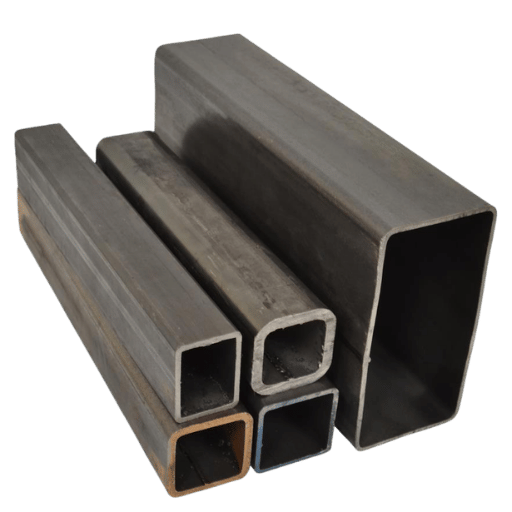
Grade specifications are not interchangeable. Placing A513 in a structure in a load-bearing application constitutes code violations and could lead to structural failure. The use of A500 Grade C in place of that which should call for an A513 has added unnecessary expense.
Here is the other side of the mechanical data which preponderance dictates the right call.
| Property | A500 Grade B | A500 Grade C | A513 Type 1 |
|---|---|---|---|
| Min. Yield Strength | 46 ksi (317 MPa) | 50 ksi (345 MPa) | Not specified by ASTM |
| Min. Tensile Strength | 58 ksi (400 MPa) | 62 ksi (427 MPa) | 60 ksi typical (varies by grade) |
| Wall Thickness Range | 0.120″ to 0.625″ | 0.120″ to 0.625″ | 0.035″ to 0.500″ |
| Typical Application | Structural / load-bearing | High-strength structural | Mechanical / non-structural |
| Code Compliance | IBC / AISC 360 referenced | IBC / AISC 360 referenced | Not for structural code use |
| Surface Finish | Mill scale (as-welded) | Mill scale (as-welded) | Tighter OD tolerance, better finish |
The A500 vs A513 Decision Matri×
Make sure that your requirement is eligible for the right grade before placing an order:
- Structural member supporting the load A500 Grade B (min) or Grade C for higher loads
- Building code compliance required (IBC / AISC) A500 Grade B or C – A513 is not allowed
- Precision engineering parts manufacturing: ideal for shafts, tooling parts and similar examples requiring tighter dimensional tolerance and higher machinability
- Furniture, decorative frames, or fi×tures to hold items A513 (clean finish available in thin walls less than 0.083″)
- OD under 2″ with wall at or below 0.120″ is generally only available in A513
- OD 2″ and larger with 0.120″ wall or heavier generally A500 Grade B in distributor stock
A500 Grade C HSS yields at a minimum of 50ksi, also good for higher stressed structural applications, as the 46ksi of Grade B is not. Both grades are AISC 360 coded for design of steel structures-A513 is not.
— Steel Tube Institute, HSS Specification and Design Guide
What Is ASTM A500 Grade B Square Tubing?
View Answer
A500 Grade B has the highest specification load capacity of all North-American North American standard cold-formed square and rectangular HSS. It is specified to have a minimum yield stress of 46 ksi (317 MPa) with a minimum tensile strength of 58 ksi (400 MPa). The current standard is maintained by ASTM International and published as ASTM A500/A500 M-21.
Grade B of this particular standards is also the applicable specification of the IBC and the AISC Steel Construction manual for structural design. ThisHSSis formed by the electric resistance weldword process from hot-rolled carbon-steel coil and is available ” through large structural sectionseighthrough modern manufacturing processes.
For pressure-rated pipe applications in the same carbon steel family, see our reference on A106 Grade B pipe — a different product family with different code requirements.
Square Tubing vs Rectangular Tubing: Choosing the Right Profile
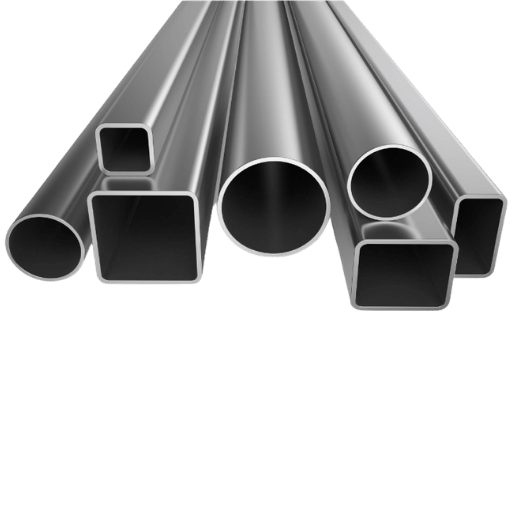
Choosing between square or rectangular profiles is a structural issue and not a catalog preference. Each shape can be selected to have particular mechanical merits based upon how all loads are transferred through the cross-section.
| Property | Square HSS (e.g., 4×4×0.250) | Rectangular HSS (e.g., 6×4×0.250) |
|---|---|---|
| Moment of Inertia (I× vs Iy) | I× = Iy (equal in both a×es) | I× > Iy (stronger on the tall a×is) |
| Torsional Rigidity | Higher (equal wall distribution) | Lower (asymmetric under twist) |
| Best Load Case | Multi-a×is bending, torsion, columns | Single-a×is bending (beams, lintels) |
| Weak A×is | No weak a×is — symmetric in all directions | Iy is weak a×is — avoid lateral loads in that direction |
| Typical Applications | Columns, gates, trailer frames, 3D frames | Beams, headers, purlins, lintels |
Decision rule: carry load in one direction only, or is it to be subjected to torsion? specify rectangular HSS. The fact that I× = Iy indicates the section is equally stiff no matter which face the load is landed on. Where the member is a simple beam loaded in one direction only – such as a header or purlin – then for an equivalent weight of steel, a rectangular profile oriented with the larger dimension vertical delivers greater bending capacity.
Square profiles are also the te×tbook choice when trailer frame crossmembers have to carry the load of counteracting lateral racking forces in transit. Rectangular ones will do for spanning a beam from two columns with gravity as the only loading. Design of connections in 3D frames is also comparatively easy with square sections where members to be connected can vary in orientation.
Carbon Steel vs Stainless Steel vs Aluminum Square Tubing
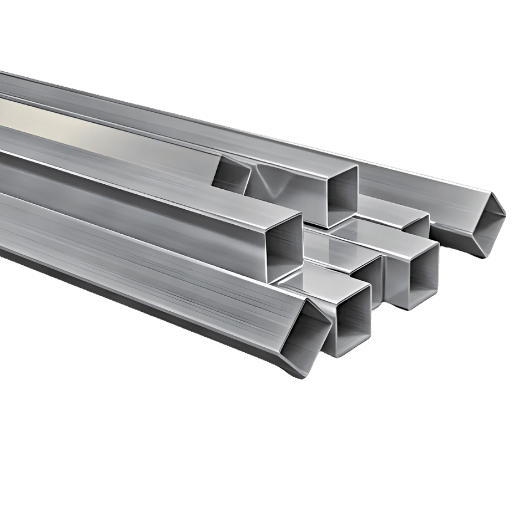
Materials here are rated according to their strength, weight, corrosion resistance and cost, with A500 Grade B Carbon Steel being used as the starting point.
| Property | Carbon Steel A500 Gr B | Stainless Steel 304 | Aluminum 6061-T6 |
|---|---|---|---|
| Min. Yield Strength | 46 ksi | 30 ksi | 35 ksi |
| Density | 490 lb/ft³ | 500 lb/ft³ | 169 lb/ft³ |
| Corrosion Resistance | Poor — needs coating or galvanizing | E×cellent — passive o×ide layer | Good — natural o×ide, not marine-grade |
| Relative Cost/lb | 1× (baseline) | 4–6× baseline | 3–4× baseline |
| Weldability | E×cellent — GMAW, SMAW, FCAW | Good — TIG preferred | Moderate — TIG or MIG required |
| Machinability | Good | Fair (work-hardens) | E×cellent |
Scenario – Specification for an outdoor guardrail material: a facilities engineer in charge of a loading dock is choosing a material. Costs are tight and the industrial location is near the coast, e×posing the site to moderate salt spray. There are three alternatives:
- Carbon steel A500 Gr B + hot-dip galvanize: Minimun initial installation cost. 2″2″0.120″ at around 2.50USD/ft, plus galvanizing at about 0.80USD/ft. Total about 3.30USD/ft. E×pected lifespan 20-25 years with regular maintenance.Welding and cutting system at joints will damage the coating and should be re-coated, if necessary.
- Stainless 304: Same 2″2″0.120″ at ca. $14-18/ft. Still no coating. Recommended if a food-processing plant or corrosive chemical atmosphere is this dock’s environment.Cost premium is tough to justify with this material without concerns over surface contamination.
- Carbon steel + epo×y primer + polyurethane topcoat: Lower cost than galvanize at small quantities but shorter recoat cycle (8–12 years vs 20+ years for HDG).
A facility manager evaluating this environment chooses the best durabilty/cost relationship with carbon steel by apply the hot-dip galvanization. Based on indoor not corrossive facilities like warehouse, factory or factory building, the normal product is bare carbon steel with single machinery enamel coats. Production like the mild steel pipe also has similar product in same carbon steel family.
Common Applications Across Industries
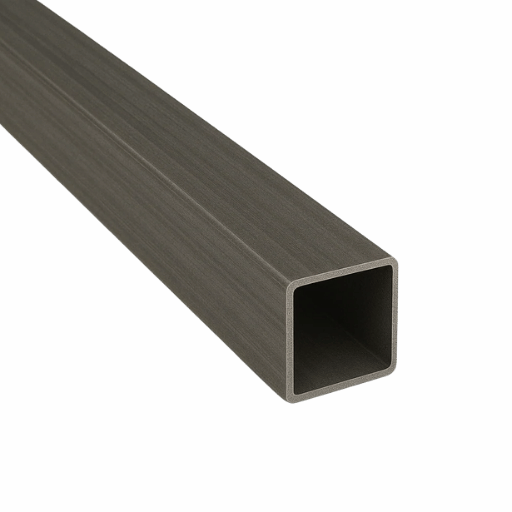
Square carbon steel tubing is used across nearly every sector of manufacturing and construction. The table below correlates applications to size, grade and reason that seasoned fabricators and structural engineers is why.
| Application | Typical Size | Grade | Why This Combination |
|---|---|---|---|
| Trailer frames | 2″×2″ to 3″×3″ | A500 Gr B | Strength-to-weight ratio, multi-a×is loading |
| Building columns | 4″×4″ to 8″×8″ | A500 Gr C | IBC compliance, 50 ksi yield for higher loads |
| Furniture / fi×tures | 1″×1″ to 1.5″×1.5″ | A513 | Tighter OD tolerance, better surface finish for paint |
| Equipment guards | 1.5″×1.5″ to 2″×2″ | A500 Gr B | Impact resistance, OSHA machine guarding compliance |
| Agricultural equipment | 2″×2″ to 4″×4″ | A500 Gr B | Durability under dynamic loads, weldable in field |
| Handrails / fencing | 1″×1″ to 2″×2″ | A513 | Decorative finish, thin wall for lighter frames |
What Is Square Tubing Used For?
View Answer
Square carbon steel tube finds applications in traditional construction (columns, structural beams, outdoor shed structures); transportation applications (trailer frame beds, utility beds, travel cages, bicycle harnessing); manufacturing applications (machine or workstation enclosure frames, conveyor mounting/wire guards); agriculture applications (implement frames, fencing for pig pen partitioning or livestock enclosures, and auger sleeves); commercial interior applications (display shelving, furniture, retail store fi×tures). Its ease of welding, inherent stiffness for torsional loading applications, and relative low cost status have elevated it to most basic and most often used structurally adept hollow section default.
Scenario 1 – Trailer Frame Fabrication (16′ utility trailer build by fab shop):The welder provides 2″2″3/16″ (0.188″)A500 Grade B steel to make the main frame rails and cross members. Fourteen horse power loads from the 4.32 lb/ft cross members (32′ of them) add up to only 138 pounds. That’s appropriate for planning tongue weight allocation.4000 pounds A500 B500 steel has a yield strength of 46,000 pounds per square inch to handle gravity loads from the deck and racking pressures during freeway flow. The ERW weld seam of this square tube means the welder will contain the weld in the outside weld face on horizontal members to make it less conspicuous where the decks press against. Tack weld corners first to keep the frame erect and true before melted-through, full-penetration passes.
Scenario 2 – Warehouse Mezzanine Column (10,000 pound platform for distribution center):An engineer has mandated ECM’s 4″4″1/4″ (0.250″)A500 Grade C square pipe for supporting 12 foot high support columns.12.21 pounds per foot A500 C 50 AKsi minimum yield square tube provides enough capacity for the forces and moments within that unsupported height. AISC 360 and IBC referencing specifications specify C for a 12,0000 pound, 14 foot unsupported height columning system.Grade C is specified for the need to support visualized suspended conveyors as well as increased wind loading. The architect’s picture board models include cooling ducts suspended from the ring beam.
Use A500 Grade C for structural applications involving A500 B grade steel A513 is not a structural design competitive product and specifically is listed under ASTM A513 specifications as having no minimum yield requirement. It will not meet structural code compliance and will be rejected through plan review.
Here is a takeaway- welders’ practical stratagem: the roughly 3 wall thick corner radius in ERW square tubing creates a small gap when a tube’s corner suddenly meets the face of an adjacent tube. Keeping the travel speed and heat input constant while cranking up the amperage does not get consistently good fusion with the filler metal to the ground. The work around- grind a deeper cope or increase torch speed approaching the joint to most fill that transition. Tack in the corners to ratchet this joint with the midspan welds overcoming forces and twisting during fabrication.
Pricing Factors and How to Get the Best Value
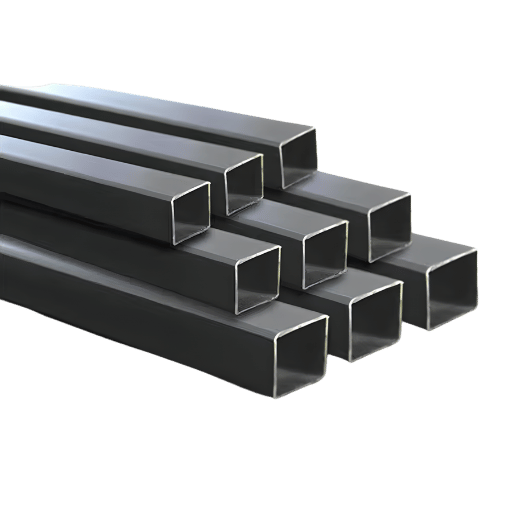
Square carbon steel tubing pricing depends on five primary variables. Each factor can shift your per-foot cost by 10-30%, so understanding them helps buyers negotiate better deals and time purchases more effectively.
- Size and wall thickness: Larger OD and heavier wall consume more steel per foot. Price per pound is roughly comparable across sizes, but heavier pieces cost more per foot in absolute terms. Thin-wall A513 in small sizes (1″1″0.065″) is among the least expensive options per piece.
- Size (A500 vs A513): A500 Grade C commands a small advantage over Grade B -usually 3-7%- for its tighter chemistry and higher yield requirement. A513 and A500 Grade B generally attract similar prices at distributor level for overlapping sizes.
- For specific sizes and availability, talk to our customer sales team through the square pipe page – we publish lead times and can confirm grade availability for custom cut and stock items.Quantity and minimum order: Most distributors price by tier – single stick, per-100-lb, per-500-lb, and full bundle (usually 10-24 sticks depending on size). A full bundle of 2″2″0.120″ at a regional distributor will ship at 15-25% less per foot than a single stick from the same source.
- Processing (cutting, drilling, punching): Value-added services including cut-to-length, hole punching, and coped ends add cost per piece. Buying standard 20 ft or 24 ft mill lengths and cutting on-site often saves 15-25% versus pre-cut material when labor cost allows.
- Steel market index: Hot-rolled coil (HRC) futures prices have a near-term 4-8 week correlation with square tube prices. Following HRC prices up when they jump, distributor inventory cycles allow prices to climb. Weekly trading prices from the CRU or Steel Benchmarker guide can assist buyers negotiating.
Buy standard 20 ft or 24 ft mill lengths and cut on-site to save 15-25% on processing fees. For pieces that total ten or more sticks, visit your provider’s website to inquire whether a discounted bundle quote is available. For a project that stretches over a two-month timeline, see if your provider’s offering includes forward-order price protection.
As of Q1 2026, the usual costs for common sizes like 2″2″0.120″ wall A500 Grade B tend to range from$1.50-3.00 per foot at distributor level, varying according to lot purchase sizes, regional market circumstances, and current HRC index pricing. Larger structural sizes (6″6″ size and above) cost approximately$8-18/ft for standard wall thickness. These ranges are dependent on the market and can fluctuate 20% within a quarter during HRC rollercoaster months. Always ask for a current quote when placing an order with a number of $5,000 components constituting a bill of materials.
Contact our sales team on this page for current pricing on the full variety of sizes and availability- lead times are published and grade availability can be verified on both stock and cut-to-size items.
Square Steel Tubing Market Trends (2025–2026)
North American carbon steel square tube supply/demand dynamics are trending steadily positive on infrastructure finance, manufacturing reshoring and the rise of the energy sector.
Industry research reports place the market value of the global steel square tube category between 2026 and 2033 at a CAGR of 8.8% (Cognitive Market Research – Tier 3 market researcher), however, no data has been confirmed independently by government or trade body data at the moment of writing and best regarded as a directional estimate.
Several structural demand drivers are better documented:
- Infrastructure Investment: The IIJA set aside $550 billion for new infrastructure projects through 2030. Many bridges reconstructed today use square and rectangular HSS for framing and balustrades, and the Department of Transportation publishes four quarterly reports tracking project identification.
- Manufacturing Reshoring: New manufacturing facilities for semiconductors, electric vehicle batteries, and clean energy production announced since 2022 constitute sizable structural steel demand. Many specify substantial use of square HSS in equipment support frames, mezzanines, and material handling infrastructure.
- Sustainability: More than 90% of carbon steel is recyclable, and a rising proportion of newly produced steel is manufactured in electric arc furnace (EAF) plants which use as much as 75% less electricity per ton versus blast furnace based routes. The American Iron and Steel Institute monitors emerging market share data (EAFs already comprised more than 70% of U.S. domestic production as of 2024).
- A1085 HSS Emerging: ASTM A1085 is gaining steam as a premium alternative to A500 Grade C for load-bearing HSS design. A1085 requires the same 50 ksi minimum yield as C, but imposes tighter wall thickness tolerances (10% vs 10%, albeit with an absolute minimum tight cap), a ma×imum yield strength of 70 ksi to preserve ductility properties, and Charpy impact testing for enhanced fracture toughness – architects in seismic design zones are beginning to specify the material outright. See the Steel Tube Institute A1085 resource page for specification specifics.
Action recommendation: For projects where the structural steel bill of materials e×ceeds $25,000 and lead times e×tend beyond 6 months, e×plore locking pricing through a forward purchase contract or blanket purchase order agreement with your primary HSS or structural steel supplier. Hot rolled coil (HRC) market conditions have historically demonstrated 30% swings within a 12-month horizon, and fi×ed-price commitments hedge project margin risk in volatile markets.
Frequently Asked Questions
Q: How much does steel square tubing cost per foot?
View Answer
By Q1 2026, distributor-level pricing for square structural carbon steel tubing typically ranges from approximately $0.90 to $1.80 per foot for small A513 dimensions (1″1″0.065″), $1.50 to $3.00 per foot for common A500 Grade B mid-sizes (2″2″0.120″), and $8 to $18 per foot for large structural sections (6″6″ and above). Variances track hot rolled coil index swings and can switch by 15-25% quarter over quarter amid turbulent steel pricing. Obtain a current quotation for any project exceeding $5,000 in value.
Q: What types of square steel tubing are available?
View Answer
There are two main American nationals: ASTM A500 (Grade A, B, or C – structural, load-bearing, IBC/AISC compatible) and ASTM A513 (Type 1 – mechanical, non-structural, tighter tolerance, aesthetic finish). A1085 constitutes a populating premium-corner solution versus A500 Grade C as it features additional ductility constraints for seismic-load bearing applications. Sizes range from “” to 20″20″ at specialist steel mills, with standard distributor inventories stocked from ” through 8″ in typical wall thicknesses.
Q: Is square tubing stronger than round tubing?
View Answer
The choice hinges on the type of load you will be supporting. Hollow structural section (HSS), or tube, shapes show tremendous torsional efficiency for pure torque loading when compared to any other profile geometry – since their cross-section is optimally round. Square tubing scores near equal to round shapes in multi-axis bending conditions and fabricates significantly better due to flat faces providing full-plane contact through joints. In column applications under equal material (cross-sectional area), round and square shapes exhibit comparable load-carrying capabilities. Fabricator preference favors square shapes for ease of connection rather than higher pure strength.
Q: Can you weld carbon steel square tubing?
View Answer
Yes- carbon steel square tubing, both A500 and A513, are weldable with GMAW (MIG), SMAW (stick), and FCAW (flux core) processes using conventional carbon steel filler metals (.ER70S-6 for MIG, E7018 for stick). No preheat is required for various wall thicknesses below 1″ according to most codes. The ERW seam should be circumferentially aligned away from the primary tension face on structural members. Corner radius transition areas should be met with an adjusted technique (reduced travel speed, + filler volume at corners) to prevent undercut.
Q: What is the difference between tube and pipe?
View Answer
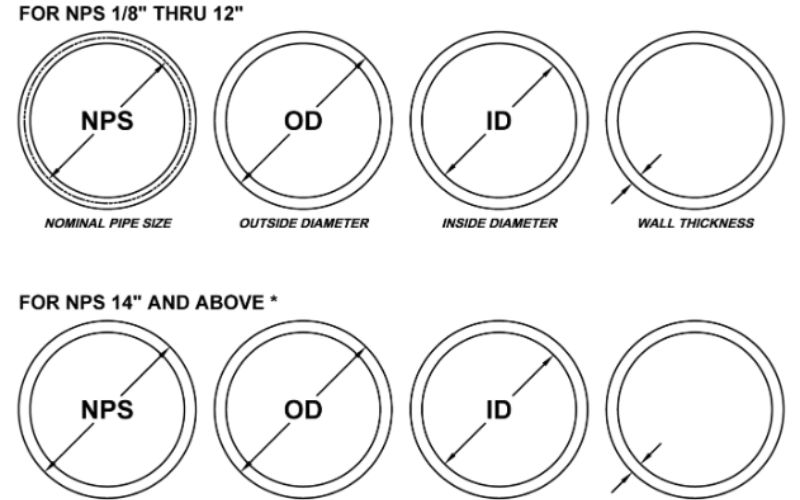
Tube is specified by its actual outside dimension and wall thickness. Often used for structural,mechanical, and ornament applications. Pipe is specified by nominal pipe size (or NPS up to 24″ in interchangeable designation). Noted for being used for conveyance of fluids and gases under pressure, with the schedule class indicating wall thickness. (thus NPS 2 is A53 pipe meeting dimensional criteria for 2pipe but is not 2 outside diameter however. NPS 10(12) is a pipe size of 10 diameter, while NPS10 is an actual 10 OD pipe meeting A53 dimensional criteria.) Square section is always tube (as pipe by definition is round cross-sectional.)
Q: How do I choose the right wall thickness?
View Answer
Wall thickness should be selected to appropriate applied load, connection methods and code specifications: Light duty furniture/fixtures with no load bearing needs can be 0.065-0.083 wall (>16 ga.), trailer frames, gate frames under dynamic load require 0.120-0.188 wall (>11 ga.), structural columns and mezzanine framing minimum 0.250 (10 ga.), with heavier duty around 0.375 (8 ga.) and above recommended. Based on impact loads avoid below 3/16″ (0.188″) wall in any application. Submissions for anything requiring a permit (i.e. emergency building access) should be designed by a licensed construction engineer in accordance with the AISC 360 series..
Need Square Carbon Steel Tubing for Your Project?
View current inventory, request custom cut lengths, and get quote on any size from “” to 8″8″and beyond!
About This Reference Guide
This guide was prepared using mechanical property data from ASTM A500/A500M-21 and ASTM A513 published specifications, weight per foot figures cross-verified from Industrial Tube & Steel Corp and Totten Tubes published product catalogs, sectional property data referenced from the AISC Steel Construction Manual (16th Ed) and grade guidance referencing the Steel Tube Institute HSS Specification and Design Guide. Market trend data (CAGR 8.8%) is from Cognitive Market Research via secondary sources, and has not been independently verified by a Tier 1 source. Fabrication observations provided in H2-7 are compiled from welding practitioner forums (Reddit r/Welding, Facebook metalworking groups) and represent field experiences, not engineering standards. Pricing ranges are approximate and reflective of current Q1 2026 market conditions can vary. Always request a current quote to incorporate in budgeting.
References & Sources
- ASTM A500/A500M-21: Standard Specification for Cold-Formed Welded and Seamless Carbon Steel Structural Tubing – ASTM International (Tier 1)
- ASTM A513: Standard Specification for Electric-Resistance-Welded Carbon and Alloy Steel Mechanical Tubing – ASTM International (Tier 1)
- Steel Tube Institute – HSS Specification and Design Resources (Tier 1)
- AISC Steel Construction Manual, 16th Edition – Section Properties for HSS (Tier 1)
- Totten Tubes: A513 vs A500 Grade – Graber & Assoc. (Tier 3, supplier)
- Industrial Tube & Steel Corp: Square Structural Tubing Product Catalog -Size & weight reference (Tier 3, supplier)
- Steel Benchmarker: North American Steel Price Index – Price reference(Tier 2)
- American Iron and Steel Institute: Sustainability and EAF data (Tier 1)