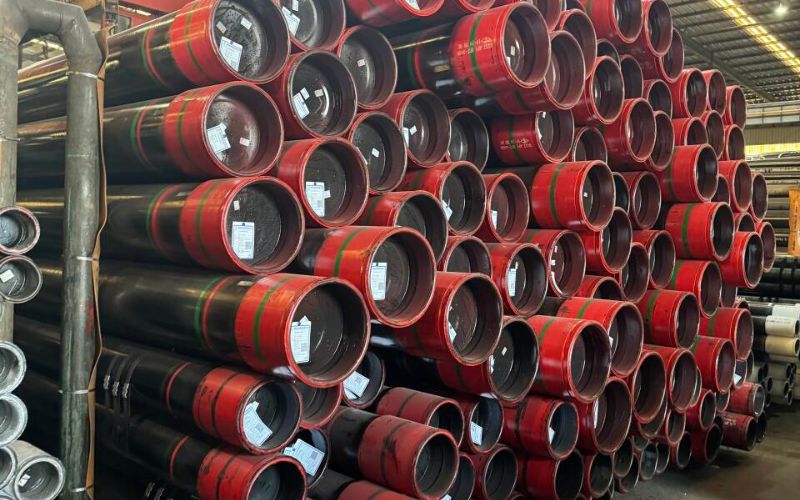
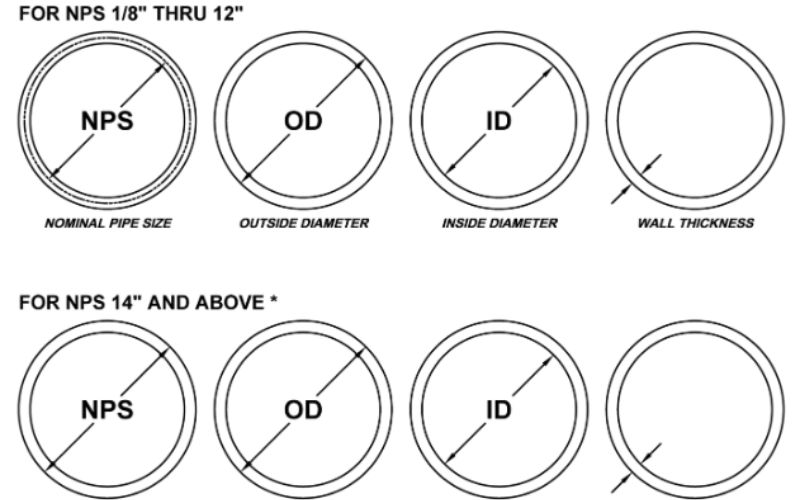
304 stainless steel tubing is a chromium-nickel austenitic tubular product used in equipment, fabrication and fluid systems. Buying the right tube requires more than the alloy name: the product specification, outside diameter, wall basis and delivered condition determine what arrives and how it can be accepted.
Updated October 2026
- Alloy family: austenitic stainless steel.
- Size description: actual outside diameter × specified wall × length.
- General-service route: ASTM A269 covers seamless and welded tubing.
- Wall basis: distinguish nominal, minimum and ordered average wall.
- Engineering acceptance: select the product specification and system requirements together.
304 stainless steel tubing is selected by product standard, diameter, wall, condition and service environment. ASTM A269 addresses general service tubing; mechanical and heat transfer and sanitary services have their own requirements.
- A213 tubing can be ordered on an average-wall basis; the rule “A213 always means minimum wall” is incomplete.
- 304L reduces sensitisation risk associated with carbon; it doesn’t replace local-corrosion benefit of an appropriate Molybdenum bearing grade.
- A tube’s manufacturing route and heat number are separate from its suitability to the required service.
What Is 304 Stainless Steel Tubing?
304 stainless steel tubing is a hollow product of the 304 austenitic alloy family. Chromium promotes passive film formation, and nickel supports austenitic stability. The grade identifies material chemistry; the purchase specification also defines the tube’s form, manufacturing condition and acceptance requirements for the intended application.
Round tubing is only one product form. A project may need stainless steel round sections for a handrail, rectangular members for furniture, or a steel tube carrying a process fluid. Those purchases can share a grade while requiring different dimensional control, surface finish, and testing. An automotive exhaust component and a kitchen equipment frame require different acceptance decisions. “General purpose” describes a broad use category rather than a design approval.
The starting point, in most cases, is the component drawing. A 25.4 mm outside-diameter tube has a physical size requirement; a nominal pipe description belongs to another sizing system. Treat the metal grade and connection dimensions as separate fields so that the correct alloy does not arrive with the wrong fitting interface. Treat the metal grade, connection dimensions and the alloy specification as different fields.
For material background, Baling Steel’s 304 stainless steel property guide covers the alloys more broadly. Tube acceptance should be in accordance with the applicable product requirements, including any specified mechanical properties, rather than using a single strength value for all cases.
Ordering consequence: A requirement for 25.4 mm OD identifies a dimension, while “304” identifies the alloy. Keeping both fields on the drawing ensures a nominal-size substitution doesn’t pass a grade-only receiving check. Add the wall and length before releasing the purchase description.
Which Product Specification Fits the Application?
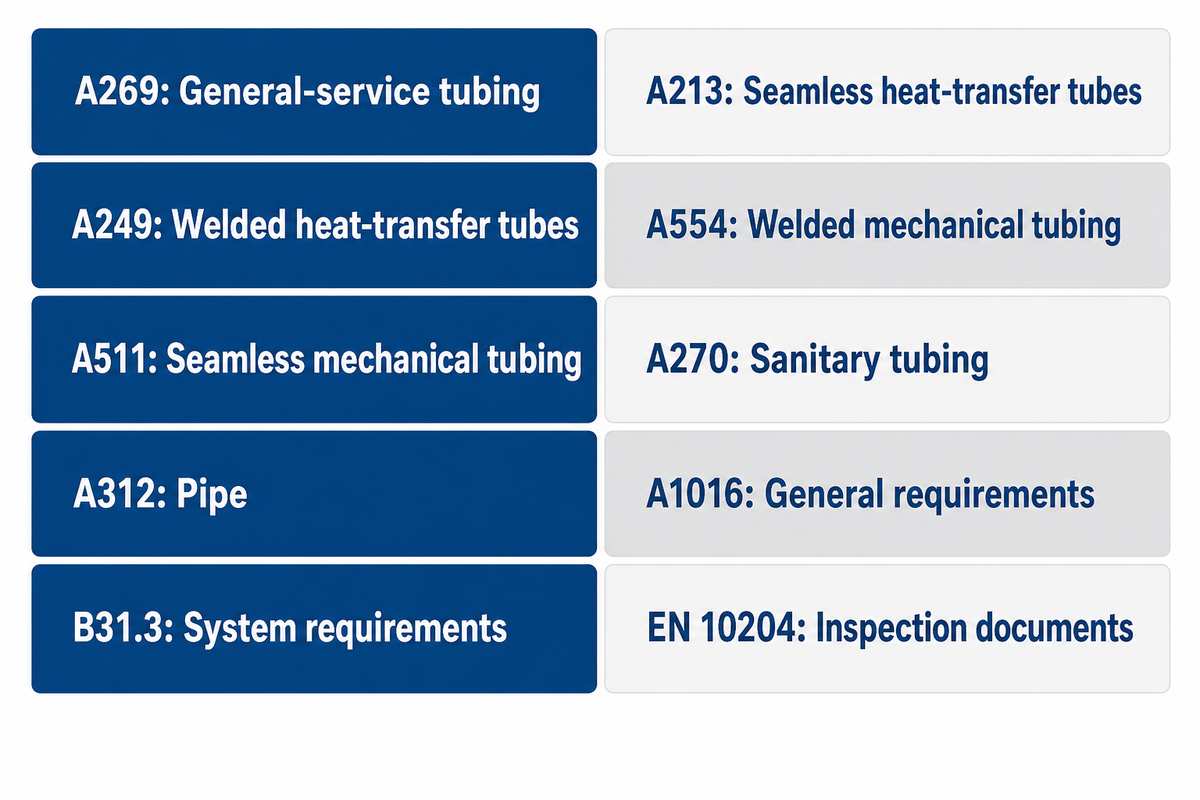
Select the product specification from the duty and product form. ASTM A269 addresses welded and seamless stainless tubing, A213 and A249 cover different heat-transfer tube routes, and A554 addresses welded stainless steel mechanical tubing. Sanitary tubing has A270 requirements. The alloy name 304 does not substitute for these product level differences.
Tubing Specification Crosscheck
A product-scope comparison connects each standard to the purchase decision it controls.
| Reference | Product or decision | Purchase consequence |
|---|---|---|
| ASTM A269/A269M-25 | Seamless and welded austenitic tubing for general service | State grade, dimensions and the nominal-wall basis. |
| ASTM A213/A213M-25 | Seamless boiler, superheater and heat-exchanger tubes | Identify minimum wall or average wall when specified in the order. |
| ASTM A249/A249M-24ae1 | Welded austenitic heat-transfer tubes | Use the heat-transfer product requirements rather than a mechanical-tube description. |
| ASTM A554-26 | Welded mechanical tubing | Specify shape and delivered condition for ornamental, structural or related mechanical work. |
| ASTM A511/A511M-25 | Seamless mechanical tubing and hollow bar | Keep mechanical-product selection separate from general-service fluid tubing. |
| ASTM A270/A270M-24 | Sanitary tubing for dairy and food industry use | Define special surface finishes; pharmaceutical quality is a supplementary request. |
| ASTM A312/A312M-25 | Austenitic stainless steel pipe | Use the pipe dimensional description required by the project. |
| ASTM A1016/A1016M-24a | General requirements for listed tube specifications | Resolve requirements together with the applicable product specification and order. |
| ASME B31.3-2024 | Process-piping system requirements | Address system design, fabrication, examination and testing alongside tube supply. |
| EN 10204:2004 | Types of inspection documents | Select documents through the order and technical delivery conditions. |
The ASTM’s A270 sanitary-tubing scope includes special surface finishes. For food processing equipment, specifying “food grade 304” does not resolve the internal finish, weld condition and acceptance for cleaning of the bore. A polished outside surface also leaves the bore condition undefined.
Is ASTM A312 a type of stainless steel?
No. ASTM A312 is a stainless steel pipe specification and not an alloy grade. A pipe order requires both the material grade and the applicable pipe requirements. A tubing order also requires a corresponding product specification. Substituting “A312” for “304” changes the type of information supplied rather than completing the description.
For a sanitary skid, the purchase objection could be that mechanically polished stock looks equivalent. Surface appearance doesn’t answer the bore finish requirement. The order should describe which surfaces get the specified finish and how that finish will be accepted.
According to ASTM’s A270 public scope, sanitary tubing extends to 12 in. [300 mm] outside diameter and has specific surface-finish provisions. That scope range is useful for product selection; the ordered size and finish still belong in the purchase description. A dairy tube and an ornamental tube need separate acceptance decisions.
304 Tubing Sizes: Outside Diameter, Wall and Tolerance
Tube size is defined by outside diameter, specified wall thickness and length, with tolerances related to the ordered product. Nominal walls, minimum walls and average walls relate to different acceptance criteria. The inside diameter is defined by the measured geometry, so a catalog wall entry shouldn’t become a guaranteed finished minimum wall.
ASTM A269/A269M-25 describes nominal wall thickness tubing. By contrast, A213/A213M-25 scope 1.3 uses minimum wall thickness, or average wall thickness when specified in the order. Therefore, a purchase order that simply states “A213 wall” may leave a drawing-specific average-wall requirement unresolved.
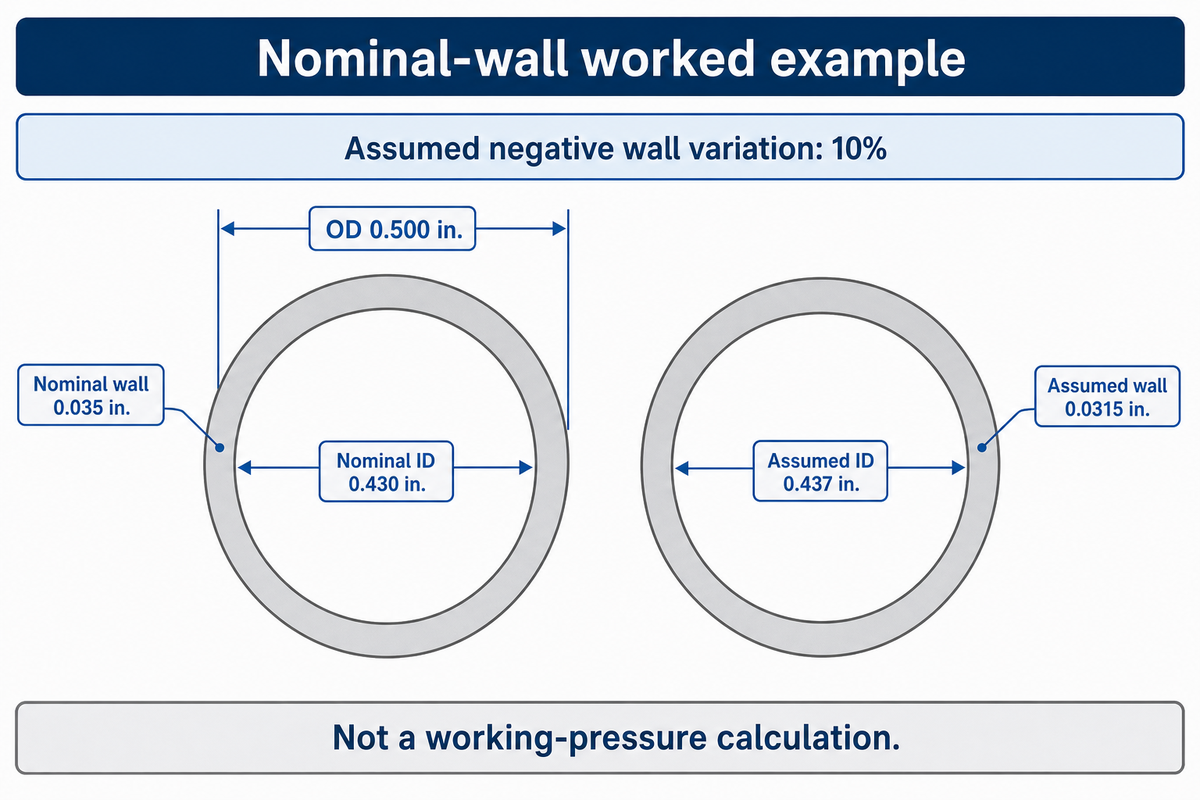
Nominal-Wall Worked Example
A stated geometry calculation separates the nominal bore from the wall that the order requires.
Example: a drawing calls for 0.500 in. OD and 0.035 in. nominal wall. The nominal inside diameter is 0.500 − (2 × 0.035) = 0.430 in. Suppose the purchasing exercise allows a 10% negative wall variation. The corresponding wall becomes 0.035 × 0.90 = 0.0315 in., and the inside diameter at unchanged OD becomes 0.437 in. The difference matters when the drawing requires at least 0.035 in. after manufacture: that nominal-wall description fails the drawing’s requirement.
The 10% allowance is an assumed input for this exercise. Use the actual tolerance and wall basis in the governing order. OD variation, ovality and thinning after a bend require their own treatment; subtracting twice a nominal wall is a geometry calculation, not a working-pressure calculation.
What are the dimensions of a 1-inch stainless pipe?
A 1-inch nominal pipe description is incomplete without its dimensional standard and schedule; it isn’t a request for 1.000 in. tube OD. For tubing with a physical 1.000 in. outside diameter, write that OD explicitly, then specify wall and tolerance. Pipe and tube fittings must be consistent with the chosen dimensional system.
Baling Steel’s pipe schedule terminology and dimensions offer a separate pipe reference. Keep the inch-pound system consistent instead of mixing rounded metric dimensions from a different standard system. A cheaper nominal-wall offer can’t meet a finished-minimum requirement by using the same grade name.
For 0.500 in. OD × 0.035 in. nominal wall, the nominal bore is 0.430 in. A purchase requirement for 0.035 in. minimum wall is a different acceptance condition. Recording the required wall basis before comparing prices prevents a dimensional shortfall from becoming a receiving dispute.
304, 304L or 316: Make the Grade Decision First
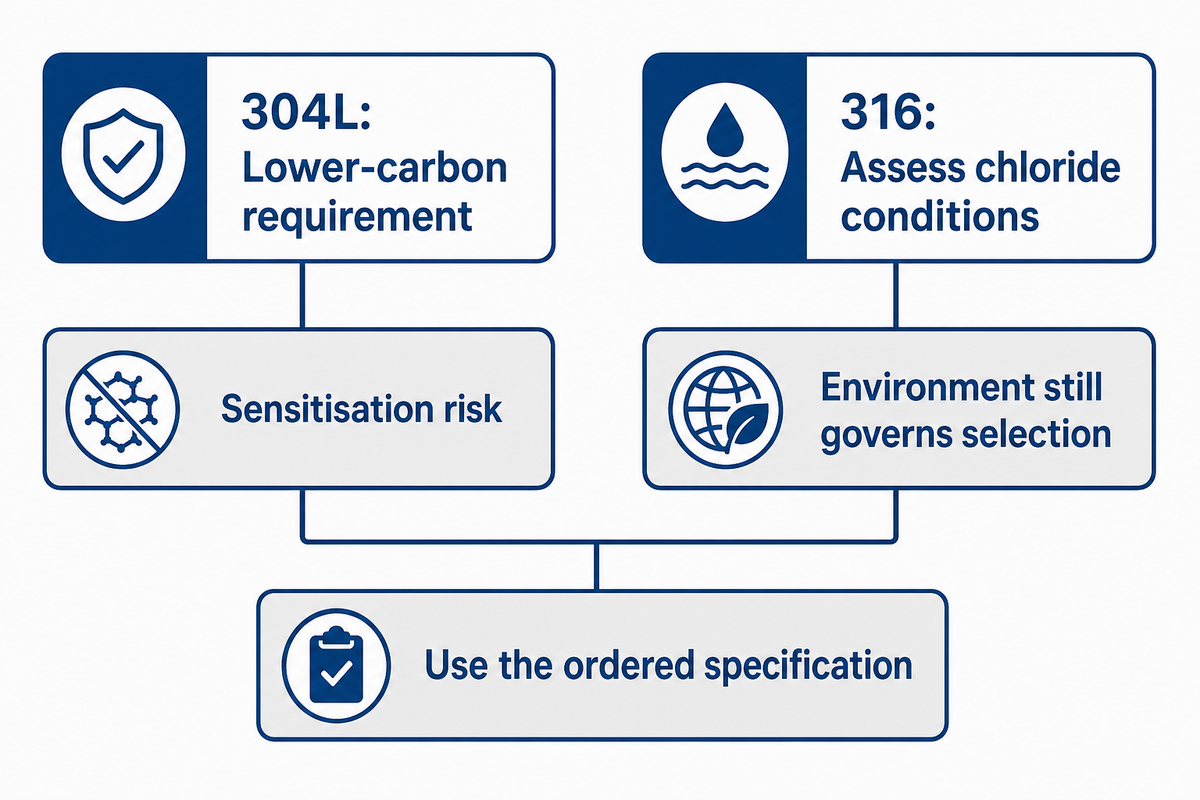
304L should be used when the lower-carbon requirement addresses the assembly’s sensitisation risk; assess 316 or another suitable alloy when the local environment requires more resistance to chloride attack. These are different risks. Neither a low-carbon suffix nor a higher grade number removes the need to assess the environment.
The British Stainless Steel Association’s 304/304L composition comparison gives AISI carbon maxima of 0.08% for 304 and 0.030% for 304L. It also identifies the European composition ranges. Use the chemistry limits belonging to the ordered specification, rather than treating every international grade cross-reference as identical.
Carbon can take part in the formation of chromium-carbides during the sensitisation thermal exposure. Less carbon lowers the risk of this occurring. Molybdenum instead helps resistance to local breakdown of the passive layer in chloride conditions, as BSSA explains in its corrosion-resistance overview. Paying for 304L doesn’t make it 316.
A welded bracket assembly exposed to mild indoor conditions and a washdown tube carrying a chloride-bearing stream do not present the same selection problem. For the assembly, consideration to weld thermal history and other specified conditions may take precedence over grade. For the second, the fluid chemistry, deposits and temperature need attention before the purchasing team decides that the lower-carbon option closes the corrosion question.
304 and 304L are to be compared against the ordered specification. The lower-carbon limit of 304L stainless steel addresses a particular metallurgical risk rather than every corrosion mechanism. Fixed 316 price premiums are a poor surrogate for current quotes. Compare the same dimensions, finish and testing scope. Baling Steel’s 316 stainless steel tubing guide covers that adjacent grade; retain the application boundaries when comparing alternatives.
Seamless or Welded: Match Route, Finish and Fabrication
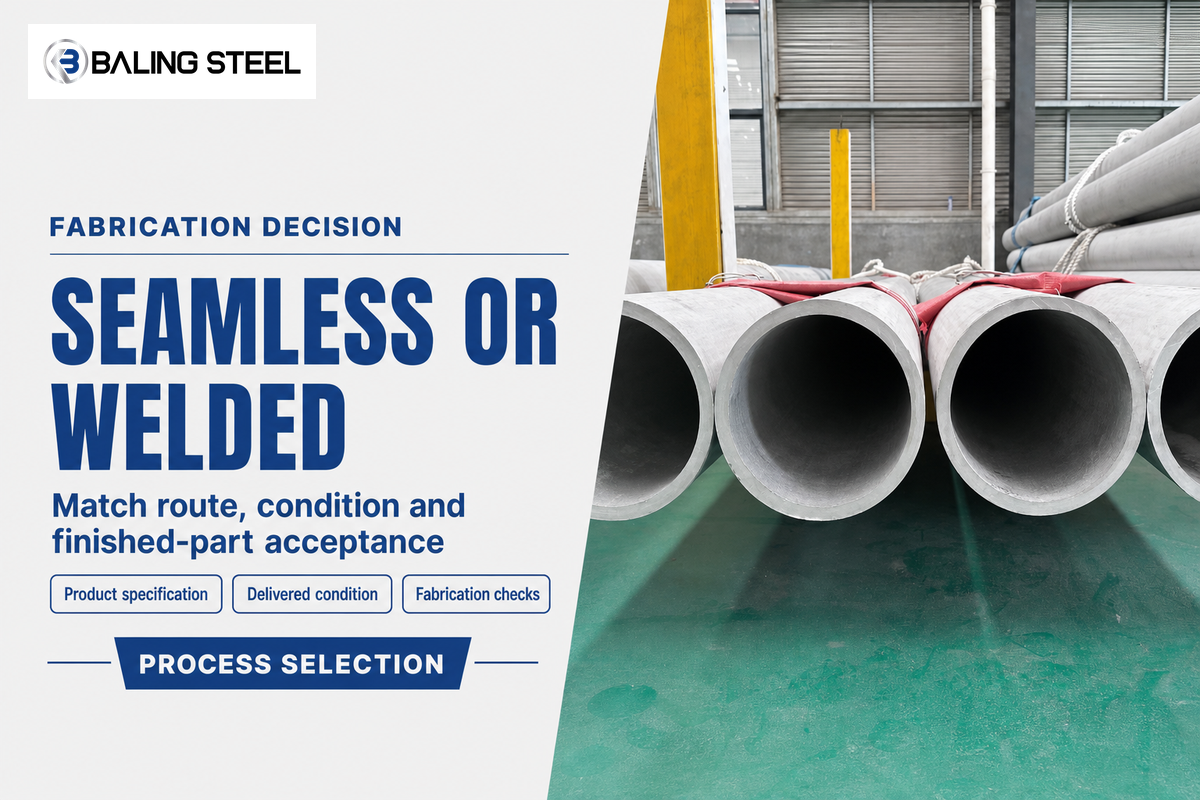
Choose welded and/or seamless tubing against the product specification and the component’s manufacturing requirements. A269 covers both routes, while other standards define different product families. Delivered condition, wall consistency, finish and fabrication acceptance deserve separate entries in the order. Absence of a seam doesn’t make a tube immune to corrosion.
For ornamental construction, ASTM A554-26 covers round, square, rectangular, and special shapes, with several supply conditions. An annealed stainless steel tube and a cold-reduced product can behave differently during forming. “Weldable” also leaves the welding procedure, joint preparation and postweld condition to be specified.
Can you bend 304 stainless steel pipe?
Yes. 304 can be bent with a process matched to its dimensions and condition. Tight radii and thin walls make tooling support, lubrication and repeatability more critical. Define the finished bend’s wall, ovality and surface acceptance on the drawing instead of selecting a universal minimum bend radius from the alloy name.
In a Discussion on Eng-Tips on a 304 exhaust manifold a 38.1 mm OD with a 1.2 mm wall and 47.63 mm centerline radius had already been prototyped, and the issue was repeatable production. A prototype answers a different question from an acceptable production process. The anecdote supports a trial-and-inspection plan, not a recommended bend limit.
Chris Fletcher of Tower Metalworking Fluids explains how the OD/wall ratio and centreline-radius/OD ratio affect bending severity in The Tube and Pipe Journal. His examples of lubrication are application-specific. The downstream effect is practical.
“Lubricant removal might be necessary”
Residue left behind before welding can affect welding. A premium tube price doesn’t eliminate the need for a compatible cleaning. Bend-consistency guidance of Jay Robinson also states that the loading position and orientation of seam and tooling settings are repeatability checks.
A 38.1 mm OD × 1.2 mm wall prototype bent to a 47.63 mm centreline radius is a specific fabrication case. Production acceptance still needs a finished-wall and ovality requirement. Tooling trials should use the intended delivered condition and downstream cleaning sequence, rather than relying on the alloy designation alone.
Corrosion and Pressure Limits: Where 304 Stops Being a Shortcut

304 tubing requires an environment-specific corrosion assessment and a separate pressure-design basis. Chlorides, crevices and deposits along with the condition of fabrication can impact the local corrosion resistance. Working pressure is also dependent on the dimensions, material condition, temperature and governing system requirements. No single pressure number applies to every product sold as 304 tubing.
What are the downsides of 304 stainless steel?
304 is subject to local corrosion in unsuitable chloride-bearing environments, and may require special control of fabrication and cleaning. As a buying description, it’s incomplete without dimensions and a product standard. A durable indoor handrail and a hot process line face different limitations, even if both are of stainless steel 304.
BSSA’s seawater selection guidance states that 304 isn’t suitable for use with seawater. Crevice corrosion and pitting corrosion are limitations for 316 as well. Moving to 316 is therefore an alloy-selection step, not permission to ignore stagnant liquid, crevice geometry or deposits.
Weld heat tint is another local condition. In The Welder, Martin Denault and Robert Koltz of ESAB, write that thick oxide (weld) differs from the protective passive film. Chromium depletion beneath it can leave the surface susceptible to local attack. Specify weld protection and postweld finishing through the fabrication procedure rather than accepting blue or purple colour as proof of weld quality.
Consider external surfaces as well. The NRC’s NUREG/CR-7030 research on dry-cask test specimens identifies deposited salt, residual stress, temperature and humidity as interacting factors in atmospheric stress corrosion cracking. Regarding tubing, include external salt accumulation and cyclic exposure to wet and dry conditions in the service review; the onset times of the phenomena reported in the cask study don’t predict tube-life.
ASME B31.3 addresses process-piping design through fabrication, inspection and testing. A269 also notes that B31.3 applications can require additional testing. For instrumentation, match tube dimensions and delivered condition to the selected fitting system’s requirements. Copper connections and other dissimilar-metal interfaces need a system-level compatibility assessment; a blanket rule based only on the presence of copper misses the environment and joint design.
A working pressure can’t be assigned to a 0.500 in. OD tube solely on the basis of diameter. Wall basis, material condition and design temperature are part of the assessment, as are the requirements of the governing code, corrosion and post-bend wall loss. Only then can a nominal straight tube dimension be used as an input to a system design.
How to Compare a 20-Foot Tube Quote
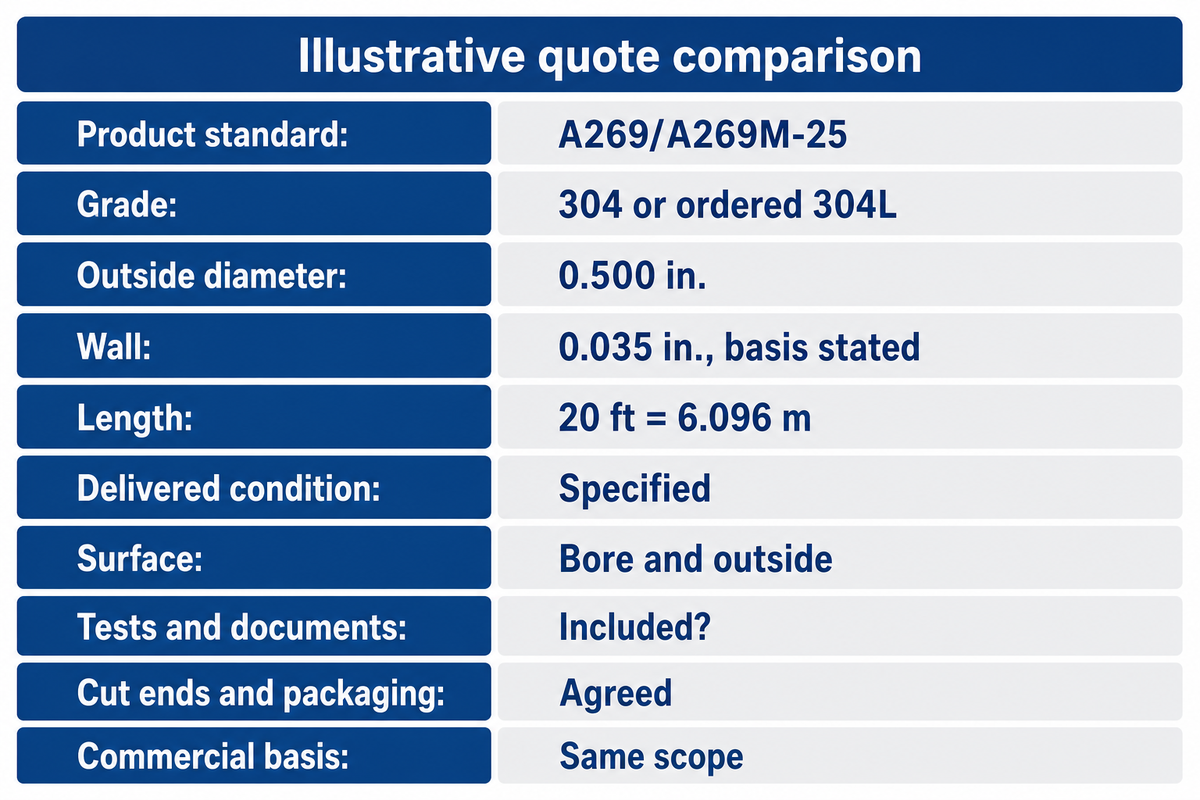
A 20-foot long tube quote with the same specification, grade, size, conditions, and extent of inspection should be compared. 20 feet is approximately 6.096 meters. Twenty feet equals 6.096 m, so a 6 m length is a different supply quantity. Separate the material price from the cost of cutting, documentation, packaging and freight to evaluate the delivered cost of usable parts.
Quote Comparison Sheet
A common purchase description reveals price differences without hiding supply differences.
| Comparison field | Entry for the example enquiry | Difference to resolve |
|---|---|---|
| Product standard | ASTM A269/A269M-25 | Mechanical or sanitary product substituted? |
| Grade | 304 or explicitly ordered 304L | Same grade and certification basis? |
| Outside diameter | 0.500 in. | Actual OD or nominal pipe label? |
| Wall | 0.035 in., required basis stated | Nominal, minimum or average? |
| Length | 20 ft = 6.096 m | 6 m stock offered instead? |
| Delivered condition | Specified heat-treated condition | Equivalent manufacturing condition? |
| Surface | Bore and outside requirements listed | Polish applied to which surface? |
| Testing and documents | Product tests plus ordered records | Included in the base price? |
| Cut ends and packaging | Drawing’s end condition and protection | Cutting or packing charged separately? |
| Commercial basis | Quantity, delivery point, freight, validity | Same delivered quantity and responsibility? |
Example: a fabrication buyer compares 20 ft bars with 6 m stock for a batch of cut parts. Each 6 m bar is short by 0.096 m. Across 100 bars, purchased length would vary by 9.6 m before cutting losses. How that impacts the number of usable parts depends on the cut layout and saw kerf. The buyer needs to compare the nest against each quoted length and include end trimming and rejected ends. They may also need to consider the delivery charges to calculate the cost of usable parts. The price per bar may affect the total cost of the accepted component (cost).
The A1016 general-requirements hierarchy gives precedence to the product specification over general requirements, and to a conflicting, more stringent purchase-order requirement. Therefore, written requirements should be in the quotation package before a supplier prices the job.
Baling Steel offers 304, 304L, 316 and 316L grade options and cutting, packaging and welding services through its seamless stainless steel pipe supply range. Send your tube specification and drawing along with your inquiry to ensure the offer identifies the required product form.
A 20 ft bar contains 6.096 m of length; a 6 m bar is shorter by 96 mm. For 100 bars, that difference totals 9.6 m before kerf and trimming. Comparing usable cut parts against the same drawing gives procurement and finance a more useful basis than comparing the price per bar.
Inspection: Connect the Tube to Its Test Report
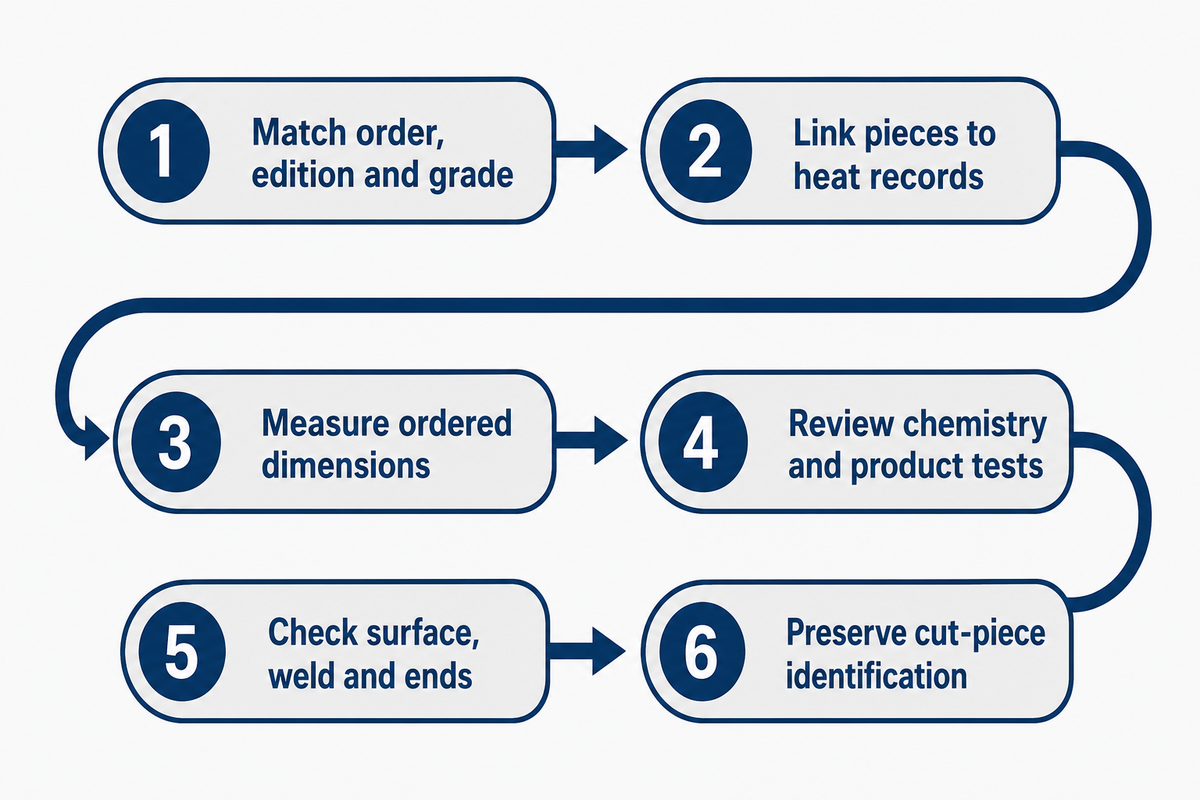
Accept tubing through linked checks of identity, dimensions, condition and required test results. A heat number relates to records of material; product testing addresses acceptance requirements. Maintain those checks separate. The types of documents and additional examinations should be in conformity with the purchase order, product specification and project needs.
Heat-to-Piece Acceptance Trail
An ordered tube is linked by a receiving sequence to records and pertinent physical checks.
- Match the order’s product specification, edition and grade to the supplied description.
- Connect the delivered pieces or bundle identity to the heat and manufacturing records.
- Measure the drawing’s OD, wall, length and other acceptance dimensions.
- Review the required chemistry and product-test results for the supplied material.
- Check the specified surface, weld and end condition.
- Preserve identification through cutting, storage and fabrication using the agreed marking or record method.
A269’s public abstract requires each tube to receive a nondestructive electric test or hydrostatic test. A heat-level chemistry entry and an integrity test answer differing questions. For a component that’s to be bent, the receiving plan should also differentiate straight-tube acceptance from the finished component’s dimensional acceptance. Receiving tests and maintenance inspections in service accomplish different purposes.
NEN’s EN 10204 scope connects the types of inspection documents to the order and product technical delivery conditions. Use a 3.1 document when the purchase or project condition requires it; don’t implement the document type as a universal rule for all commercial tube orders.
Example: A shop cuts a 6.096 m bar into shorter components for two assemblies. The original bundle tag remains with the offcuts, and unmarked pieces go to the welding area. A cut list showing piece identification and linkage to the heat record retains the agreed trail. Receiving dimensions and required test records still require checks. The UK HSE’s inspection guidance explains that a test method’s capability depends on the defects being sought and how the method is applied. A traceable “pass” result should be read with its method and coverage.
For a 6.096 m bar cut into several parts, identification must follow the pieces under the agreed quality plan. Heat chemistry, tube-integrity testing and finished-part dimensions are acceptance checks. Retaining their links prevents a complete-looking document pack from obscuring a missing measurement or an unsuitable inspection method.
Industry Outlook: Specify More Than the Alloy Name
When considering a new tubing programme, control standard editions and quotations for validity before accepting a supply assumption. Product requirements, scope of delivery, and usable dimensions influence the purchase directly. Large stainless production figures may give a general market view; however, an agreement on commercial and technical terms for a grade tube order is necessary to finalize the arrangement.
October 2026 checks on ASTM showed Active Tubular-products included A269/A269M-25, A213/A213M-25 and A554-26. An older edition catalog may cause a contract conflict. State the required edition and resolve supplier deviations prior to release. Proposed revisions are future activities of standards, not requirements incorporated in the order.
worldstainless reported 2025 stainless melt-shop production of 64.2 million tonnes, up 2.1% from 2024. That aggregate covers stainless production across grades and product routes. It shouldn’t be used to infer a specific 304 tubing price, local stock position or delivery lead time.
A prudent procurement plan separates the release from the commercial validity period. Freeze drawing revisions and acceptance at the enquiry stage, retain the quoted validity date, and compare revised offers against the same product description. This preserves a meaningful cost comparison when the order progresses from the engineering to the purchasing function. A mill substitution or changed finish should be assessed as a technical change rather than accepted as a price update.
For the next enquiry, ask for the applicable specification and edition, 304/304L grade basis, actual OD and wall basis, cut lengths and tolerances, delivered condition, surface requirements, test records, quantity and delivery point. State which items are included in the quoted price and how cut-piece identity is retained. This is the opportunity to settle purchasing queries.
Baling Steel’s company and supply background provides context for the enquiry. Complete the comparison sheet to provide the supplier with a clear technical scope, and obtain a like-for-like offer.
Frequently Asked Questions
Is 304 stainless steel the best?
Read the answer
304 is a useful general-purpose choice when its corrosion resistance and product condition suit the application. It is not the best grade for every environment. Chloride exposure, welding history and required mechanical performance can change the selection. Choose the product specification and service conditions before comparing alloy prices or availability.
Is 304 stainless steel safe to drink from?
Read the answer
304 can be used in drinking-water equipment, but the grade alone does not establish approval for a finished product. Drinking-water use requires the applicable local material and product requirements, suitable fabrication and cleaning, and compatible water conditions. Select tubing and assembled components for that defined use rather than assuming approval.
What is food grade 304 stainless steel?
Read the answer
Food grade 304 describes an intended use, rather than a complete tubing specification. Food-contact equipment also needs appropriate surface condition, weld quality and cleaning provisions. ASTM A270 addresses sanitary tubing for dairy and food applications with special finishes. The purchase description should state those requirements instead of relying on shorthand.
What is 304 stainless steel pipe used for?
Read the answer
304 pipe is used in suitably specified fluid systems and industrial equipment. Mechanical or ornamental fabrication can require a different tubular product. Match the material standard and dimensions to the component’s service and drawing.
Is 304 tubing magnetic after fabrication?
Read the answer
304 tubing can develop a magnetic response after cold working. BSSA explains that deformation can transform some austenite into ferromagnetic martensite, particularly in worked regions. Magnetic response is one characteristic of the delivered condition; a magnet’s pull is an unreliable standalone grade-acceptance check. Use the ordered material identity and appropriate inspection plan. Applications specifying low magnetic permeability need that requirement addressed alongside chemistry and fabrication history. Record the permeability requirement separately on the drawing or purchase description so a receiving check answers the intended application question rather than relying on a hand-held magnet.
Does ASTM A269 tubing have one pressure rating?
Read the answer
No. A269 is a tubing product specification. Working pressure requires the governing design basis, including dimensions, wall allowance, material condition and temperature. A completed product test is separate from the installed system’s design rating.
What does dual-certified 304/304L tubing mean?
Read the answer
Dual-certified tubing is supplied as meeting both grade designations under the stated product specification. BSSA describes dual certification as possible when the finished product satisfies the relevant requirements, including the low-carbon composition. The material report should identify both grades and the applicable specification. Treat the dual designation as a defined conformity claim, rather than assuming that any tube labelled 304 automatically meets 304L or that chemistry alone resolves every product requirement. When the order specifies 304L, the report and delivered identification should retain that connection through receiving and subsequent fabrication under the agreed quality plan.
Where can I buy 304 stainless steel tubing?
Read the answer
Buy from a tubing supplier that quotes the required product standard, dimensions, condition and inspection records together. Baling Steel accepts stainless tubular-product enquiries with drawings and grade requirements. A complete request helps compare the offered product form, cut lengths, finishing services and delivery scope before the purchase order is released.
Technical basis: This guide merges public standard scopes and attributed technical advice with illustrative purchasing examples. Final design and acceptance rely on the project’s regulating requirements and ordered product conditions.
References & Sources
- ASTM A01.10: active tubular-product specifications.
- ASTM A269/A269M-25: general-service tubing; A213/A213M-25: seamless heat-transfer tubing; A554-26: welded mechanical tubing.
- ASTM A270/A270M-24: sanitary tubing; A1016/A1016M-24a: general tube requirements.
- ASME B31.3-2024: process piping; NEN-EN 10204:2004: inspection-document scope.
- BSSA: standard and low-carbon grades; seawater selection; cold work and magnetic response.
- Chris Fletcher: bending lubrication; Jay Robinson: bend consistency; Martin Denault and Robert Koltz: weld discoloration.
- NRC NUREG/CR-7030: atmospheric stress corrosion research; HSE: inspection and nondestructive-testing capabilities.
- worldstainless: 2025 melt-shop production.