Quick reference
- Document standard: EN 10204:2004, listed as current by BSI and NEN.
- 3.1: specific inspection, validated by the manufacturer’s authorized representative independent of production.
- 3.2: specific inspection with additional purchaser-authorized or officially designated validation.
- Ordering priority: product specification, certificate type, accepted validator and inspection plan.
EN 10204 is the European standard for types of inspection documents accompanying a material supply. A certificate request can transform into a delivery problem when “3.2 required” first appears after pipe has been bought. The EN 10204 3.1 vs 3.2 certificate decision belongs in the order, alongside the grade and inspection requirements. The distinction starts with who validates the results; acceptance also requires a defensible relationship between the results and the material delivered.
EN 10204 3.1 vs 3.2 certificate selection concerns validation: both report specific inspection, while 3.2 adds purchaser-authorized or officially designated validation. Specify the required document and inspection scope before ordering.
- A higher document number doesn’t create a better steel grade.
- Stock assessment to the intent of 3.2 needs an accepted route; a stamp alone is insufficient.
- EU pressure-equipment material rules and particular material appraisal are separate issues.
- Receipt checks must cover required tests and results, as well as the heat number.
What Is the Difference Between EN 10204 3.1 and 3.2?
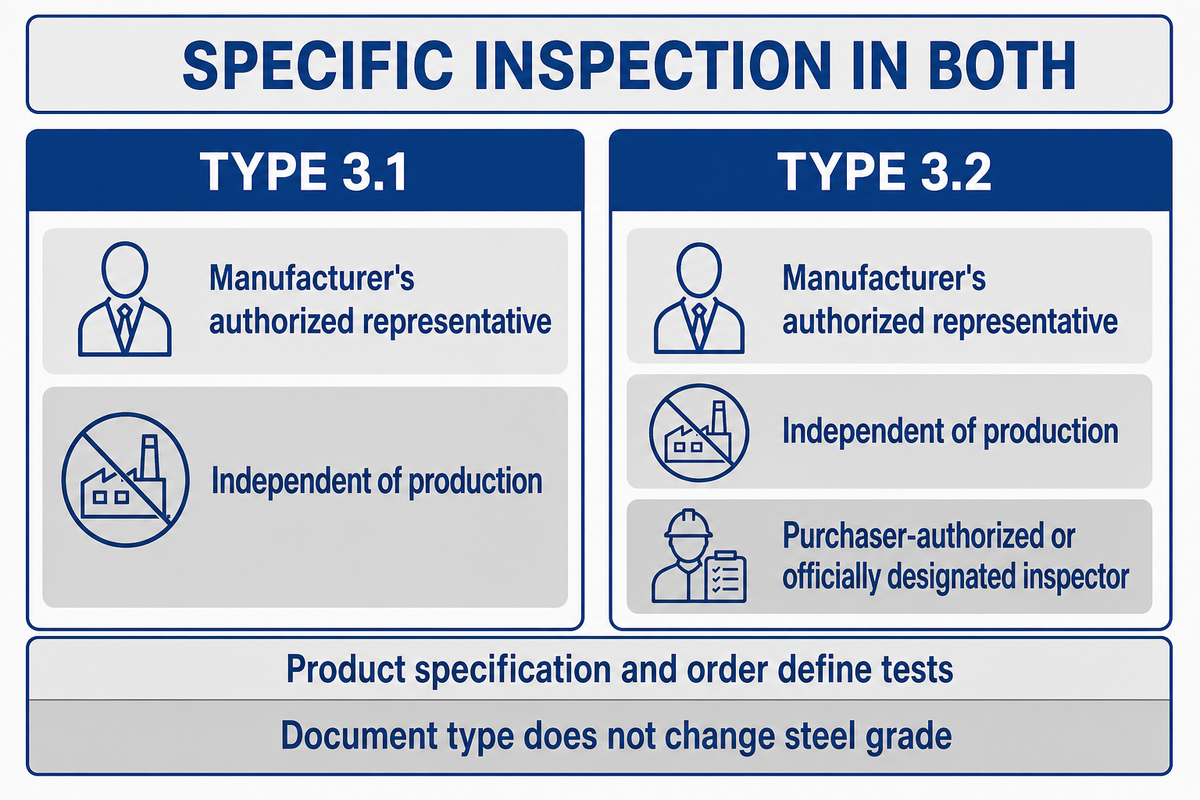
EN 10204 3.1 and 3.2 are inspection documents that include results of a specific inspection. Type 3.1 employs the manufacturer’s authorized inspection representative, independent of the manufacturing department. Type 3.2 incorporates the purchaser’s authorized representative or the inspector designated by official regulations. The additional validation alters responsibility and involvement, as opposed to the ordered steel grade.
The British Stainless Steel Association’s certificate table explains the roles. Specific inspection relates to the products supplied, or the test unit containing them. A test unit can cover more than one piece under the applicable product specification. Neither document label creates a universal requirement to test each individual pipe.
| Acceptance question | Type 3.1 | Type 3.2 |
|---|---|---|
| Inspection basis | Specific inspection | Specific inspection |
| Compliance statement | Requirements of the order | Requirements of the order |
| Manufacturer validation | Authorized inspection representative | Authorized inspection representative |
| Independence from production | Required for manufacturer’s representative | Required for manufacturer’s representative |
| Additional validating party | Outside validation is not inherent in this type | Purchaser-authorized or officially designated inspector |
| Required test program | Product specification and order | Product specification, order and agreed inspection plan |
| Witnessing arrangements | As applicable to the purchase | Defined with the accepted inspecting party |
| Heat/test-unit linkage | Needed for meaningful receipt review | Needed alongside additional validation |
| Effect on material grade | Does not change the grade | Does not change the grade |
Comparison basis: published interpretation of BSSA and the IOGP Report 571 on purchasing steel material and equipment. Inspection-plan details must be in alignment with the purchase.
Does a 3.2 certificate mean better steel?
No. A Type 3.2 certificate adds an accepted independent validation role; chemical composition, mechanical properties and applicable acceptance limits come from the material specification and order. For a buyer with greater concerns, the more important change is a defined verification scope. Paying for an additional signature without resolving that scope still leaves the same engineering concerns.
What Is a 3.1 Certificate in EN 10204?
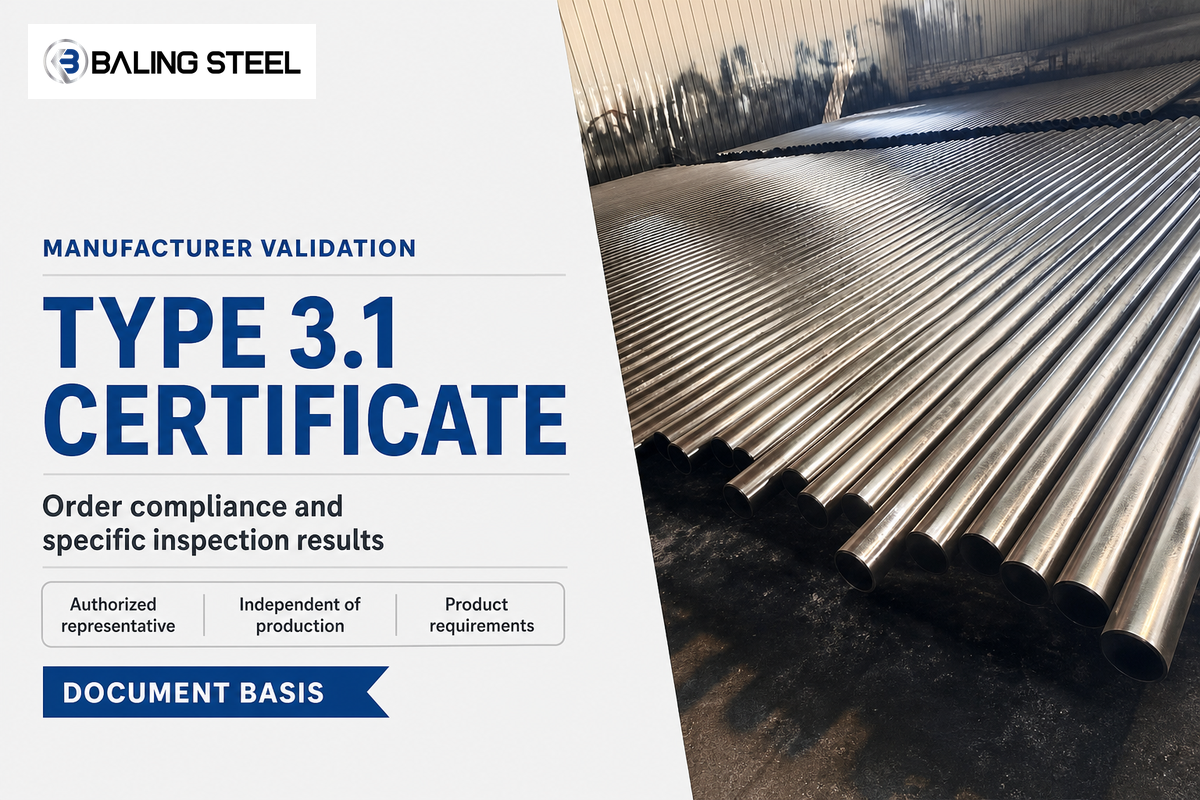
A Type 3.1 inspection certificate is a document issued by the manufacturer that declares compliance with the requirements of the order and provides specific-inspection results. The authorized inspection representative validates it independently of the manufacturing department. Thus, EN 10204 3.1 concerns a defined document and inspection basis rather than a general quality endorsement.
The declaration states that the products supplied are in compliance with the order. Results may include chemical composition and mechanical testing for the item in question. For an order covering pipe, plate or forgings, the applicable technical delivery conditions determine what results belong in the package. NEN’s current EN 10204 scope explicitly links inspection documents with product specifications.
What does independent of the manufacturing department mean?
An authorized inspection representative independent of production can work for the same manufacturer. Employment by that company doesn’t itself rule out Type 3.1. An outside inspection company is a different situation. Procurement should distinguish the person authorized to validate a certificate from the operator who made the product and the technician who performed the test.
For a purchase already specifying 3.1, a request for 3.2 is a change of inspection arrangements, not a typographical correction. Settle on that change before scheduling manufacture or releasing stock.
Who Validates a 3.2 Inspection Certificate?
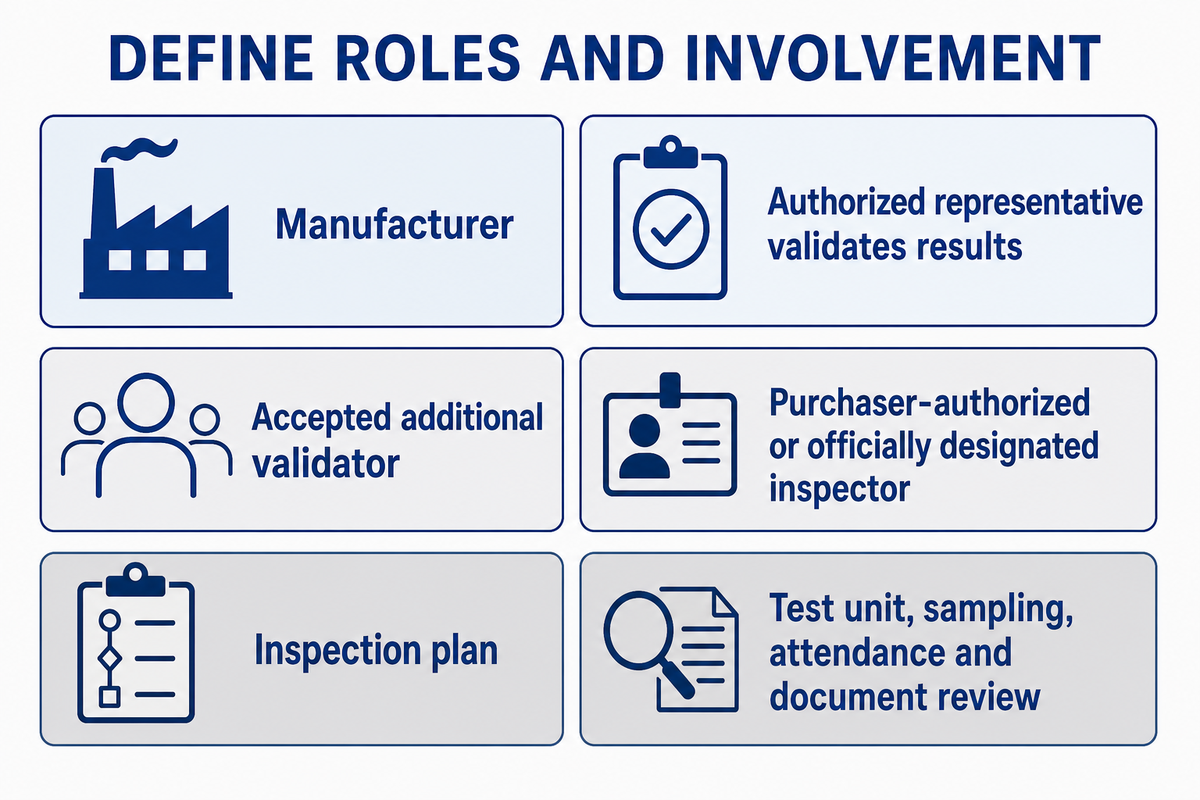
A 3.2 certificate requires the authorized inspection representative of the manufacturer together with the purchaser’s authorized inspection representative or the inspector designated by the official regulations. The accepted party’s defined role in the order is important. The results are validated through the agreed arrangement. A laboratory’s test report or a third-party inspector’s name alone doesn’t establish that arrangement.
The inspection and test plan is mutually agreed between the inspector, manufacturer and purchaser. That plan shows access, sampling and witnessing and other records relating to the product supplied. An independent third party can perform the agreed work, but the intended recipient must accept its authority and the resulting documentation. Independent verification is of great help in answering the purchase requirements.
Must the external inspector witness every test?
The external inspector must perform the involvement required by the applicable inspection arrangement; there is no useful substitute in the phrase “witness everything.” Define the test unit, sampling, required attendance and document review in the inspection plan. Omitting an agreed witness point can require a modified acceptance route, even if the basic test results are OK.
A published ABS service description illustrates the difference: the example includes traceability checks, attendance at additional metallurgical tests, and review of documentation. These are all activities included in inspection. A purchaser comparing 3.2 certification offers should compare these activities and the stated deliverable, rather than the agency name alone.
Which Certificate Type Does Your Project Require?
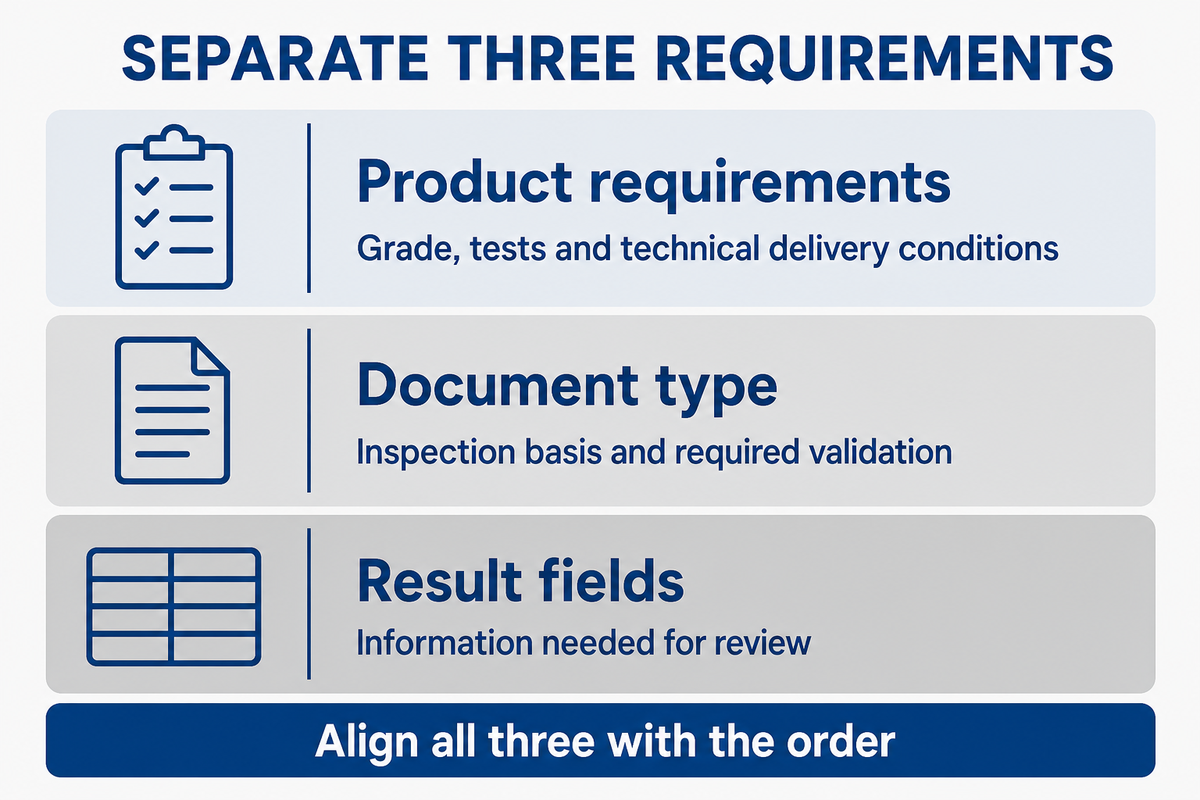
Use the certificate type required by the order and applicable product, project or regulatory rules. Where 3.1 is specified and acceptable, order 3.1. Where 3.2 is required, name the accepted validation arrangement before manufacturing. For critical applications, documentation should occur in the engineering review prior to order release; the document number shouldn’t be a substitute for that review.
Keep three layers separate: product requirements set grade and tests; document type sets the inspection-document basis and validation; result fields record the information needed for review. For steel, SIS describes EN 10168 as the list and description of inspection-document information. A complete-looking form still needs the results required by the order.
- Fits orders accepting manufacturer-validated specific inspection.
- Avoids adding an outside validation scope unnecessarily.
- Does not meet an order that specifically requires 3.2.
- Adds the accepted outside validation role.
- Supports an agreed inspection and witnessing scope.
- Needs advance access, scheduling and document coordination.
Does PED automatically require 3.2?
No. The EU Pressure Equipment Directive’s Annex I 4.3 requires a certificate of specific product control for main pressure-bearing parts of categories II, III and IV equipment. It also considers a material manufacturer’s appropriately certified quality-assurance system. That wording has to be read in conjunction with the applicable material route and equipment requirements; it isn’t a general case instruction that all items in categories III/IV require 3.2.
Annex I 4.2(c) and 4.3 of Directive 2014/68/EU address different concerns. Particular material appraisal under 4.2(c) is different from the document requirements of a material maker and quality-assurance provisions of 4.3. The document request should be related to the equipment’s applicable conformity route.
Different components can also have different purchase requirements. An Oak Ridge National Laboratory pipe-support procurement specification, for example, distinguishes Type 3.1 structural-steel documents from Type 2.1 documents for commercial support components. That’s a particular purchasing example, not a universal rule for pressure pipe.
Can Stock Material Move From 3.1 to 3.2?
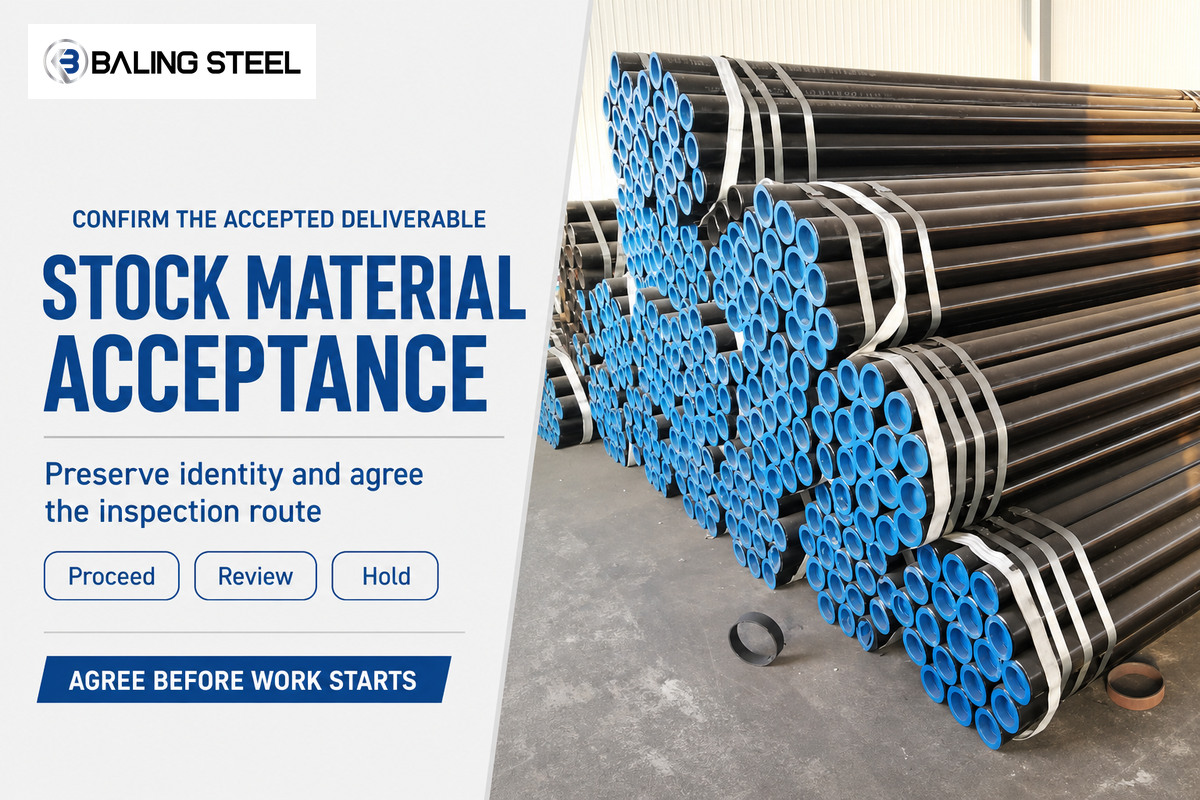
Stock material may be subject to an additional assessment route, but an original manufacturer Type 3.2 certificate and a report meeting the intent of 3.2 are two different things. The route must retain material identity, make the original records available, allow suitable inspection access, and employ an acceptable plan for testing. Purchaser acceptance must be settled before paying for retrospective work.
David Thompson of LRQA calls out property-changing processing as something different than simple stock resale or cutting in an article he authored. LRQA indicates the intent of type 3.2 for the simple stock resale or cutting case and notes some end users reject it. IOGP separates manufacturer certification from the intent of certification report as well. The difference should be part of the quote and purchase order.
“The acceptability of meeting the intent of type 3.2 should be confirmed with the purchaser before work starts.”
What if the material has already left the mill?
Start with the original material identity and the exact document the purchaser will accept. The Stock-Lot Acceptance Route has three distinct outcomes: (i) proceed under an already accepted original document; (ii) review a defined additional assessment; or (iii) hold the material whose identity, properties or required inspection history can’t be adequately established. The commercial objection “the stock is ready now” requires an acceptance route; an unsupported certification promise isn’t sufficient.
- Establish the original record. Link stock markings and test-unit references to manufacturer documents.
- Agree the accepted deliverable. Separate original Type 3.2 from intent-of-3.2 assessment in writing.
- Plan the additional inspection. Identify access, sampling, tests and witnessing before cutting or dispatch.
- Release against the agreed route. Close missing evidence or hold the material for the purchaser’s disposition.
LRQA rejects paperwork-only review as a substitute for determining the traceability and properties of the material. It also explains that adding “EN 10204 3.2” to a test-house report doesn’t convert the report to the required certificate.
How Do You Check the Certificate Against Delivered Pipe?
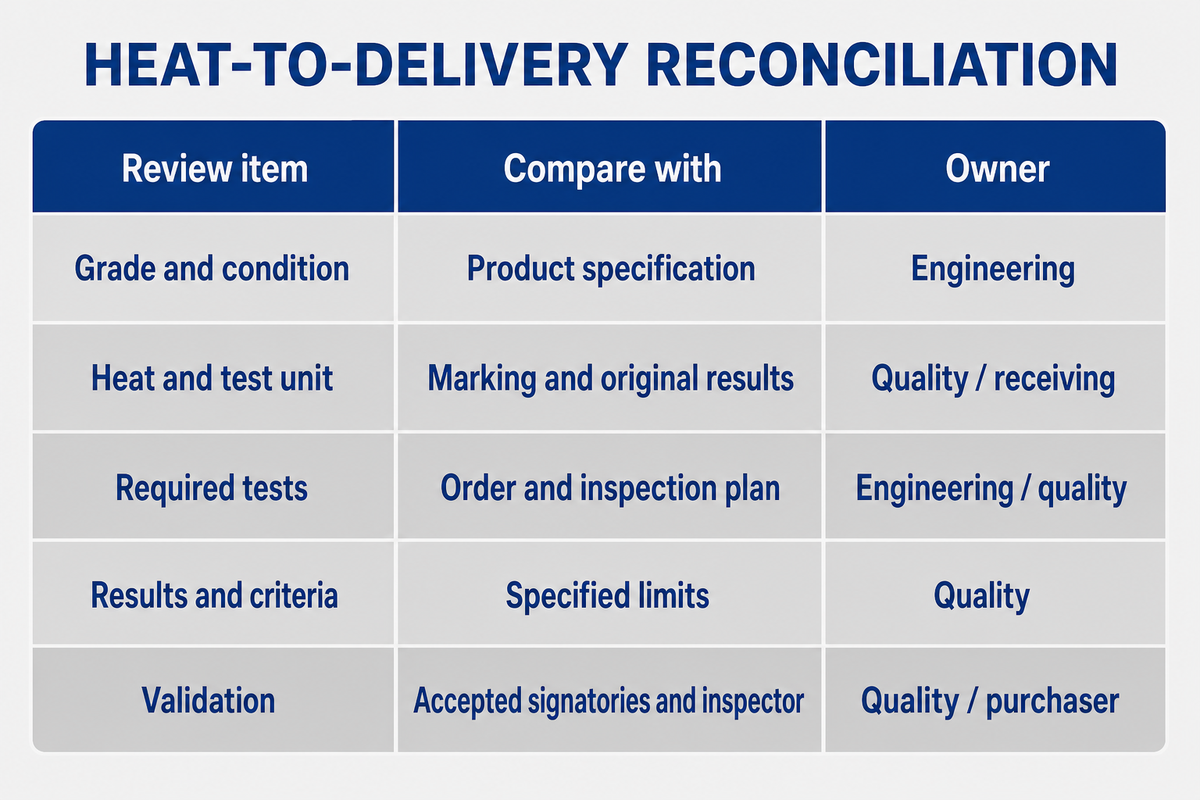
Match the order’s product specification and required tests to the certificate, and then correlate the heat or test-unit identifiers of the delivered material to the distribution records. A matching heat number is one verification. Results of the acceptance tests, acceptance limits and the manufacturing condition and authorized validation must also cover the product being accepted.
For A106 Grade B pipe, keep the product specification separate from the EN 10204 document type. Use the Heat-to-Delivery Reconciliation Sheet to assign each mismatch to a decision owner. IOGP’s inspection guidance and NEN’s product-specification link support this approach.
| Review item | Compare with | Disposition owner |
|---|---|---|
| Order and specification edition | Purchase order, item description and approved deviations | Engineering / purchasing |
| Manufacturer identity | Original certificate issuer and supply-chain records | Quality |
| Grade and manufacturing condition | Product specification and ordered delivery condition | Engineering |
| Heat and test-unit references | Material marking, original results and lot allocation | Quality / receiving |
| Required tests | Order, product standard and inspection plan | Engineering / quality |
| Results and acceptance criteria | Specified limits and approved testing scope | Quality |
| Dimensions and quantity | Packing list, item identification and receipt measurements | Receiving / purchasing |
| Validation and appointment | Required certificate type, authorized signatories and accepted inspector | Quality / purchaser |
| Stockist or cut-piece linkage | Unaltered original documents, transfer records and piece identification | Stockist / receiving |
Example: an order contains twelve 6 m lengths, six from heat A and six from heat B, for 72 m total. Cutting every length into two 3 m pieces produces twenty-four pieces. The packing and transfer records must preserve which pieces came from each heat. An unchanged total length can’t resolve a lost heat allocation or a missing required test.
What does a mill test report prove?
A mill test report demonstrates the stated results and material identification on its declared inspection basis. Acceptance of the receipt, however, requires the actual material, ordered tests and a valid signing arrangement to align. A label of MTR or MTC alone can’t define which EN 10204 type was supplied, and a tensile test result can’t substitute for a different required test.
Integrate the certificate review with the receiving-release procedure. Carry the ordered dimensional tolerances and test acceptance limits into the review sheet in their specified units. EN 10204 selects the document basis; the applicable pipe specification supplies those technical limits. Record the requirement beside its result so that a missing value is visible before release.
A current enforcement example makes the receipt issue concrete. In July 2026, the UK Office for Product Safety and Standards published a recall notice for named Sempell valve fasteners after test results showed incorrect plating. The notice cites EN 10204-3.1/3.2 noncompliance. The case involving these fasteners is for Great Britain; the lesson, however, is to reconcile documented requirements with the product supplied.
How Should Buyers Compare Cost and Lead Time?
Compare quotations against the same accepted inspection scope rather than a standard 3.2 surcharge. Separate inspector attendance, travel, laboratory work and sample preparation, additional testing and document review. Release timing also includes access to original records and agreed witness points. A low inspection fee can leave a material identification problem unresolved.
IOGP Report 571 states that there needs to be a better understanding of potentially longer lead times. The historical Eskom material-specification guideline addresses stronger certification costs and reviews before delivery. Therefore, it would be prudent to normalize the scope rather than assign a rigid number of days to all orders.
Which inspection requirements belong in the request for quotation?
The quotation requires certificate type, the accepted inspecting party, the required tests, hold or witness points and the document review deadline. Engineering defines the acceptance limits. Quality defines the verification plan. Purchasing compares the scope and release commitments. As a result, Finance can compare a defined cost rather than fund repeated work caused by an incomplete request.
Inspection Scheduling Bottleneck Map: missing manufacturer records block traceability review; an unagreed inspector blocks appointment; inaccessible samples block testing; a missed witness point blocks the agreed inspection sequence; unresolved result fields block final review. Each quotation should identify who clears its applicable bottleneck and when that work enters the schedule.
How Do EN 10204 Certificate Types 2.1, 2.2, 3.1 and 3.2 Fit Together?
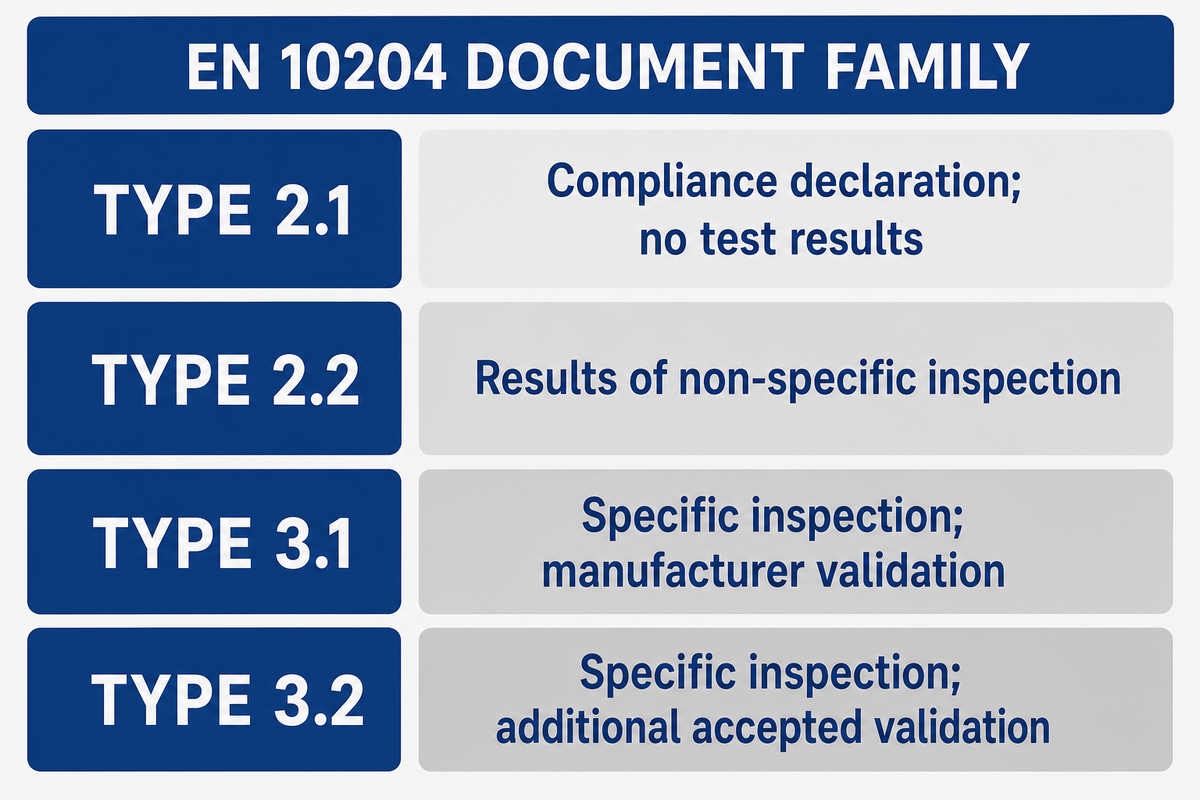
The EN 10204 certificate types distinguish declarations, non-specific test reports, and specific inspection certificates. The different types of inspection documents form the EN 10204 system, with distinct contents and validation mechanisms. Type 2.1 is a compliance declaration without test results; 2.2 includes the results of non-specific inspection. Types 3.1 and 3.2 use specific inspection and have different validation mechanisms. Select the document required for the component, instead of viewing different types as material grades.
BSSA’s document-family table also identifies older 3.1B terminology as replaced by Type 3.1. A legacy drawing using 3.1B needs interpretation against the current purchase requirements, rather than silent relabeling. DIN or ISO references in a document package need their own scope.
What is a 3.1 report?
In a 3.1 report, the Type 3.1 inspection certificate is typically meant. The important question is whether the declaration, along with the specific test results and manufacturer validation, satisfies the order. Material test reports issued by the mill should keep product and test unit links required by the recipient buyer.
How Are Digital Records Changing Material Traceability?
Digital records are increasingly important for linked identifiers and accessible document histories during material purchasing. The European Commission’s Digital Product Passport Registry and testing environment, announced on July 20, 2026, include steel among the sectors supported. The named first deadline in February 2027 is for certain large batteries and not a steel-pipe requirement.
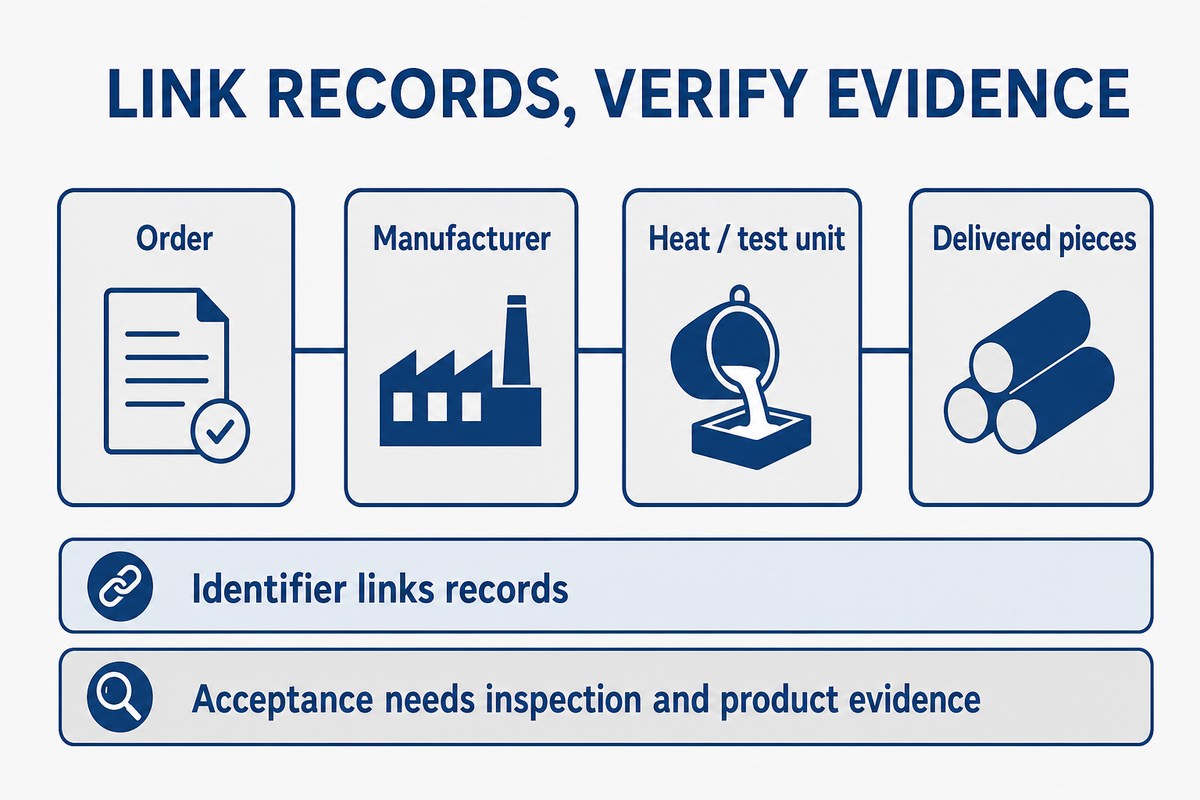
The Commission’s registry announcement refers to the information structure in the product chain. Buyers can prepare by retaining readable and original certificates and consistent links between the order, manufacturer, heat/test units and the delivered pieces. A digital identifier can link records. Acceptance of the material still requires the required inspection and product evidence.
Order the required certificate type together with its product-test requirements and accepted validation route. Preserve that connection through stock transfers, cutting and final receipt.
Send a complete pipe documentation request
Send Baling Steel the product specification and edition, dimensions, quantity, certificate type, accepted inspector, inspection plan and document delivery requirements. Include the destination market and any end-user acceptance conditions. Hunan Baling Steel Co., Ltd. is the company identified on the brand’s About Us page.
FAQ
Is a 3.1 certificate the same as a mill test certificate?
A mill test certificate may be Type 3.1, but the label alone is insufficient.
The document needs to state its inspection basis and contain the corresponding results and validation. MTC and MTR are broad commercial names. A buyer ordering EN 10204 3.1 should receive the required Type 3.1 document rather than accept a generic test certificate solely because it came with the shipment. Match its product references to the purchase item and the supplied lot.
Can a stockist issue an EN 10204 3.1 certificate?
A stockist passing on unchanged material should preserve the original manufacturer’s certificate and traceability.
Distribution paperwork should connect that original document to the stockist’s delivery. It shouldn’t imply that the stockist performed the manufacturer’s validation merely by copying the results. Processing that changes material properties raises a different manufacturer-responsibility question. LRQA’s stockist discussion distinguishes those routes; the order must describe the required deliverable and its accepted issuer rather than use the word stockist as a certification category.
Is EN 10204 3.2 mandatory for every pressure application?
No. Applicable equipment, material and purchase requirements control the document selection.
For EU work, the PED’s specific product-control requirement for main pressure-bearing parts must be read with the material route, quality-assurance provisions and applicable product rules. A pressure application alone doesn’t resolve those conditions. The purchaser’s engineering review should identify the required evidence and accepted validation arrangement before the order is released. Great Britain has its own regulatory framework; a UK recall isn’t a substitute for the EU material provisions.
Does a 3.2 certificate expire?
Do not apply a universal 90-day expiry to a 3.2 certificate.
Use the order’s document conditions and assess material identity, condition and any processing or storage changes. A recent signature can’t repair missing traceability.
What is an inspection certificate?
An inspection certificate combines the declared inspection basis, relevant results and required validation.
For EN 10204 Type 3.1 or 3.2, the results relate to specific inspection. The document remains part of a product-and-order acceptance package, rather than a general approval of every use of the material.
Can an invoice heat number replace the original material record?
No. The invoice reference must connect to the manufacturer’s results and the delivered material.
A repeated number is useful only when that connection is intact. Resolve missing original records through the agreed quality procedure before acceptance.
Does 3.2 certification automatically include every NDT method?
No. Required non-destructive testing comes from the product specification, order and agreed inspection plan.
EN 10204 certification doesn’t select every possible NDT method. Record the required method, scope and acceptance criteria alongside the reported result.
Technical basis: BSSA’s inspection-document guidance, IOGP Report 571, and the official legal and regulatory sources listed below.
Technical scope
This guide compares document selection and purchasing checks using public standards guidance, inspection-body explanations and identified regulatory examples. The named worksheets are editorial purchasing aids. Product design limits and project acceptance remain governed by the applicable specification, order and responsible approval route.
References & Sources
- BSEN 10204 test certificates for stainless steel products, British Stainless Steel Association.
- Purchasing of steel material and equipment, International Association of Oil & Gas Producers, Report 571, August 2016.
- BS EN 10204:2004: Metallic products. Types of inspection documents, British Standards Institution current catalog.
- NEN-EN 10204:2004, NEN current catalog and public scope.
- Steel products: Inspection documents, list of information and description, Swedish Institute for Standards, EN 10168:2004.
- Directive 2014/68/EU, Annex I 4.2 and 4.3, EUR-Lex, consolidated reference dated 30 May 2026.
- Technical specification for roughing pump system pipe supports, Oak Ridge National Laboratory, specific procurement example.
- Product Recall: Emerson Sempell GmbH Valve Fastener (2509-0175), UK Office for Product Safety and Standards, 28 July 2026.
- Material Specification and Certification guideline, Eskom, revision 2, November 2020; historical purchaser procedure.
- The Digital Product Passport Registry is now live, European Commission, 20 July 2026.
Inspection-body explanations cited in context: David Thompson at LRQA on stock-material certification and ABS Type 3.2 service scope.