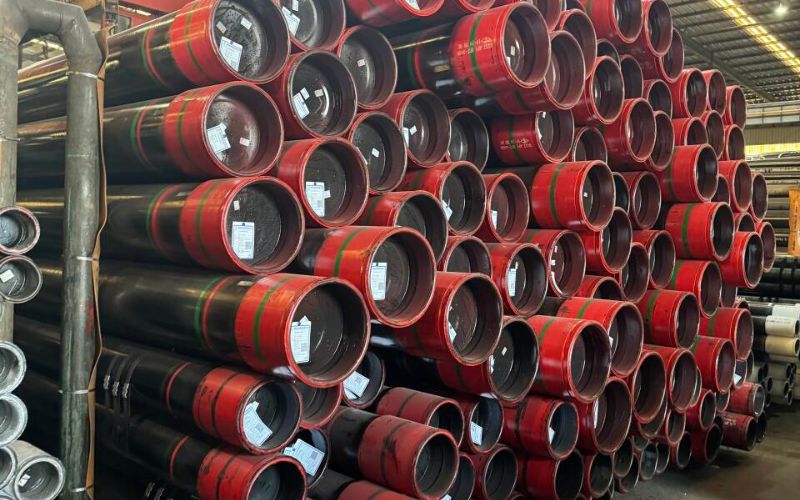
Compression fittings stainless steel are flareless mechanical connectors that seal fluid and gas lines without welding or threading. In high-pressure process systems, a double ferrule 316 stainless steel tube fitting grips annealed tubing rated up to 5,100 psig for 1/4-inch x 0.035-inch wall tubing per Swagelok Tubing Data MS-01-107. A compression nut tightly cinches a double ferrule against a conical body seat and creates a leak-free seal.
Matching the alloy chemistry, tube OD, and tube hardness is essential to choosing the correct stainless steel compression tube fitting. This guide covers mechanics of DIN 2353, limits of 316ss chloride, Tube OD, ASME B31.3 pressure math, and turn-count installation. It also includes cost benchmarks of 2025, EN 10204 3.1, and traceability.
How Do Stainless Steel Compression Fittings Seal Without Welding or Threads?
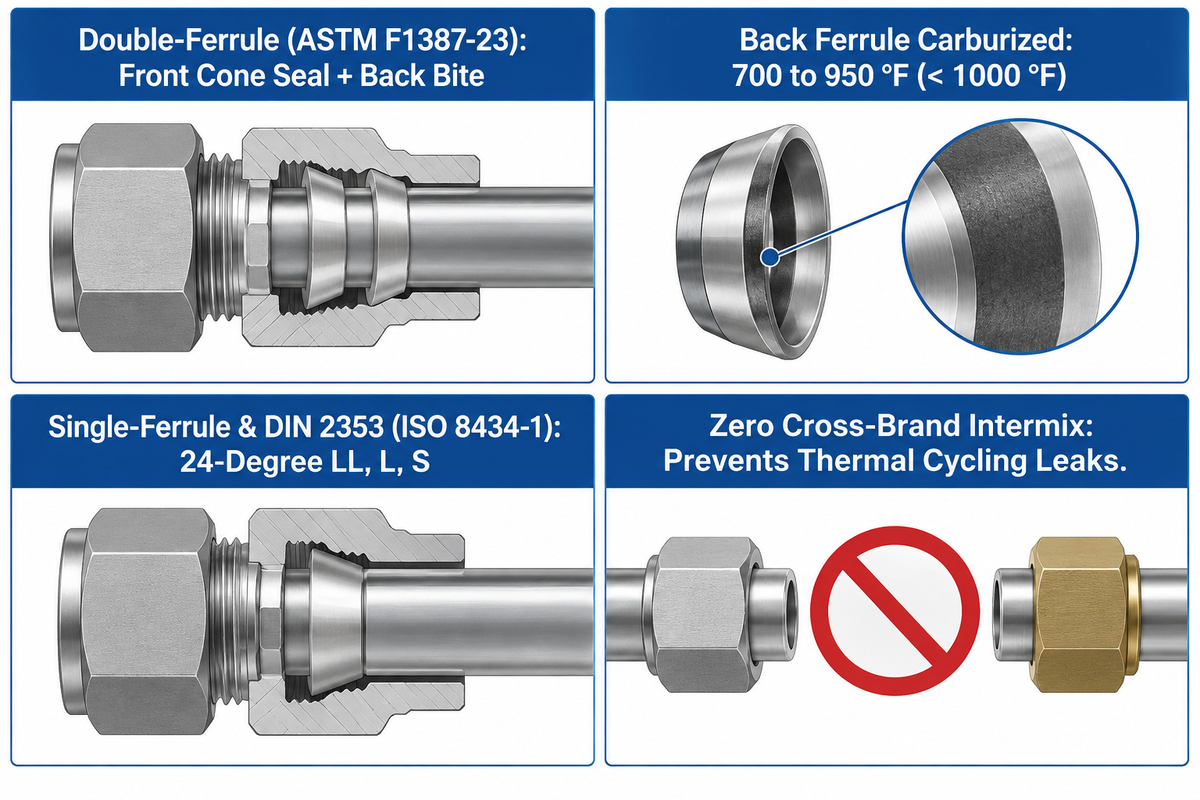
A stainless steel compression tube fitting seal is achieved by wedging one or two metal ferrules between a conical body seat and smooth tubing. As the compression nut progresses along the male body thread, axial force drives the ferrule inward against the tube wall. The qualification of mechanically attached fittings is described in ASTM F1387-23.
Engineers select among three mechanical compression connections based on service condition; that is, either vibration level or pressure rating. In a double ferrule design (i.e. Swagelok MS-01-140 and Parker A-LOK Catalog 4230/4233), the front ferrule and the back ferrule have distinct functions. The long front ferrule slides against the tapered body cone. This action forms a broad gas-tight primary seal against the body and the tube OD.
The back case-hardened ferrule folds inward to bite the stainless steel tube radially, and also loads the front ferrule against line vibration. In accordance with USPTO Patent US6093303A, low temperature gas carburization at 700 to 950 °F (< 1000 °F) case hardens the back ferrule. Above 1000 °F, carbides will form in stainless steel, and thus, to prevent carbide formation, carburization is kept at 700 to 950 °F. The bite edge therefore retains full corrosion resistance.
A single-ferrule instrumentation fitting (i.e. Parker CPI) uses a single bowed ferrule to form the seal and grip the cone. Metric hydraulic circuits in Europe and Asia often times specify ISO 8434-1 (DIN 2353) 24-degree fittings. As indicated in the Brennan Industries DIN 2353 Technical Guide, DIN 2353 tube fittings use a 24-degree connection geometry in Very Light (LL), Light (L) and Heavy (S) series.
| Design Parameter & Architecture Type | Double-Ferrule Instrumentation (Swagelok / Parker A-LOK) | Single-Ferrule Instrumentation (Parker CPI) | Metric 24-Degree Bite-Type Cutting Ring (DIN 2353 / ISO 8434-1) |
|---|---|---|---|
| Primary Governing Standard | ASTM F1387-23 / ASME B31.3 (ASTM Steel Standards) | ASTM F1387-23 / ASME B31.3 (ASTM Steel Standards) | ISO 8434-1 / DIN 2353 (ISO 8434-1) |
| Body Seat Cone Geometry | Proprietary shallow tapered instrumentation cone (Swagelok MS-01-140) | Proprietary shallow tapered instrumentation cone (Parker Cat 4230) | Standardized 24-degree connection geometry (Brennan DIN 2353) |
| Sealing & Tube Grip Separation | Separated: front ferrule seals cone; back ferrule grips tube | Combined in one spring-action bowed ferrule | Single cutting ring bites into metric tube wall |
| Rear Ferrule Surface Treatment | Low-temp carburized at 700 to 950 °F, below 1000 °F (USPTO US6093303A) | Suparcase surface-hardened austenitic ferrule (Parker Cat 4230) | Surface-hardened stainless cutting ring (Brennan DIN 2353) |
| Rated Working Pressure Window | Up to annealed tubing burst limit (3,700 to 5,100 psig on 1/2 in. OD per MS-01-107) | Up to annealed tubing burst limit (3,700 to 5,100 psig on 1/2 in. OD per MS-01-107) | Very Light (LL), Light (L), and Heavy (S) series (Brennan DIN 2353) |
| Primary Industrial Application | Chemical process systems, analyzer lines, hydrogen gas, vacuum | Instrumentation panels, chromatographs, low-trap sanitary lines | High-pressure hydraulic power skids, lubrication manifolds |
Can You Intermix Stainless Steel Compression Ferrules and Bodies Across Brands?
Engineers never intermix compression ferrules, nuts and fitting bodies across brands. Cross-brand component intermixing causes leaks and voids OEM warranties.
Even when full assemblies fit standard tubing, no commercial standard fixes the exact cone angle, back-ferrule nose radius, or case-hardening profile across Swagelok, Parker, and Hoke (Hoke Engineering Bulletin 79307; Collins-Oliver Reuse & Intermixing Guide). Installing a Parker ferrule inside a Swagelok body shifts the swaging contact zone. Under thermal cycling or gas service, that mismatched interface weeps and fails prematurely.
316 vs. 304 Stainless Steel Compression Fittings: Material Grades, Chloride Limits, and Standards
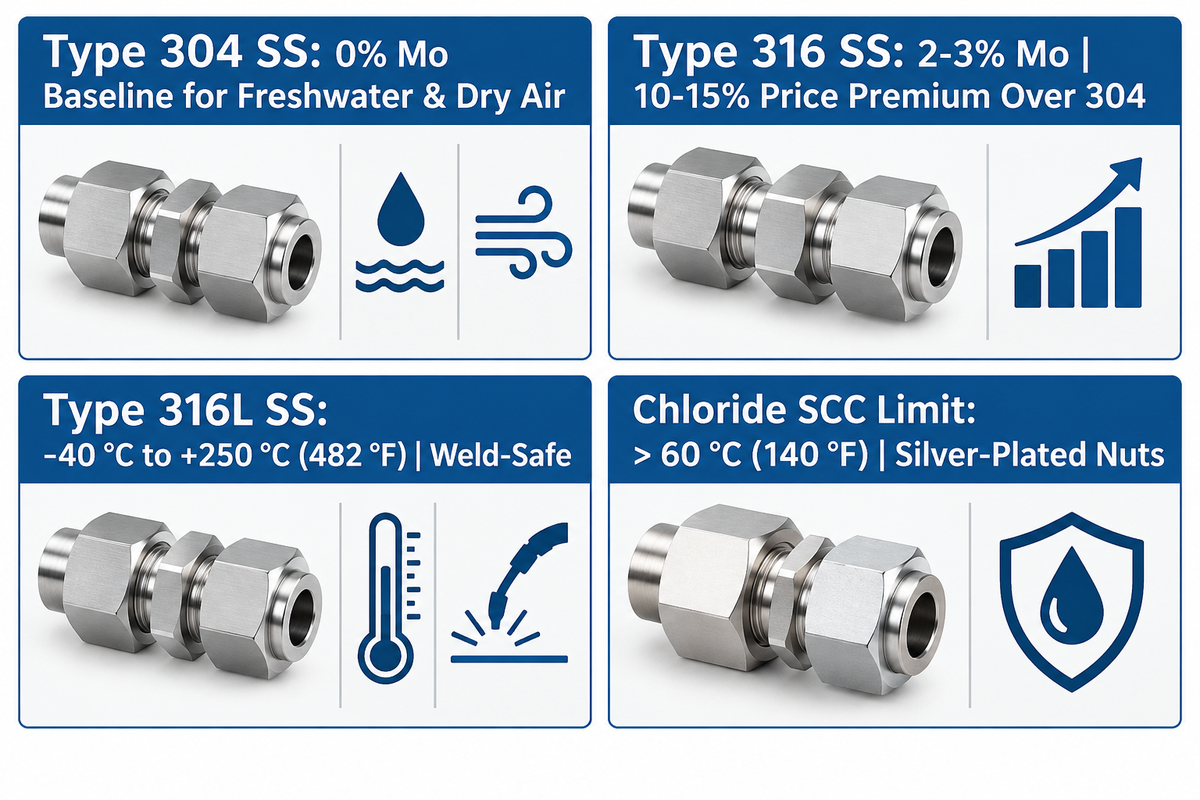
Type 316 stainless steel compression fittings add 2–3% molybdenum for chlorides, saltwater, and acidic environments, whereas Type 304 contains no molybdenum (Twinco Industrial Stainless Fittings Guide). The molybdenum addition increases the pitting resistance in marine and chemical service (Nickel Institute Corrosion Guidelines 11023). Straight bodies and nuts are machined from ASTM A276/A276M-25 or ASTM A479/A479M-26 barstock. Shaped elbows, tees, and crosses are machined from ASTM A182 F316 forged stainless steel fittings.
In freshwater and mild industrial services, Type 304 fittings provide reliable general corrosion resistance. Type 316 and 316L fittings withstand more exposure to chlorides and coastal marine salt spray. However, standard 316 and 316L fittings are prone to stress corrosion cracking (SCC) from chlorides at temperatures above 60 °C (140 °F) in highly concentrated brines (Nickel Institute Guideline 11023). In services above 60 °C with a high chloride content, duplex or super-austenitic stainless grades should be specified.
Austenitic stainless steel is also prone to cold-welding (thread galling) under high axial swaging loads. To prevent galling without introducing process media contamination, 316ss compression nuts employ internal silver plating per Swagelok MS-01-140.
| Material Property & Alloy Class | Type 304 Stainless Steel | Type 316 Stainless Steel | Type 316L Low-Carbon Stainless Steel |
|---|---|---|---|
| Molybdenum Alloy Addition | No molybdenum addition (Twinco Industrial) | 2–3% molybdenum for chlorides and saltwater (Twinco Industrial) | 2–3% molybdenum with low-carbon chemistry (Twinco Industrial) |
| Weld Sensitization Resistance | Standard carbon level for non-welded mechanical joints | Standard carbon level for high-strength bar and forgings | Low-carbon grade prevents weld-zone carbide precipitation (Nickel Institute) |
| Barstock & Forging ASTM Standards | ASTM A276/A276M-25 & ASTM A182/A182M-26b (ASTM Catalog) | ASTM A276/A276M-25 & ASTM A182/A182M-26b (ASTM Catalog) | ASTM A276/A276M-25 & ASTM A182/A182M-26b (ASTM Catalog) |
| Chloride & Marine Environment Rating | Indoor utilities, dry air, low-chloride water | Coastal salt spray, chemical process, offshore instrumentation | Welded tube stub adapters, semiconductor, pharmaceutical lines |
| Operating Temperature Window | Elevated temperature factors from 200 °F to 1000 °F (Swagelok MS-01-107) | Elevated temperature factors from 200 °F to 1000 °F (Swagelok MS-01-107) | -40 °C to +250 °C (482 °F) in compression assemblies (Parker 316L) |
| Relative Fitting Price Premium | Baseline austenitic stainless steel cost | 10–15% more than 304 (Twinco Industrial) | 10–15% more than 304 (Twinco Industrial) |
When Should You Upgrade from 304 to 316 Stainless Steel Compression Fittings?
To gain greater corrosion resistance, consider upgrading your compression fittings from 304 to 316 or dual-certified 316/316L. This is especially true when process media contain chlorides or acid (Twinco Industrial). You should also specify 316 in marine or coastal atmospheres, sour gas service, or when connecting to 316 tubing, because a 304 fitting, paired with 316 tubing, creates a galvanic cell site at the ferrule bite.
For lines carrying sour gas, consider specifying dual-certified 316/316L fittings in the solution-annealed condition (Swagelok MS-01-140). When process lines include tube stub weld adapters or sanitary ball valves, low-carbon 316L prevents weld-zone carbide sensitization (Nickel Institute Guideline 11023).
Tube OD vs. Nominal Pipe Size (NPS): Sizing, Configurations, and Thread Adapters
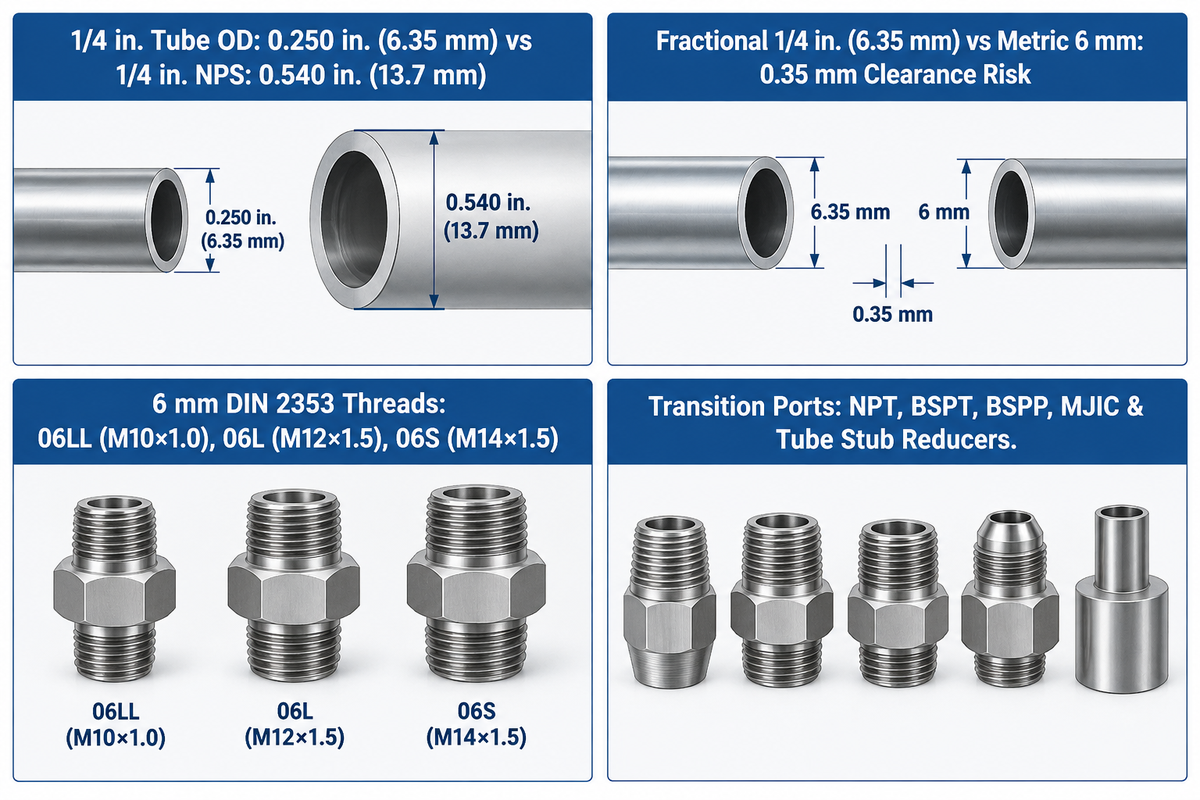
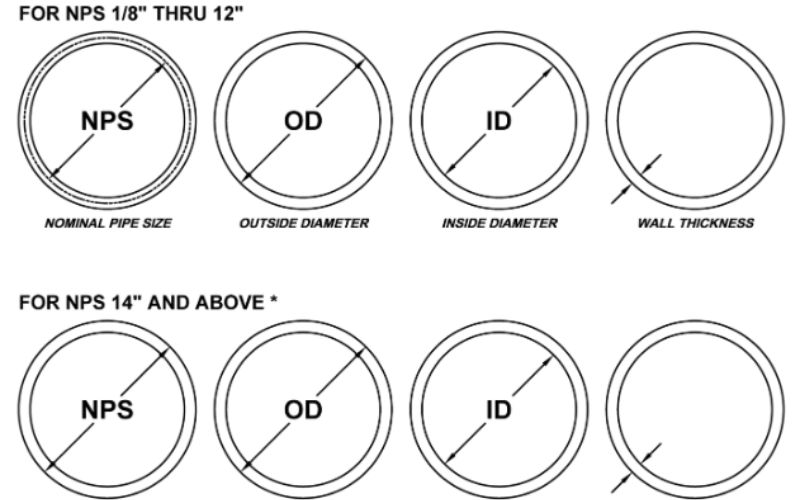
Stainless steel compression fittings are sized by actual Tube Outside Diameter (OD) in fractional inches or metric millimeters (such as 6 to 16 mm, or 0.24 to 0.63 inch per Parker 316L Compression Specifications). They are not sized by Nominal Pipe Size (NPS). According to Swagelok Pipe Fittings Catalog MS-01-147, 1/4 inch NPS pipe is 0.540 inches (13.7 mm) actual outside diameter. Contrarily, 1/4 inch tubing is 0.250 inches (6.35 mm) OD. Review our engineering guide on the dimensional differences between nominal pipe size and actual tube outside diameter before ordering parts.
Fractional and metric compression tube fittings must be separated on the shop floor. A 1/4-inch fractional tube has an outside diameter of 6.35 mm, which is 0.35 mm larger than a 6 mm metric tube (Swagelok MS-01-140). A 6 mm tube in a 1/4-inch fitting leaves radial clearance and causes high pressure blowout.
Even within metric DIN 2353 fittings, thread sizes change across pressure series for the same tube size. As shown in Brennan Industries DIN 2353 Chart, a 6 mm OD fitting uses an M10×1.0 nut thread in the 06LL series. It uses M12×1.5 in the 06L series and M14×1.5 in the 06S series. When routing directional changes alongside welded piping, engineers can check steel pipe fittings specifications to align transition ports.
Standard industrial configurations cover every tubing layout and connection type:
- Straight union and reducing union connectors connect two lengths of identical or different OD tubing in a straight run.
- Union elbow fittings (90 degree and 45 degree) route tubing turns without bending tight-radius stainless steel tube runs.
- Equal tee, branch tee, and union cross bodies split process analyzer or hydraulic distribution lines into multiple ports.
- Bulkhead union assemblies pass tubing through instrument cabinet walls or control panel plates using a backup jam nut.
- Male connector and NPT female adapter (FNPT) bodies transition from a compression tube end to a tapered NPT pipe threads (Swagelok MS-01-147), BSPT threads, parallel BSPP threads, or flared MJIC hydraulic adapters.
- A reducer fitting (tube stem or port connectors) uses a pre-machined tube stem that inserts directly into another compression fitting port.
| Fitting Configuration Type & Connection Class | Nominal Size / Model Designation | Actual Tube or Pipe OD | Mating Thread or Series Specification | Primary Reference Standard |
|---|---|---|---|---|
| Fractional Straight Union (Tube-to-Tube) | 1/4 in. Fractional Tube | 0.250 in. (6.35 mm) | Twin-ferrule compression nut and ferrules | Swagelok MS-01-140 |
| Metric Very Light Straight Fitting (06LL) | 6 mm Metric Tube | 6 mm | M10 × 1.0 male metric thread (LL Series) | Brennan DIN 2353 |
| Metric Light Series Connector (06L) | 6 mm Metric Tube | 6 mm | M12 × 1.5 male metric thread (L Series) | Brennan DIN 2353 |
| Metric Heavy Series Connector (06S) | 6 mm Metric Tube | 6 mm | M14 × 1.5 male metric thread (S Series) | Brennan DIN 2353 |
| Metric Light Series Union Elbow (08L) | 8 mm Metric Tube | 8 mm | M14 × 1.5 metric 24-degree cone thread | Brennan DIN 2353 |
| Fractional 90-Degree Union Elbow | 3/8 in. Fractional Tube | 0.375 in. (9.53 mm) | Forged ASTM A182 316 elbow body | Swagelok MS-01-140 |
| Metric Male Stud Connector (1805 Series) | 10 mm Metric Tube | 10 mm | NPT 1/4 or BSPT R1/4 male pipe thread | Parker 316L Catalog |
| Metric Female Stud Adapter (1814 Series) | 12 mm Metric Tube | 12 mm | BSPP G3/8 or G1/2 parallel female thread | Parker 316L Catalog |
| Fractional Male Connector / FNPT Adapter | 1/2 in. Fractional Tube | 0.500 in. (12.70 mm) | 1/2 in. NPT tapered pipe thread | Swagelok MS-01-147 |
| Metric Heavy Header Connector (25S) | 25 mm Metric Tube | 25 mm | M36 × 2.0 male metric thread (S Series) | Brennan DIN 2353 |
Pressure Ratings, Seamless Tubing Hardness Limits, and Wall Thickness Calculation
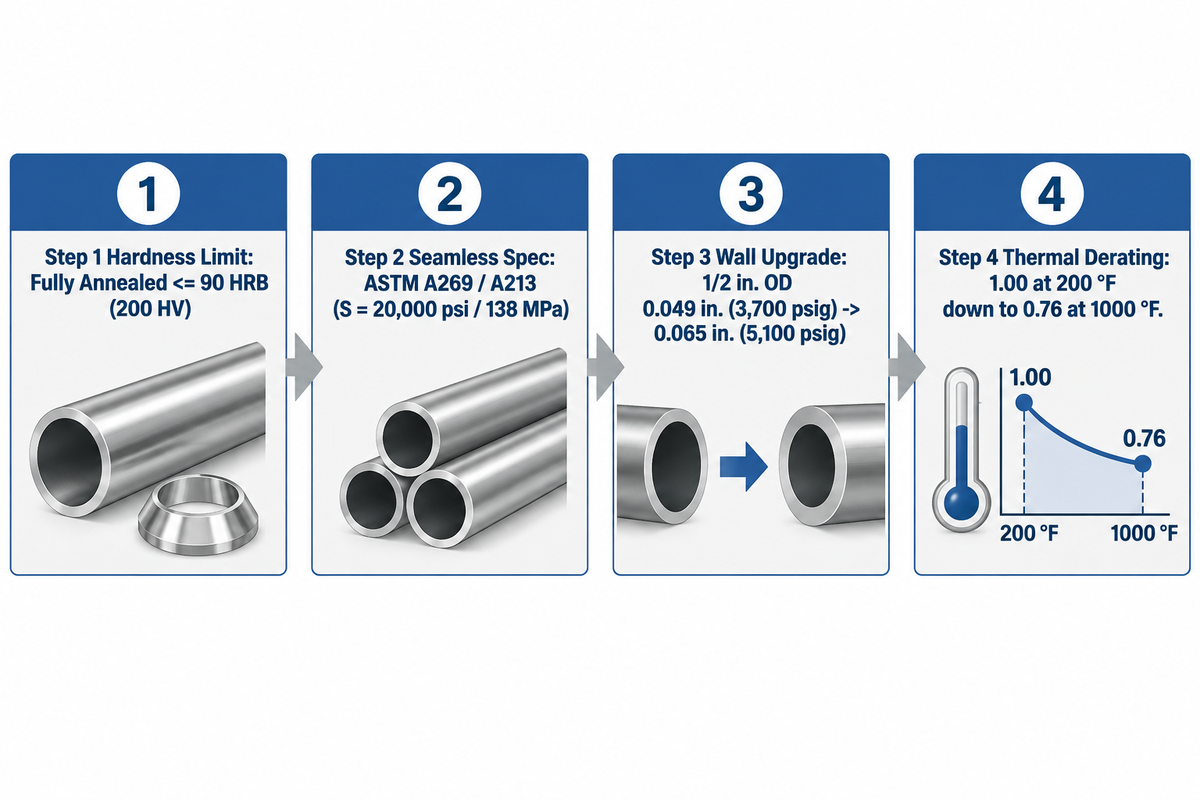
In a properly assembled stainless steel compression fitting, maximum allowable working pressure (MAWP) is governed by the annealed tubing wall thickness and <= 90 HRB hardness limit rather than the fitting body alone. Cold-drawn 1/8-hard tubing cannot achieve catalog pressure ratings in standard twin-ferrule fittings. Per Swagelok MS-01-107 and Merit Brass Stainless Tubing Pressure Ratings, ASME B31.3 ratings from -20 °F to 100 °F use an allowable stress of S = 20,000 psi (138 MPa) for ASTM A269 TP316 tubing.
“Stainless steel tubing must be fully annealed seamless tubing or welded tubing per ASTM A269 or A213, with a maximum hardness of 90 HRB (200 HV), and free of surface scratches suitable for bending and flaring.”
Engineering Selection Protocol: The 4-Point Tube-to-Ferrule Match
Use the 4-Point Tube-to-Ferrule Match before pressuring any stainless steel compression tube line above 3000 psi:
- Verify on the mill certificate that tubing is fully annealed to a maximum hardness of 90 HRB (200 HV) per Swagelok MS-13-03 (316 stainless steel yield strength and hardness limits).
- Specify seamless stainless steel tubing and pipe per ASTM A269 or A213 for high-pressure gas and impulse lines. See why seamless tubing outperforms welded seams under radial ferrule compression to avoid weld-bead ovality leaks.
- Match the wall thickness to the internal working pressure and collapse resistance of the front ferrule (Hydraulics & Pneumatics Flareless Guide where flareless fittings handle average fluid working pressures to 3000 psi on medium-to-thick-walled tubing).
- Confirm clean outer surfaces free of draw scratches so the front ferrule cone seals on initial pull-up (Swagelok MS-13-03).
Step-by-step ASME B31.3 Barlow’s formula calculation (P = 2St/D at S = 20,000 psi for ASTM A269 TP316) proving why upgrading 1/2 in. OD tubing from 0.049 in. wall to 0.065 in. wall raises theoretical working pressure from 3,920 psi (3,700 psi catalog rating) to 5,200 psi (5,100 psi catalog rating) (Swagelok MS-01-107).
| Tube OD Model & Wall Class | Actual Tube OD | Nominal Wall Thickness | ASME B31.3 Working Pressure | Service Suitability & Reference |
|---|---|---|---|---|
| 1/4 in. Standard Instrumentation Tube | 0.250 in. (6.35 mm) | 0.035 in. | 5,100 psig | Gas & liquid service (Swagelok MS-01-107) |
| 1/4 in. Heavy-Wall High-Pressure Tube | 0.250 in. (6.35 mm) | 0.049 in. | 7,500 psig | High-pressure gas & liquid (ASTM A269 316SS Chart) |
| 1/4 in. Extra-Heavy Hydraulic Tube | 0.250 in. (6.35 mm) | 0.065 in. | 10,200 psig | Extreme-pressure instrumentation (Swagelok MS-01-107) |
| 3/8 in. Light Process Tube | 0.375 in. (9.53 mm) | 0.035 in. | 3,300 psig | Liquid process lines (Swagelok MS-01-107) |
| 3/8 in. Standard Gas & Liquid Tube | 0.375 in. (9.53 mm) | 0.049 in. | 4,800 psig | Gas & liquid service (Swagelok MS-01-107) |
| 3/8 in. Heavy-Wall Hydraulic Tube | 0.375 in. (9.53 mm) | 0.065 in. | 6,500 psig | High-pressure gas & hydraulic (Swagelok MS-01-107) |
| 1/2 in. Standard Instrumentation Tube | 0.500 in. (12.70 mm) | 0.049 in. | 3,700 psig | Gas & liquid service (Swagelok MS-01-107) |
| 1/2 in. Heavy-Wall Process Tube | 0.500 in. (12.70 mm) | 0.065 in. | 5,100 psig | High-pressure gas & liquid (Swagelok MS-01-107) |
| Metric 6 to 16 mm 316L Compression Assembly | 6 to 16 mm (0.24 to 0.63 in.) | Standard metric wall | 400 bar (5,802 psi) | Vacuum to 400 bar (Parker 316L Catalog) |
When operating above 200 °F, multiply the ambient pressure rating by the Swagelok MS-01-107 temperature derating factor. For 316 stainless steel tubing, the elevated temperature factor is 1.00 at 200 °F, 0.96 at 400 °F, 0.85 at 600 °F, 0.79 at 800 °F, and 0.76 at 1000 °F.
Why Must Seamless Stainless Steel Tubing Be Softer Than 90 HRB for Compression Fittings?
Seamless stainless steel tubing must be softer than 90 HRB (200 HV) so the hardened rear ferrule bites into the tube wall (Swagelok MS-13-03; Parker Guide).
If a standard fitting is installed on an impulse or hydraulic line, and the tubing is cold drawn and hard, the rear ferrule may skid on the hard wall and the impulse of fluid may blow the tube out of the fitting body.
Step-by-Step Installation, Turn-Count Make-Up, and Reassembly Protocol
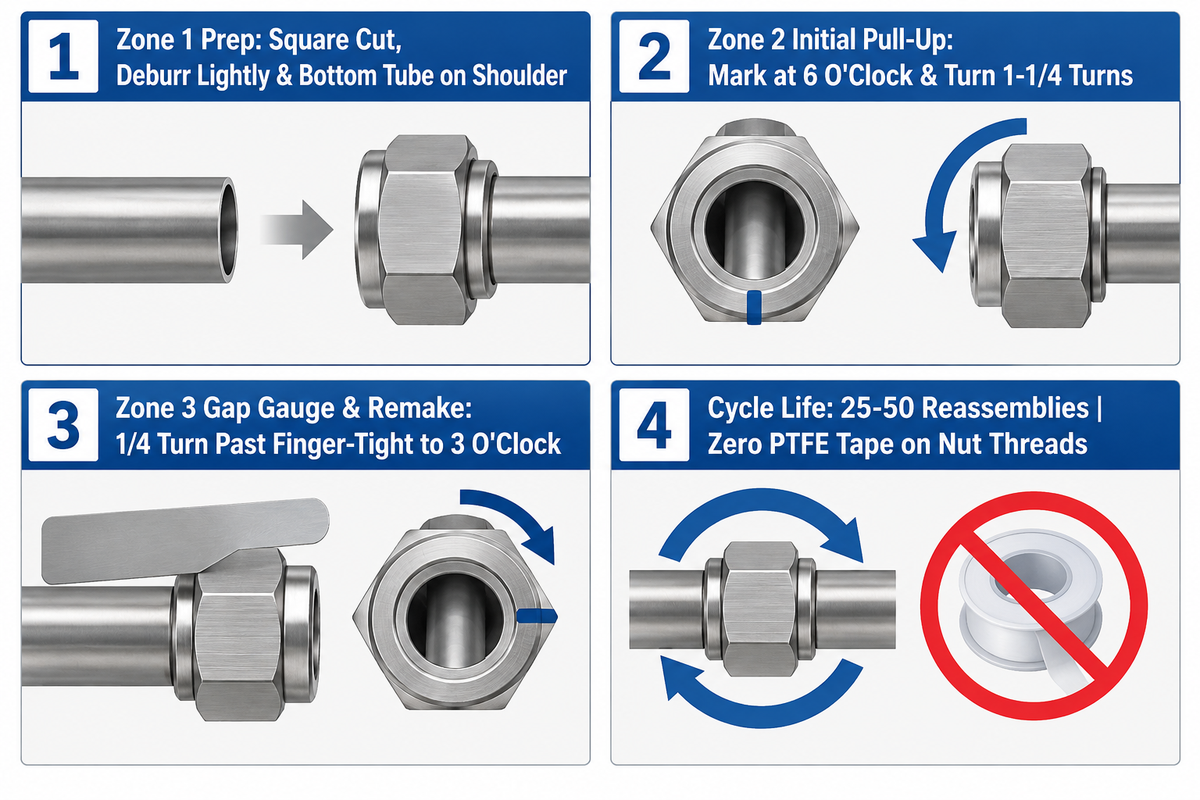
Installation of stainless steel compression fittings requires geometric turn-count displacement past finger-tight as opposed to wrench torque values. According to Swagelok MS-13-03 and Collins-Oliver Installation Standards, the first installation requires 1-1/4 turns past finger-tight, so the ferrule drives into the tube wall and creates the initial seal.
Shop-Floor Procedure: The 3-Zone Ferrule Make-Up Check
Use the 3-Zone Ferrule Make-Up Check to eliminate initial assembly leaks and maintenance over-tightening.
- Zone 1 (Tube Preparation and Shoulder Bottoming) – Square the tubing, deburr lightly, and do not chamfer the outer seal surface. Firmly push the tube against both ferrules past the body shoulder and finger-tighten the nut (Swagelok MS-13-03).
- Zone 2 (Reference Mark and Turn-Count Pull-Up) – Mark the compression nut hex and fitting body at 6 o’clock. While holding the fitting body still with a backup wrench, turn the nut 1-1/4 turns past finger-tight for the first installation (Collins-Oliver).
- Zone 3 (No-Go Gap Gauge and Remake Verification): Use a no-go gap inspection gauge to check the initial pull-up. Tighten 1/4 turn past finger-tight from the original tightened position, so that the pencil line on the nut rotates to the 3 o’clock position (Collins-Oliver).
Never apply PTFE Teflon tape or pipe dope to straight compression nut threads (Huron Industries Thread Sealing Guide; PneumaticPlus Fitting Failure Analysis). PTFE tape around the threads or olive prevents the nut from seating properly and results in a leak. PTFE tape can be used on male tapered NPT or BSPT pipe adapter threads. Field mechanics in r/IndustrialMaintenance also warn against using dirty shop grease or impact drivers on stainless nuts.
How Many Times Can You Reuse a Stainless Steel Compression Fitting Without Leaking?
Most published references state that after about 25-50 reassembly cycles, a stainless steel compression fitting should be replaced (Collins-Oliver Reuse Standards ). In order to reach this cycle life, the 1/4 turn reassembly rule should be followed. Repeating the initial 1-1/4 turn pull-up can crush the front cone and ruin the seal.
Always check the front ferrule cone for deep axial scores before each remake and replace the tube stub and ferrules if the cone is gouged.
Industrial Applications: Hydraulic, Process Instrumentation, Marine, and High-Purity Systems
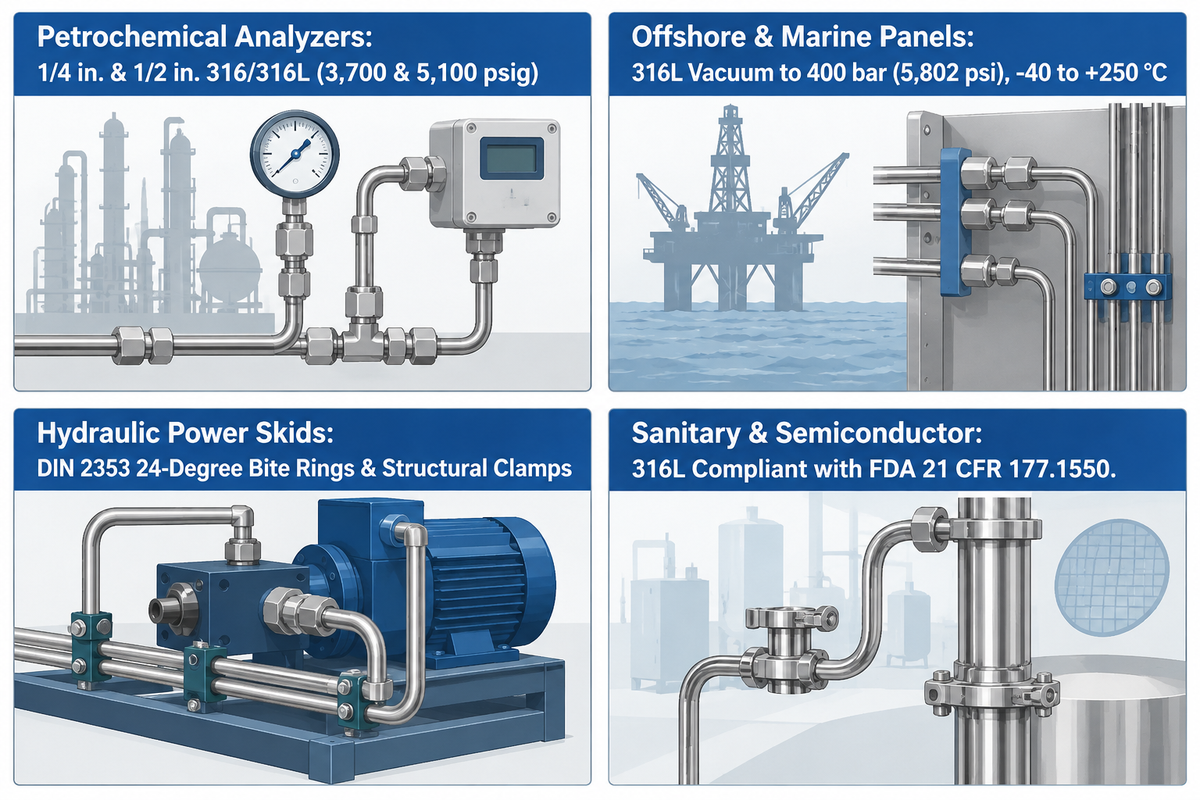
Stainless steel compression fittings serve four primary industrial environments where threaded pipe joints fail from vibration, corrosion, or fugitive leaks (Parker Stainless Steel Compression Fittings):
- Petrochemical and refinery process analyzer lines use 1/4-inch and 1/2-inch 316/316L double-ferrule fittings rated to 3,700 and 5,100 psig (Swagelok MS-01-107) without hot-work welding permits.
- Offshore oil and gas and marine control panels rely on 316L compression connectors rated from vacuum to 400 bar (5,802 psi) and -40 °C to +250 °C (Parker 316L Specifications) to withstand salt spray.
- High-pressure hydraulic power skids incorporate DIN 2353 24 degree bite rings with seamless tubing, where vertical structural clamps hold horizontal piping runs and limit vibration and shock (Hydraulics & Pneumatics Clamping Guide).
- Sanitary, food, and semiconductor process systems use 316L compression connections compliant with FDA 21 CFR 177.1550 (Parker 316L Catalog).
Cost Benchmarks and Bulk Lead Times for 304 vs. 316 Stainless Steel Compression Fittings
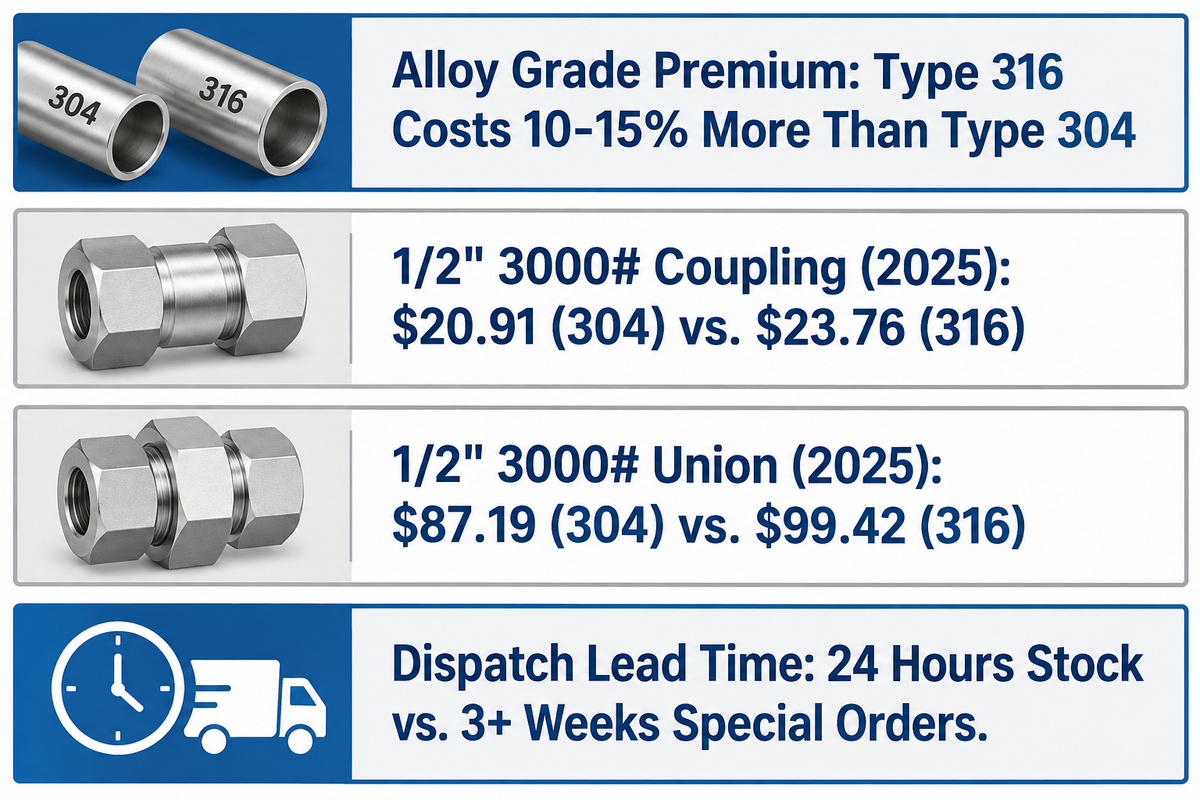
Verified 2025 stainless steel fittings price comparison showing Type 316 stainless typically costs 10-15% more than 304, with a 1/2″ 3000# 304 coupling at $20.91 versus $23.76 for 316, and a 1/2″ 304 union at $87.19 versus $99.42 for 316 (Twinco Industrial / Porter Pipe 2025 Stainless Fittings Price List). Standard online stock items ship in 24 hours, but non-stock special orders typically take a minimum quantity and have a lead time of at least three weeks (LubeTechnologies Stainless Compression Catalog).
Distributor unit prices are determined by LME nickel and ferro-molybdenum surcharges, order quantity, and EN 10204 Type 3.2 witnessing fees. Higher pressure classes (3000#, 6000#, 9000#) and multi-port unions or tees require more forging work (Twinco Industrial).
| Procurement Metric & Cost Category | Type 304 Stainless Steel | Type 316 / 316L Stainless Steel | Published Reference & Supply Condition |
|---|---|---|---|
| Alloy Grade Price Differential | Baseline 304 stainless steel pricing | 10–15% more than 304 (Twinco Industrial) | Ryerson & Twinco Industrial 2025 Market Analysis |
| 1/2″ 3000# Coupling Distributor List Price | $20.91 (Twinco Industrial) | $23.76 (Twinco Industrial) | January 2025 US Distributor Price Sheet |
| 1/2″ 3000# Union Distributor List Price | $87.19 (Twinco Industrial) | $99.42 (Twinco Industrial) | January 2025 US Distributor Price Sheet |
| 1/4 in.–1 in. Union Pricing Tier Comparison | Varies by factory MOQ; request a quote | Varies by factory MOQ versus single-piece retail; request a quote | OEM Bulk FOB (Baling Steel) vs. Retail |
| Standard Warehouse Stock Dispatch | Usually ships in 24 hours (LubeTechnologies) | Usually ships in 24 hours (LubeTechnologies) | Regular stock warehouse items |
| Non-Stock Special Order Production | Varies by fitting and minimum order quantity; request a quote | Varies by fitting and minimum order quantity; request a quote | Custom factory production (LubeTechnologies) |
Manufacturer Qualification, Cross-Reference, and EN 10204 3.1 Traceability
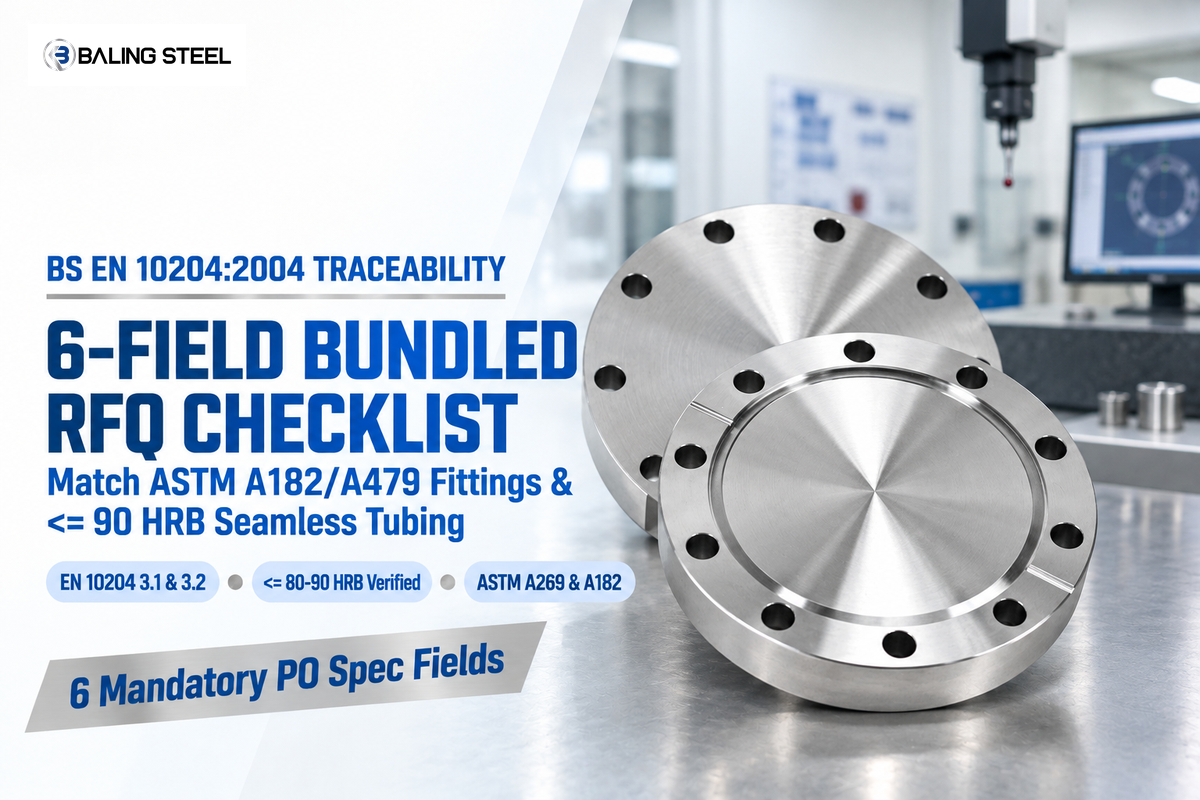
An audit of a stainless steel compression fitting supplier ensures dimensional cross-reference accuracy and traceability of the heat-lot of the material under BS EN 10204:2004. As explained in Holland Applied Technologies EN 10204 Guide, EN 10204 was revised in 2004 and published as BS EN 10204:2004. It describes the two main Inspection Documents for pressure fittings, Type 3.1 and 3.2.
The actual test results of the material in the lot from which the steel products were supplied are reported in an EN 10204 Type 3.1 Inspection Certificate and in a Type 3.2 Inspection Certificate. However, it is countersigned and verified by a third-party witness to confirm the material and test (Holland Applied Technologies; ABS EN 10204 Type 3.2 Certification).
Hunan Baling Steel Co., Ltd. (baling-steel.com) provides integrated packages of cold-finished bright-annealed smooth (verified <= 80-90 HRB) ASTM A269 / A213 and ASTM A182 / A479 stainless steel fittings backed by EN 10204 3.1 and third-party witnessed 3.2 inspection (SGS, TÜV, Lloyd’s, BV). Integrated mill sourcing (Swagelok MS-13-03) mitigates the field blowout risk from procuring unverified hard-drawn tubing and compression fittings from different vendors.
Engineering RFQ Checklist for Bundled Stainless Steel Compression Fittings & Tubing
The following 6 specification fields must be listed on the purchase order to prevent sizing mismatches and field blowouts:
- Specify Double Ferrule Instrumentation (ASTM F1387-23) or Metric 24 Degree Bite-Type (ISO 8434-1 / DIN 2353 with explicit LL, L, or S series).
- State ASTM A276/A276M-25 barstock and ASTM A182/A182M-26b 304, 316, or dual certified 316/316L stainless steel.
- Fractional Tube OD (1/4 in. = 6.35 mm) should be kept separate from Tube OD (6 mm per Swagelok MS-01-140) and specific male or female pipe connectors (NPT, BSPT, BSPP, MJIC) should be explicitly stated.
- Require ASTM A269 or A213 fully annealed seamless tubing with documented maximum hardness of 90 HRB (200 HV per Swagelok MS-13-03).
- Require silver-plated internal nut threads for galling prevention, plus ultrasonic cleaning and degreased oxygen-clean packaging.
- Require heat-code stamped bodies with BS EN 10204:2004 Type 3.1 (or Type 3.2) certificates (Holland Applied Technologies) and Positive Material Identification (PMI) reports.
Industry Outlook: High-Pressure Hydrogen, Semiconductor Ultra-High Purity, and Metric Standardization
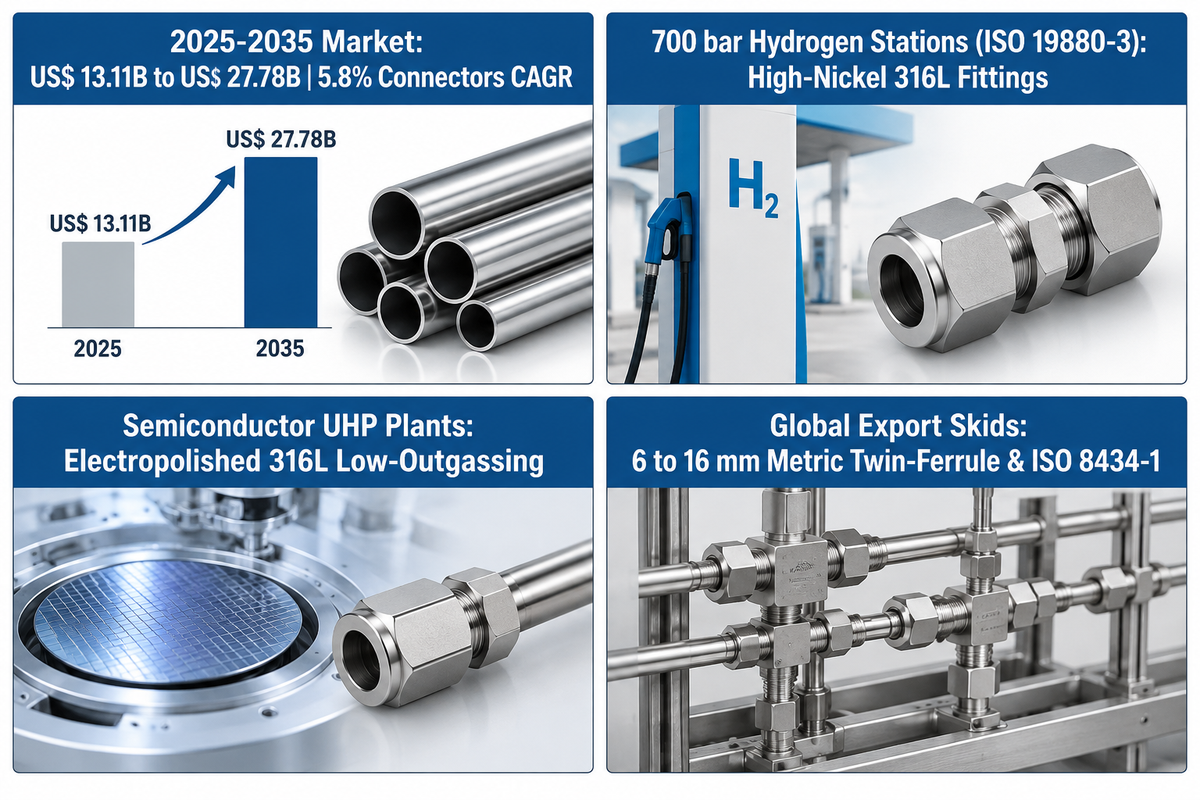
There is rapidly increasing global demand for stainless steel compression fittings in clean energy and microelectronics sectors. According to DataM Intelligence, the global stainless steel tubes and fittings market was US$ 13.11 billion in 2025 and is projected to reach US$ 27.78 billion by 2035. Of this market, the fitting connectors segment is projected to grow at a 5.8% Compound Annual Growth Rate (CAGR) from 2026 to 2035 (IndexBox Market Forecast to 2035).
Three significant technical changes to OEM engineering specifications are expected between 2026 and 2035:
- Gaseous hydrogen refueling stations operating at 700 bar under ISO 19880-3 specify high-nickel 316L stainless steel valves and fittings to resist hydrogen embrittlement during rapid thermal decompression.
- Semiconductor wafer fabrication plants use ultrasonically cleaned and electropolished 316L compression connections to minimize particle retention and moisture outgassing (IndexBox).
- Process skids built for export in Europe and Asia are standardizing on 6 to 16 mm metric twin-ferrule and ISO 8434-1 connections (Parker 316L).
Frequently Asked Questions
Can you install stainless steel compression fittings on nominal pipe sizes like 1/2-inch Schedule 40 pipe?
No, standard stainless steel compression tube fittings are manufactured to fit tubing sized by precise outside diameter (1/2-inch OD = 0.500 inch), and won’t fit 1/2-inch Nominal Pipe Size (NPS) which is way larger in outside diameter.
Apart from the size differences, nominal Schedule 40 pipe has higher stiffness and a roughened wall, compared to ASTM A269 annealed tubing. Because of the roughened surfaces, a gas-tight ferrule seal cannot be achieved. To connect a compression tube run to a 1/2-inch Schedule 40 pipe header, use a compression-to-male-NPT or female-NPT adapter fitting (Swagelok MS-01-147). Alternatively, one may specify a dedicated pipe-OD mechanical coupling.
Do stainless steel compression fittings require PTFE tape or thread sealant on the ferrule nut threads?
No, installers must never apply PTFE Teflon tape or liquid sealant to the straight threads under a compression fitting nut. The pressure seal forms between the metal ferrule and the tapered body cone rather than on the nut threads.
Wrapping PTFE tape around straight compression nut threads alters thread friction and blocks full axial travel (Huron Industries). Shredded fluoropolymer tape ribbons can also get into downstream instruments and clog orifices. Quality 316 stainless steel compression nuts already feature internal silver plating to prevent thread galling. Apply PTFE tape strictly to the male tapered NPT or BSPT pipe thread end of an adapter fitting.
What is the difference between a tube stub adapter and a standard male pipe connector?
A standard male pipe connector connects from a compression ferrule end (which grips cut tubing) to a male NPT or BSPT pipe thread. Different from tube stub adapters, which feature a pre-machined smooth tube stem that inserts into a compression fitting port.
Tube stub adapters (also known as port connectors or tube stem reducers) eliminate the short piece of cut tubing normally used between two adjacent compression components. This allows an installer to mount a 316ss ball valve or pressure gauge directly on a manifold tee. Because the factory-machined tube stub includes a pre-grooved ferrule seat, initial make-up requires only 1/4 turn past finger-tight (Collins-Oliver).
How do vibration and thermal cycling affect double-ferrule versus single-ferrule stainless steel fittings?
Double-ferrule stainless steel fittings isolate vibration better, because the rear ferrule swages a collet grip behind the primary sealing cone.
That separation prevents pump pulsation from reaching the front seal.
What is the maximum operating temperature for 316 stainless steel compression fittings?
Metal 316 stainless steel compression fittings can operate up to 1000 °F with a 0.76 temperature derating factor, per Swagelok MS-01-107.
How do you specify EN 10204 3.1 versus 3.2 mill test certificates when ordering bulk tubing and compression fittings together?
For standard chemical, hydraulic, and refinery instrumentation, specify BS EN 10204:2004 Type 3.1 certificates (Holland Applied Technologies). Under Type 3.1, the manufacturer’s independent quality department certifies heat-specific chemical and mechanical tests (including tubing hardness of no higher than 90 HRB) stamped on every fitting body and tube bundle.
For offshore platforms, sour gas lines and high-pressure hydrogen transportation lines, client specifications may require third-party verification (EN 10204 Type 3.2 prior to production) (ABS Type 3.2 Certification). As per Type 3.2, an independent third party surveyor (SGS, TÜV, Lloyd’s or BV) witnesses the heat-lot mechanical tests and countersigns the final inspection certificate package, along with the mill’s quality representative.
References & Sources
- ASTM International — Steel Piping, Tubing, and Fittings Standards Catalog (ASTM F1387-23, ASTM A269/A269M-25, ASTM A276/A276M-25, ASTM A479/A479M-26, ASTM A182/A182M-26b)
- Swagelok Company — Gaugeable Tube Fittings and Adapter Fittings Catalog (MS-01-140)
- Swagelok Company — Tubing Data Sheet: ASME B31.3 Working Pressure Ratings and Elevated Temperature Factors (MS-01-107)
- Swagelok Company — Swagelok Tube Fitter’s Manual (MS-13-03)
- Swagelok Company
Pipe Fittings and Tapered Thread Specifications Catalog (MS-01-147)
- Parker Hannifin Corporation- CPI and A-LOK Instrumentation Tube Fittings Catalog 4230/4233
- Parker Hannifin Corporation- Fittings and Materials, Tubing Selection Guide
- United States Patent and Trademark Office (USPTO)- Patent US6093303A: Stainless Steel Tube Fitting Low-Temperature Carburization (Williams & Marx, Swagelok Company)
- International Organization for Standardization (ISO)- ISO 8434-1: Metallic Tube Connections for Fluid Power and General Use – Part 1: 24 Degree Cone Connectors
- Brennan Industries — Fittings 101: DIN 2353 / ISO 8434-1 24-Degree Bite-Type Pressure Ratings and Thread Chart
- Nickel Institute- Guidelines for the Welded Fabrication of Nickel-Containing Stainless Steels for Corrosion-Resistant Services (Publication 11023)
- Hydraulics & Pneumatics- Make the Right Connections: Flareless Ferrule Fittings and Tubing Selection
- Twinco Industrial / Porter Pipe & Supply- 2025 Stainless Steel Pipe Fittings Price List: 304 vs. 316 Cost Comparison
- Collins-Oliver Inc.- Compression Fitting Reuse Standards, Remake Turn Counts, and Intermixing Risks
- Holland Applied Technologies- What Is the Difference Between BS EN 10204:2004 Type 3.1 and Type 3.2 Inspection Certificates?
- American Bureau of Shipping (ABS)- EN 10204 Type 3.2 Vendor Certification and Material Traceability Requirements
- IndexBox Market Intelligence- Compression Fitting Connectors Market Forecast to 2035 (5.8% CAGR)
- DataM Intelligence- Global Stainless Steel Tubes and Fittings Market Report (2025-2035)