Updated November 2026 · Technically Reviewed by the Hunan Baling Steel Co., Ltd. technical team
ASTM A312 covers seamless, straight-seam welded, and heavily cold worked austenitic stainless steel pipe for high-temperature and general corrosive service. Leaving the standard number alone leaves the supplier free to interpret alloy grade, manufacturing route, unit basis, and optional testing. Purchase orders tie up engineering intent by linking the applicable edition with grade, route code, nominal pipe size, schedule, and inspection records.
The active edition of ASTM A312/A312M-25 was approved on May 1, 2025. Pipe grades TP304L and TP316L follow product-specific chemical limits in Table 1, so sheet carbon ceilings do not govern pipe orders. Unless otherwise directed on a purchase order, supplementary tests are not required.
Direct Answer: For industrial process headers, ASTM A312 is the standard covering seamless (SMLS), autogenously welded (WLD), and heavily cold worked (HCW) austenitic stainless steel nominal pipe. ASTM A312 pipes require furnace solution heat treatment per Table 2, lot mechanical testing, and either a hydrostatic test or a nondestructive electric test on every length. Buyers must specify the edition, grade, route, unit basis, and dimensions for each order line.
| Specification Parameter | Governing Rule | Procurement Action |
|---|---|---|
| Edition Governance | Contract-specified revision or current active edition | Match contract code edition or confirm active revision |
| Manufacturing Routes | Seamless (SMLS), Welded (WLD), Heavily Cold Worked (HCW) | State permitted route code explicitly on each line item |
| Unit System Rule | Inch-pound default unless “M” metric basis is ordered | Keep dimensions and tensile limits inside one unit system |
| General Requirements Hierarchy | Stricter PO prevails over A312; A312 prevails over A999 | Write project-specific tolerances and witness holds on the PO |
| Baseline Leak or NDE Check | Hydrostatic test or nondestructive electric test per pipe | Specify the required method if project rules forbid mill choice |
| Heat Treatment Condition | Furnace solution heat treatment per Table 2 | Verify heat-treatment condition and lot traceability on MTR |
- Risk of weld sensitization is reduced for TP304L and TP316L pipe grades, if welding heat input is controlled. Hot concentrated chloride deposits can cause stress corrosion cracking in a pipeline under tension.
- Standard welded A312 pipe fuses without filler metal during pipe manufacture. Pipe made with filler metal is not automatically governed by ASTM A358, as product form and purchase rules determine the standard.
- Pipe schedules establish outside diameter and nominal wall thickness under ASME B36.19-2026 rather than assigning an installed working pressure rating.
- Optional supplementary requirements bind the manufacturer only if named directly on the purchase order.
ASTM A312 scope and applicable edition

ASTM A312/A312M is the Standard Specification for Seamless, Welded, and Heavily Cold Worked Austenitic Stainless Steel Pipes intended for high-temperature and general corrosive service. The active revision governs, unless a project contract locks a different code year, while ordering teams stipulate grade, route and dimensions separately.
What is ASTM A312?
Originally developed by the American Society for Testing and Materials, ASTM A312 is a standard specification covering austenitic stainless steel pipe across three manufacturing routes. Currently ASTM International is responsible for the document, and legacy piping specs reference the Society for Testing and Materials document. Engineers specify this pipe for high-temperature service, cryogenic headers, and chemical processing plants. It covers seamless and welded austenitic stainless lines that are widely used in industries handling process acids and steam condensate.
Each purchase in accordance with the ASTM A312 standard incorporates general delivery rules from ASTM A999/A999M-23 (Section 1.1). Combining values from SI and inch-pound tables causes non-conformance under Section 1.3 because the two systems operate independently. Seamless TP321 and TP321H pipes also carry lower tensile minimums when nominal wall thickness exceeds 3/8 inch (9.5 mm).
A complete requisition separates every independent decision field: ASTM A312-25, Grade TP316L, SMLS, NPS 2, Schedule 40S, solution annealed and pickled, beveled ends. Omitting the edition year lets distributors ship older mill stock. An edition mismatch can create a documentation and code-compliance issue when the contract specifies a particular ASME code edition.
TP304, TP304L, TP316 and TP316L: grade selection

Choose TP304 or TP304L for clean steam and potable water, and verified oxidizing acids, with no halides and no evaporative concentration. Upgrade to molybdenum-bearing TP316 or grade 316L for mild brines below 60 °C (150 °F) after checking acid or chloride concentration, flow velocity, tensile stress, and weld thermal cycles.
Balanced chromium and nickel contents stabilize the austenite matrix from cryogenic service up to elevated furnace temperatures. In oxidizing acid services, the choice of TP304L depends on verified concentration, immersion, temperature, and absence of local evaporative concentration. The ordered grade is verified to ASTM A312 Table 1 limits. Molybdenum alloying in ASTM A312 TP316 and ASTM A312 TP316L improves corrosion resistance against pitting and crevice corrosion in salt solutions. Buyers of piping stock can evaluate 316 stainless steel pipe options prior to locking line schedules.
Low-carbon L grades restrict carbon to within product-specific pipe limits to reduce chromium carbide precipitation during welding. This low-carbon chemistry helps protect weld heat-affected zones against intergranular attack, but does not prevent chloride stress cracking. Chloride stress corrosion cracking rarely occurs below 60 °C (140 °F) in full immersion, according to Specialty Steel Industry of North America (SSINA) data. However, on dry-wet evaporative surfaces on 8 to 10 wt% nickel austenitics, bulk water containing only 10 ppm chlorides has caused stress cracking. Very low oxygen near 200 metres sea depth reduces seawater attack, while stagnant surface seawater pits 304 and 316, according to British Stainless Steel Association (BSSA) guidance.
| ASTM A312 Grade | UNS Number | Alloying Basis | Target Service | Service Boundary & Review Trigger |
|---|---|---|---|---|
| TP304 | S30400 | Standard Cr-Ni austenitic (Table 1) | Clean water, nitric acid, food utilities | Can sensitize during unfavorable multi-pass welding thermal cycles |
| TP304L | S30403 | Low-carbon Cr-Ni pipe limit (Table 1) | As-welded spools in low-chloride media | Lower 25 ksi (170 MPa) yield minimum; pits in stagnant chlorides |
| TP316 | S31600 | Cr-Ni-Mo austenitic (Table 1) | Solution-annealed chemical manifolds | Requires heat-input control or post-weld anneal on heavy welds |
| TP316L | S31603 | Low-carbon Cr-Ni-Mo pipe limit (Table 1) | Welded process piping with controlled chloride exposure | Above 60 °C (140 °F) under tensile stress, evaluate duplex or higher-alloy options |
| TP321 / TP316H | S32100 / S31609 | Ti-stabilized or H-grade carbon control | Elevated-temperature steam and heater transfer lines | Seamless TP321 and TP321H strength drops above 3/8 inch (9.5 mm) wall |
Hypothetical example: Take a coastal steam-traced manifold where 316L SS instrument pipe receives cooling-tower drift containing 45 ppm of chlorides. Water evaporates on the 85 °C outer pipe skin and concentrates chlorides beneath wet thermal insulation. Resistance to chloride pitting is improved by molybdenum. However, hot salt stress cracking under tensile stress can still happen on 316L. Engineers stop external cracking by upgrading alloy family or keeping insulation dry before choosing a seamless pipe or welded pipe route.
Seamless, welded and heavily cold worked pipe

Choose seamless pipe (SMLS) when project specifications or piping code assessments call for seamless pipe without a longitudinal seam. Choose autogenously welded pipe (WLD) for tight wall concentricity and lower cost in Schedule 10S and 40S lines. Heavily cold worked pipe (HCW) applies controlled cold reduction before solution annealing.
Should I use seamless or welded stainless steel pipe?
Use seamless stainless steel pipe when project specifications or ASME B31.3-2024 categories require seamless pipe. Evaluate weld joint factors, radiography, and thermal-cycling rules for the selected construction. Use welded austenitic stainless steel pipe in Schedules 5S, 10S, and 40S when rolled-strip concentricity and cost control govern. Under Section 6.1, standard WLD pipes are welded by an automatic process without filler metal addition during manufacture.
Customers often ask for ERW pipe or electric resistant welded stainless. The mill’s automatic fusion method and full-body solution anneal must satisfy ASTM A312 requirements without filler metal. Controlling welding thermal cycles and post-weld heat treatment curbs intergranular sensitization in stainless welds, notes Dr. Hira Ahluwalia in The Fabricator. Welded pipe uses one longitudinal seam. By comparison, heavily cold-worked austenitic stainless steel pipe records state seamless pipe or welded starting stock.
Cryogenic testing in NIST Technical Note 2229 measured a nearly 20% difference in 4 K ultimate tensile strength across 316L welds from four suppliers. Nominal grade stamps alone therefore never guarantee uniform weld behavior in extreme service. Fabricators can compare welded stainless steel pipe fabrication options alongside field welding procedures for stainless pipe before locking pipe dimensions and schedules.
Dimensions, schedules and pressure design

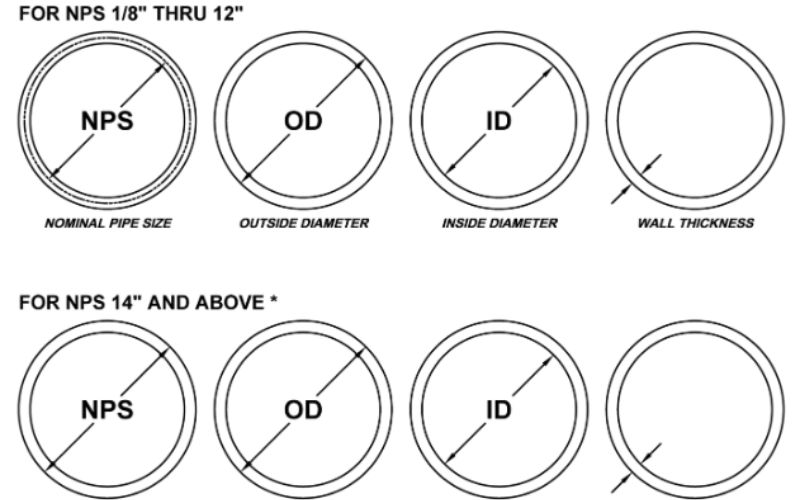
Specify pipe dimensions by pairing Nominal Pipe Size (NPS) with an ASME B36.19-2026 wall schedule such as 5S, 10S, 40S, or 80S. For example, NPS 2 Schedule 40S fixes outside diameter at 2.375 inches (60.3 mm) and nominal wall at 0.154 inch (3.91 mm), while ASME B31.3-2024 governs allowable pressure.
How are the dimensions for ASTM A312 steel pipes specified?
ASTM A312 dimensions follow ASME B36.19-2026 schedules: NPS 2 sets 2.375 inches (60.3 mm) OD, with 0.109 inch (2.77 mm) wall in 10S and 0.154 inch (3.91 mm) in schedule 40 pipe (40S). Appendix X1 lists Schedules 5S, 10S, 40S, and 80S. Unlike carbon steel wall tables, stainless S-schedules standardize thin corrosion-resistant walls. Piping designers verify matching butt-weld fitting geometry and pipe schedule dimensions on our reference page before ordering.
Hypothetical example: On a high-pressure NPS 2 header, stepping from Schedule 10S (2.77 mm wall) to Schedule 40S (3.91 mm wall) adds 1.14 mm of nominal wall. Engineers deduct mill wall under-tolerance and corrosion allowance before sizing in ASME B31.3-2024, because 40S isn’t a pressure class.
Circular pipe shape tolerances govern OD and wall thickness on beveled or plain ends, while structural square pipe is outside the scope of ASTM A312. Thin-wall Schedules 5S and 10S are generally unsuitable for cutting standard pipe threads because threading leaves inadequate residual wall. Specify socket-weld or butt-weld joints on schedules 5S and 10S, and verify acceptance limits.
Chemical composition and mechanical properties

Grades TP304 and TP316 require minimum tensile and yield strengths of 75 ksi (515 MPa) and 30 ksi (205 MPa), respectively, at room temperature. Low-carbon TP304L and TP316L carry 70 ksi (485 MPa) tensile and 25 ksi (170 MPa) yield minimums unless dual-certified stock meets standard-grade strength.
Melt chemistry and quench quality are verified on each lot against Table 1 chemical composition limits and Table 4 mechanical properties. Room-temperature tension tests follow ASTM E8/E8M-25 Section 1.4 between 10 °C and 38 °C (50 °F to 100 °F) unless otherwise specified. Under ASTM E8/E8M-25 Section 4.2, small tension-specimen material properties confirm mill lot acceptance on ASTM A312 pipes rather than establishing elevated-temperature allowable stresses in ASME B31.3-2024.
| Grade / Rule Item | Chemistry Basis | Min Tensile Strength | Min Yield Strength | Governing Acceptance Note |
|---|---|---|---|---|
| TP304 (S30400) | A312 Table 1 standard carbon | 75 ksi (515 MPa) | 30 ksi (205 MPa) | Room-temperature lot acceptance per Table 4 |
| TP304L (S30403) | A312 Table 1 pipe low-carbon limit | 70 ksi (485 MPa) | 25 ksi (170 MPa) | Do not substitute plate carbon limits for pipe Table 1 |
| TP316 (S31600) | A312 Table 1 Cr-Ni-Mo composition | 75 ksi (515 MPa) | 30 ksi (205 MPa) | Standard molybdenum grade for general process headers |
| TP316L (S31603) | A312 Table 1 low-carbon Cr-Ni-Mo | 70 ksi (485 MPa) | 25 ksi (170 MPa) | Order dual TP316/TP316L if design requires 30 ksi (205 MPa) yield |
| TP321 Seamless (≤3/8 inch wall) | A312 Table 1 Ti-stabilized | 75 ksi (515 MPa) | 30 ksi (205 MPa) | Applies up to 3/8 inch (9.5 mm) nominal wall thickness |
| TP321 Seamless (>3/8 inch wall) | A312 Table 1 Ti-stabilized | 70 ksi (485 MPa) | 25 ksi (170 MPa) | Lower heavy-wall seamless pipe tier in A312 |
| H Grades (TP304H / TP316H / TP321H) | A312 Table 1 H-grade chemistry | Per ordered H grade in Table 4 | Per ordered H grade in Table 4 | Intended for elevated-temperature creep-range service |
| Lot Tension Check | A312 Table 4 + ASTM E8/E8M | Per ordered grade minimum | Per ordered grade minimum | Confirms mill lot quality rather than installed allowable stress |
| Design Stress Selection | ASME B31.3-2024 Appendix A | Temperature-dependent table | Wall & heat-treat bound | Never swap allowable stresses across wall-thickness tiers |
Field experience shared on Eng-Tips piping forums highlights a frequent TP321 pitfall: code allowable stress tables separate heavy-wall and thin-wall seamless pipe tiers. Dual-certified TP316/TP316L pipe avoids the L-grade yield reduction in welded lines, if both grades appear on the heat treatment and test certificate.
Heat treatment, testing and traceability

ASTM A312 pipes require furnace solution heat treatment per Table 2, lot mechanical testing, and either a hydrostatic test or a nondestructive electric test on every length. Unless the purchase order specifies one test method, the mill selects the leak check and records heat-number traceability on the report.
Under ASTM A312/A312M-25 and ASTM A999/A999M-23, nondestructive electric testing takes the place of hydrostatic testing, unless the buyer requests a different method. When purchase orders include ultrasonic testing or eddy-current checks, state the method and acceptance criteria on the order. Mill test certificates then report the exact inspection performed. According to PipeCloud’s fabrication traceability guide, mistakes in manual transcription or un-transferred stencils during spool cutting break the link between pipe segments and MTRs. Quality teams comparing various European documentation formats can review mill inspection certificate levels before setting witness points.
Specification-to-Document Map
Routinely assign melt chemistry and solution-anneal reviews to materials engineering, mechanical and leak-test verification to quality inspection, and heat-number stencil checks to receiving staff, before spool fabrication.
| Verification Checkpoint | Governing Basis | Scope Trigger | Required Evidence on Record | Reviewer Role |
|---|---|---|---|---|
| Order Hierarchy & Edition | ASTM A999/A999M-23 Section 1.2 | Every purchase order | Agreed edition year and stricter PO clauses matched on MTR | Procurement Lead |
| Unit System Exclusivity | ASTM A999/A999M-23 Section 1.3 | Every order line | Consistent inch-pound A312 or metric A312M values throughout | Piping Engineer |
| Heat Chemistry | ASTM A312 Table 1 | Each melt heat | Ladle elemental analysis tied to stenciled heat number | Materials Engineer |
| Solution Heat Treatment | ASTM A312 Table 2 | Each heat-treat lot | Recorded furnace solution-anneal and cooling condition | QA Inspector |
| Room-Temp Tension Test | ASTM A312 Table 4 + ASTM E8/E8M-25 | Each production lot | Measured yield, tensile, and elongation values | QA Inspector |
| Mechanical Flattening Check | ASTM A312 + ASTM A999/A999M | Applicable pipe lots | Conforming ductility result for the ordered route | QA Inspector |
| Hydrostatic or Electric Test | ASTM A312 + ASTM A999/A999M | Each pipe length | Actual hydrostatic or nondestructive electric method stated | Piping Engineer |
| Supplementary Testing | ASTM A312 Supplementary Clauses | Only when named on PO | Additional corrosion, radiographic, or product-check reports | Materials Engineer |
| Stencil & Cut-Spool Traceability | ASTM A999/A999M + Shop QA | Each length & cut piece | Grade, SMLS/WLD/HCW route, and heat number transferred before cutting | Receiving Warehouse |
Material testing records must match the exact manufacturing route and heat number stenciled on each pipe barrel before the warehouse receiving staff releases bundles to adjacent standard checks.
ASTM A312 vs A269, A213, A358 and ASME SA312

Do not use ASTM A269 general tubing or ASTM A213 heat-exchanger tubes in place of ASTM A312 process pipe just because both have a 316L mark. Pipe orders follow NPS and schedule geometry, whereas tubing orders use outside diameter and wall thickness under distinct acceptance rules.
Tubular products covered by ASTM standards separate by sizing geometry, filler-metal rules, and pressure service. ASTM A269/A269M-25 covers seamless tubing and welded austenitic tubing specified by outside diameter and wall thickness. Consult our ASTM A269 general-service stainless tubing guide for sizing instrument runs. ASTM A213/A213M-25 governs seamless steel boiler, superheater and heat-exchanger tubes. Electric fusion welded pipe made with filler metal is included in ASTM A358/A358M-24a Section 1.3, across five classes. Class 1 requires double welding with filler metal and complete radiography, Class 2 omits radiography, and Class 5 requires spot radiography.
| Designation | Product Form & Sizing | Allowed Manufacturing Routes | Key Acceptance Distinction |
|---|---|---|---|
| ASTM A312 / A312M-25 | Process pipe (NPS + Schedule) | SMLS, autogenous WLD, HCW | −12.5% under nominal wall at any point (ASTM A999/A999M-23); austenitic grades only |
| ASME SA312 (ASME SA 312) | BPVC Section II-A pipe specification | Routes per adopted ASME edition | Marking and edition follow the governing construction code and purchase order |
| ASTM A269 / A269M-25 | General tubing (outside diameter × wall) | Seamless tubing or welded tubing | Tubing tolerances and flaring tests; not interchangeable with NPS pipe flanges |
| ASTM A213 / A213M-25 | Boiler, superheater & exchanger tube | Seamless tube for heat transfer | Heat-transfer tubing service; separate sizing and wall basis from process pipe |
| ASTM A358 / A358M-24a | Electric-fusion-welded process pipe | Filler-metal EFW across five classes | Class 1 completely radiographed; Class 2 no radiography; Class 5 spot RT |
| Duplex Stainless Pipe (S31803) | Ferritic-austenitic process pipe | Dedicated duplex pipe specifications | Excluded from austenitic ASTM A312 scope even on mixed supplier catalogs |
Shipping 2-inch OD tubing (50.8 mm) instead of NPS 2 (60.3 mm OD) leaves a 9.5 mm diameter mismatch at every weld neck flange. According to Section 1.2 of ASTM A999/A999M-23, any stricter purchase order requirement prevails over both A312 and A999, when assessing commercial pipe quotes.
Price, lead time and quote comparison

Normalize quotations for stainless steel pipe to one weight basis, route, length tolerance, traceability scope, and Incoterms, before comparing prices and lead times. Warehouse-welded pipe stock and custom seamless-pipe production with additional tests can carry different costs and schedules.
Proposal analysis rules in Federal Acquisition Regulation (FAR) 15.404-1 require price comparisons to adjust for differing terms, quantities, delivery schedules, and technical specs. A stainless steel pipe supplier quoting warehouse welded stock per meter prices theoretical mass and baseline mill testing. By contrast, a pipe manufacturer quoting custom seamless pipe heats per metric ton prices scale weight, offcuts, radiography, and export crating separately.
| Scope Field | Hypothetical Offer A (Stockist) | Hypothetical Offer B (Mill Production) | Buyer Normalization Action |
|---|---|---|---|
| Grade & Strength Basis | Single TP316L (25 ksi / 170 MPa yield) | Dual TP316/TP316L (30 ksi / 205 MPa yield) | Confirm allowable stress basis in ASME B31.3-2024 design |
| Manufacturing Route | WLD autogenous seam | SMLS hot-pierced and cold-finished | Separate WLD and SMLS unit rates before commercial ranking |
| Pricing Weight Basis | Invoiced per meter (theoretical weight) | Invoiced per metric ton (scale weight) | Convert both quotations to landed cost per usable meter |
| Length Delivery | Unsorted mill random lengths | Fixed cut-to-length fabrication spools | Account for spool offcut waste and extra field butt welds |
| Inspection Scope | Baseline mill electric test only | Hydrostatic test plus supplementary corrosion check | Add third-party testing cost and schedule time if required |
| Incoterms & Packing | EXW warehouse, bare bundles | CIF port, capped ends and seaworthy crates | Add inland freight, end protection, and ocean transit |
Every international exporter prices nickel and molybdenum alloy surcharges on a limited validity window. Request a line-item quote to get the latest price and mill dispatch schedules, and ensure you’ve adequately defined the supplier’s scope and completed the purchase-order checklist.
Supplier scope and a purchase-order checklist

Bind each supplier to order-specific edition, grade, route, heat traceability, and supplementary tests on the purchase order. Summary information from a catalog does not substantiate lot-specific testing or compliance. Separate austenitic ASTM A312 items from duplex grades on mixed inquiries, and lock ten fields before production release.
Companies that supply stainless steel products frequently group multiple alloy families on one catalog page. Baling Steel’s published stainless steel pipe specifications, for example, showcase Seamless Stainless Steel Pipe offerings of austenitic 304, 304L, 316, 316L, and duplex S31803 for petrochemical and industrial applications. Duplex S31803, which is not included in ASTM A312’s scope of austenitic stainless steels, must be treated as a separate requisition. Every qualified steel pipe manufacturer confirms actual route, solution heat treatment records, and NDE. Buyers evaluating supply options are welcome to review our guide to global stainless steel pipe manufacturers.
10-Field Pipe Order Check
A 10-Field Pipe Order Check aligns engineering, procurement, quality inspection and logistics on the ten mandatory inputs, before releasing a mill or stock order.
- Standard and edition year: State ASTM A312/A312M-25 or the exact edition locked by the project contract, plus ASME SA312 only when code construction rules require it.
- Exclusive unit system: Specify inch-pound A312 or metric A312M and keep dimensions, tolerances, and tensile limits in that single system.
- Exact austenitic grade: Name UNS and grade such as TP304L (S30403), TP316L (S31603), H-grade, or dual-certified TP316/TP316L for 30 ksi (205 MPa) minimum yield.
- Manufacturing route code: Specify SMLS, autogenous WLD, or HCW so stockists cannot substitute an unapproved route.
- NPS and ASME B36.19 schedule: Pair Nominal Pipe Size with Schedule 5S, 10S, 40S, or 80S and state any special wall-thickness tolerance on the order.
- Length basis and end preparation: Define random versus fixed cut lengths together with plain or beveled weld ends and pickled surface finish.
- Heat-treatment verification: Require furnace solution-anneal and cooling confirmation per Table 2 on the mill test certificate.
- Baseline leak check selection: State hydrostatic testing or nondestructive electric testing explicitly when project rules do not allow mill option.
- Optional supplementary clauses: Name any required intergranular corrosion, radiographic, or product-analysis rechecks directly on the purchase order.
- Heat traceability and export packing: Require heat-number stencils matched to MTRs, spool-cut heat transfer rules, end caps, crates, and agreed Incoterms.
Piping engineering owns edition, unit basis, grade, route, and schedule inputs. Procurement and finance normalize pricing and ensure Incoterms. Quality assurance aligns certificates, stencils and tests, before release.
Common specification errors before release

Most pre-shipment holds stem from mixing SI and inch-pound limits or assuming baseline ASTM A312 includes optional corrosion and radiographic tests. Un-transferred heat stencils on cut spools also hold up receiving. Discrepancies are resolved by aligning order clauses to pipe markings and mill test reports, before shipment.
Receiving rejections at fabrication yards often trace back to document mismatches across linked standards rather than off-spec melt chemistry. Requisitions sometimes mix metric MPa strengths with imperial inch-pound units in violation of ASTM A999/A999M-23 Section 1.3. On corrosive welded headers, buyers also assume baseline ASTM A312/A312M-25 covers weld-decay or radiographic testing without naming supplementary requirements on the order.
- Match every pipe barrel heat-number stencil to ladle chemistry, solution-anneal condition, and leak-test results on the certificate.
- Order dual-certified TP316/TP316L when welded spools require low-carbon weldability alongside 30 ksi (205 MPa) minimum yield strength.
- Specify supplementary corrosion or radiographic clauses on the purchase order whenever project service conditions demand extra NDE.
- Transfer stenciled heat numbers onto every cut segment before workshop beveling and spool assembly.
- Combine metric A312M strength values with inch-pound A312 dimensional tolerances in the same requisition line.
- Assume baseline A312 compliance includes radiography, intergranular corrosion testing, or minimum-wall tolerances automatically.
- Accept duplex S31803 or filler-welded A358 pipe under an A312 line item without formal engineering change approval.
- Substitute ASTM A269 outside-diameter tubing where piping drawings call for NPS and ASME B36.19 pipe schedules.
Hypothetical example: On Schedule 10S TP304L cooling headers, inspectors found cut segments missing transferred heat stencils. The certificate also showed an electric NDE where the order required hydrostatic testing. Dispatch was held until stencils and the hydrotest records matched, thus preventing costly site rework.
Frequently Asked Questions
What is ASTM A312 TP316L?
ASTM A312 TP316L designates austenitic stainless steel process pipe in low-carbon molybdenum grade UNS S31603 with a minimum tensile strength of 70 ksi (485 MPa) and a minimum yield strength of 25 ksi (170 MPa).
That material designation alone never fixes pipe geometry or route. A complete purchase order also states the applicable edition, SMLS or WLD route, Nominal Pipe Size, ASME B36.19-2026 schedule, and any supplementary corrosion or radiographic tests needed for lot acceptance.
Is ASTM A312 seamless?
No—ASTM A312 covers three manufacturing routes: seamless pipe (SMLS), straight-seam autogenously welded pipe (WLD), and heavily cold worked pipe (HCW).
Specify seamless pipe (SMLS) directly when project specifications prohibit welded seams. If the design requires a 1.00 longitudinal joint factor under ASME B31.3, specify the qualified welded or seamless route that meets that requirement.
What is ASTM A312M?
ASTM A312M is the SI metric unit designation within the combined A312/A312M specification, governing millimeter dimensions and MPa strength minimums when ordered.
Maintain dimensions, tolerances and test reports consistent within the same unit designation (either inch-pound (A312) or SI metric (A312M)) within the combined specification. Mixing of metric strength limits with inch-pound wall tolerances on the same order line does not conform to ASTM A999/A999M-23 Section 1.3.
Is Sch 40 and STD the same?
No, Schedule 40, Standard Weight (STD), and stainless Schedule 40S are distinct ASME schedule designations rather than interchangeable labels; verify exact NPS wall thickness in ASME B36.19-2026.
Where can I obtain the ASTM A312 PDF?
The controlled PDF is distributed by ASTM International and authorized standards distributors; uncontrolled web uploads are not reliable substitutes.
Build every requisition against the edition named in your contract or piping design basis. Do this even if a newer edition exists. It’s possible that uncontrolled PDFs on supplier websites may omit table footnotes or be behind the latest edition. Pair that controlled copy with your purchase-order specification, agreed supplementary clauses, and heat-traceable mill test reports. Be sure to maintain the version of the specification visible in these documents for alignment of the engineering, purchasing, and receiving inspection functions.
About This Specification Review
Our technical team compiled these scope, dimensional, metallurgical, and testing rules from ASTM A312/A312M-25, ASTM A999/A999M-23, ASME B36.19-2026, and ASME B31.3-2024. Corrosion and cryogenic weld findings draw on NIST Technical Note 2229 plus SSINA and BSSA publications. Reviewed by the Hunan Baling Steel Co., Ltd technical team.
Prepare a Clear Stainless Steel Pipe Inquiry
Send your required ASTM A312 edition, grade, SMLS or WLD route, NPS and schedule list, cut lengths, and supplementary test clauses for an item-by-item Baling Steel quotation.
References & Sources
- ASTM A312/A312M-25 (ASTM A312, ASTM A312M, ASTM A312/A312M) Standard Specification for Seamless, Welded, and Heavily Cold Worked Austenitic Stainless Steel Pipes ASTM International
- ASTM A999/A999M-23 (ASTM A999, ASTM A999/A999M) Standard Specification for General Requirements for Alloy and Stainless Steel Pipe ASTM International
- Chloride Stress Corrosion Cracking Technical Guide Specialty Steel Industry of North America (SSINA)
- Selection of 316, 304 and 303 Types of Stainless Steels for Seawater Applications British Stainless Steel Association (BSSA)
- Combating Plate Corrosion (Dr. Hira Ahluwalia) Fabricators & Manufacturers Association / The Fabricator
- NIST Technical Note 2229: Tensile Tests at 77 K and 4 K on 316L Stainless Steel Welded Plates National Institute of Standards and Technology (NIST)
- ASME B36.19-2026 (ASME B36.19) Welded and Seamless Wrought Stainless Steel Pipe American Society of Mechanical Engineers (ASME)
- ASME B31.3-2024 (ASME B31.3) Process Piping Code and ASME SA312 Material Adoption American Society of Mechanical Engineers (ASME)
- ASTM E8/E8M-25 (ASTM E8, ASTM E8/E8M) Standard Test Methods for Tension Testing of Metallic Materials ASTM International
- ASTM A269/A269M-25 (ASTM A269, ASTM A269/A269M) Standard Specification for Seamless and Welded Austenitic Stainless Steel Tubing for General Service ASTM International
- ASTM A213/A213M-25 (ASTM A213, ASTM A213/A213M) Standard Specification for Seamless Ferritic and Austenitic Alloy-Steel Boiler, Superheater, and Heat-Exchanger Tubes American Society for Testing and Materials (ASTM International)
- ASTM A358/A358M-24a (ASTM A358, ASTM A358/A358M) Standard Specification for Electric-Fusion-Welded Austenitic Chromium-Nickel Stainless Steel Pipe ASTM International
- Federal Acquisition Regulation (FAR) 15.404-1 Proposal Analysis Techniques U.S. General Services Administration (Acquisition.GOV)
- Heat Number Tracking in Pipe Fabrication PipeCloud
- Allowable Stress of ASME A312-TP321 Seamless Pipe Engineering Thread Eng-Tips