Author: Jasonxue | Technical Review: Reviewed by the Hunan Baling Steel Co., Ltd technical team
What’s drift diameter in casing? Under API Spec 5CT, drift diameter in casing is the guaranteed minimum internal clearance of a pipe joint. Inspectors verify it by passing a cylindrical mandrel through the full length without undue force. On 7-in. 29.00 lb/ft casing (nominal ID 6.184 in.), standard drift diameter is 6.059 in. (153.90 mm) checked with a 6-in. (152 mm) mandrel.
Sizing tools according to nominal bore, rather than the verified casing drift, causes packer hang-ups in legal, within tolerance pipe. Heavy-wall strings often need API 5CT alternate drift. For example, upgrading 9-5/8 in. 53.50 lb/ft casing from 8.379 in. to 8.500 in. clears an 8-1/2 in. bit. API Spec 5CT 11th Edition and Addendum 1 (published May 20, 2025; effective June 1, 2026) also tighten end-drifting and high-collapse records.
What Is Drift Diameter in Casing?
Casing drift diameter sits 0.125 to 0.1875 in. (3.18 to 4.76 mm) below nominal inside diameter across standard 4-1/2 in. to 20 in. API 5CT sizes. Engineers treat it as a go/no-go bore clearance guarantee, not a wall measurement. Every accepted casing joint passes a calibrated mandrel full length without force per API Spec 5CT and ISO 11960.
Think of casing drift like testing a highway tunnel with a rigid box truck rather than reading blueprint height. Blueprint height ignores dipped beams and surface crowns, while the rigid frame proves real vehicle passage. In oil and gas wells, a casing joint’s actual internal diameter shifts along its length within manufacturing tolerances. Under API RP 5A5 as cited by the IADC Lexicon, any pipe length that blocks a mandrel of specified diameter without undue force fails as no-drift.
Teams looking at casing and tubing selection guidance in procurement must distinguish nominal bore from drift diameter at an early stage. Nominal IDs control internal fluid capacity and annular velocity calculations. Drift diameter governs the largest drill bit, liner hanger, packer, or wireline tool allowed to pass through the casing string.
Before they’re run into the borehole, field crews also re-drift the joints to catch mill scale or shipping dents.
Why Is Casing Drift Diameter Always Smaller Than Nominal Inside Diameter?
Mill dimensional, roundness, and -12.50% minimum wall tolerances, plus piercing eccentricity and pipe ovality, force verified casing drift 1/8 to 3/16 in. under theoretical bore across 4-1/2 to 20 in. sizes. Localized thick wall spots and slight longitudinal bow further narrow the largest straight cylinder that passes cleanly through the joint.
While a joint might easily sit within outside diameter, plain-end weight, and average wall thickness tolerances, an oval cross-section may still pinch a tool of the nominal ID size. A deduction for API 5CT drift accounts for normal mill ovality, wall thickness variation, and slight pipe curvature. Any casing pipe which fails the drift gauge test has excessive deformation or obstruction and won’t enter the wellbore.
How Does Casing Drift Diameter Work Under API 5CT?
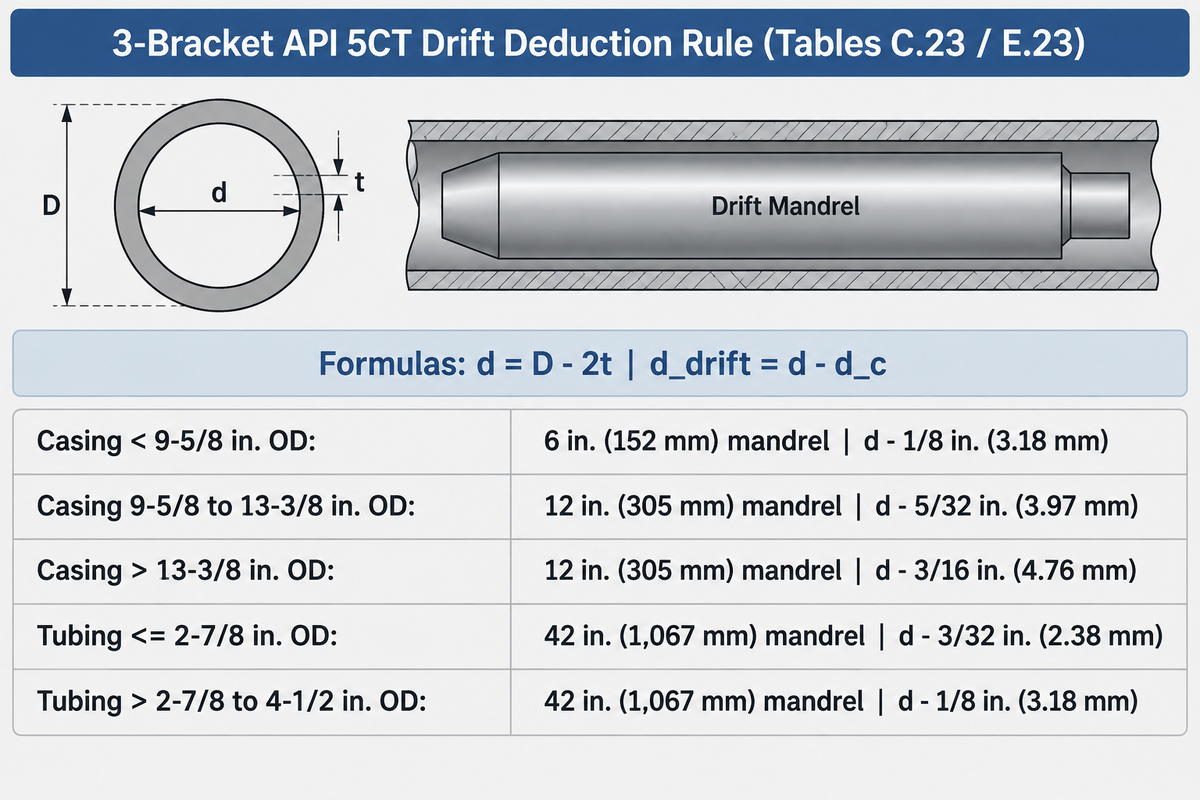
Under API Spec 5CT 11th Edition Clause 7.10.3 and Tables C.23/E.23, standard casing drift deducts 1/8 in. (3.18 mm) below 9-5/8 in. OD, 5/32 in. (3.97 mm) from 9-5/8 in. to 13-3/8 in., and 3/16 in. (4.76 mm) above 13-3/8 in. These drift specifications apply to every standard pipe length.
The two linear expressions containing the specified outside diameter (D) and nominal wall thickness (t) are employed in every calculation.
3-Bracket API 5CT Drift Deduction Rule
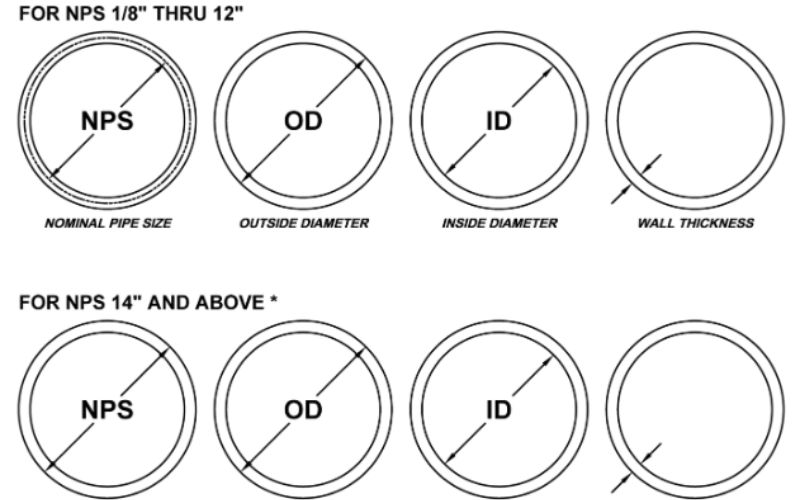
Nominal Inside Diameter: d = D – 2t
Standard Drift Diameter: d drift = d – d c (d c steps across three OD brackets per API Spec 5CT 11th Edition Tables C.23 / E.23).
Applying the 3-Bracket API 5CT Drift Deduction Rule reconciles API Spec 5CT 11th Edition drift tables (Annex C/E items 23 and 24, denoted C.23/E.23 and C.24/E.24) with widely cited 10th Edition tables (items 28 and 29, denoted C.28/E.28 and C.29/E.29). It also fixes two recurring lookup errors. First, the 6-in. (152 mm) to 12-in. (305 mm) mandrel cutoff sits at 9-5/8 in. (244.48 mm) OD rather than at the 8 in. or 8-5/8 in. cutoff. Second, this worked 5-size API 5CT drift deduction table spans 4-1/2 in. to 16 in. casing (where 16 in. and larger pipes use the 3/16 in. / 4.76 mm deduction). Several online drift guides still print a 6-in. mandrel length for all sizes including 9-5/8 in. and larger, whereas API 5CT requires a 12-in. (305 mm) cylindrical mandrel from 9-5/8 in. through 20 in.
| API 5CT Product & OD Bracket | Mandrel Length | Drift Deduction (dc) | Covered Casing / Tubing Sizes |
|---|---|---|---|
| Casing Bracket 1 (< 9-5/8 in. OD) | 6 in. (152 mm) | d – 1/8 in. (0.125 in. / 3.18 mm) | 4-1/2 in., 5 in., 5-1/2 in., 6-5/8 in., 7 in., 7-5/8 in., 8-5/8 in. |
| Casing Bracket 2 (9-5/8 in. to 13-3/8 in. OD) | 12 in. (305 mm) | d – 5/32 in. (0.156 in. / 3.97 mm) | 9-5/8 in., 10-3/4 in., 11-3/4 in., 13-3/8 in. |
| Casing Bracket 3 (> 13-3/8 in. OD) | 12 in. (305 mm) | d – 3/16 in. (0.1875 in. / 4.76 mm) | 16 in., 18-5/8 in., 20 in. |
| Tubing (≤ 2-7/8 in. OD) | 42 in. (1,067 mm) | d – 3/32 in. (0.094 in. / 2.38 mm) | 1.050 in. through 2-7/8 in. |
| Tubing (> 2-7/8 in. to 4-1/2 in. OD) | 42 in. (1,067 mm) | d – 1/8 in. (0.125 in. / 3.18 mm) | 3-1/2 in., 4 in., 4-1/2 in. (and casing ordered as tubing) |
Suppose a drilling engineer checks whether an 8-1/2 in. (215.90 mm) bit clears 9-5/8 in. 47.00 lb/ft casing. The nominal OD is 9.625 in. and nominal wall thickness is 0.472 in. That gives a nominal ID of 9.625 – (2 x 0.472) = 8.681 in. Because 9-5/8 in. sits in Bracket 2, subtracting 0.156 in. yields 8.525 in. (216.54 mm) standard drift checked with a 12-in. mandrel. That leaves 0.025 in. (0.64 mm) positive clearance over an 8.500 in. bit on straight joints, while curved doglegs still need a separate BHA check.
| Casing Size & Weight | OD (D) | Wall (t) | Nominal ID (D – 2t) | Deduction (dc) | Standard Drift (USC / SI) | Mandrel Length |
|---|---|---|---|---|---|---|
| 4-1/2 in. 11.60 lb/ft | 4.500 in. | 0.250 in. | 4.000 in. | 0.125 in. | 3.875 in. (98.42 mm) | 6 in. (152 mm) |
| 7 in. 29.00 lb/ft | 7.000 in. | 0.408 in. | 6.184 in. | 0.125 in. | 6.059 in. (153.90 mm) | 6 in. (152 mm) |
| 9-5/8 in. 47.00 lb/ft | 9.625 in. | 0.472 in. | 8.681 in. | 0.156 in. | 8.525 in. (216.54 mm) | 12 in. (305 mm) |
| 13-3/8 in. 68.00 lb/ft | 13.375 in. | 0.480 in. | 12.415 in. | 0.156 in. | 12.259 in. (311.38 mm) | 12 in. (305 mm) |
| 16 in. 75.00 lb/ft | 16.000 in. | 0.438 in. | 15.124 in. | 0.188 in. | 14.936 in. (379.37 mm) | 12 in. (305 mm) |
What Size Is an API 5CT Drift Mandrel and How Is the Drift Test Run?
An API 5CT casing drift mandrel measures 6 in. (152 mm) below 9-5/8 in. OD or 12 in. (305 mm) at 9-5/8 in. and larger, and inspectors pass it full length by hand, air rabbit, or gravity without undue force. Each gauge is machined to at least the minimum specified drift diameter. Under API RP 5A5 via the IADC Lexicon, this machined cylinder locates internal obstructions and verifies specification compliance.
A subtle shop rule catches many auditors off guard. As an API Q1 and Spec 5CT practitioner explains on Eng-Tips, API 5CT sets minimum mandrel diameter and length with no upper tolerance, and mandrels can’t carry the API Monogram. Mills often machine steel production drift mandrels 0.005 to 0.015 in. oversize for wear life and check them with a +0.005 in. no-go gauge. Shops re-test production rejects using a calibrated referee mandrel at exact API minimum size. For internally coated tubulars, inspectors switch to plastic or urethane mandrels to protect the lining.
Types of Casing Drift Diameter: Standard, Alternate, and Special Drift
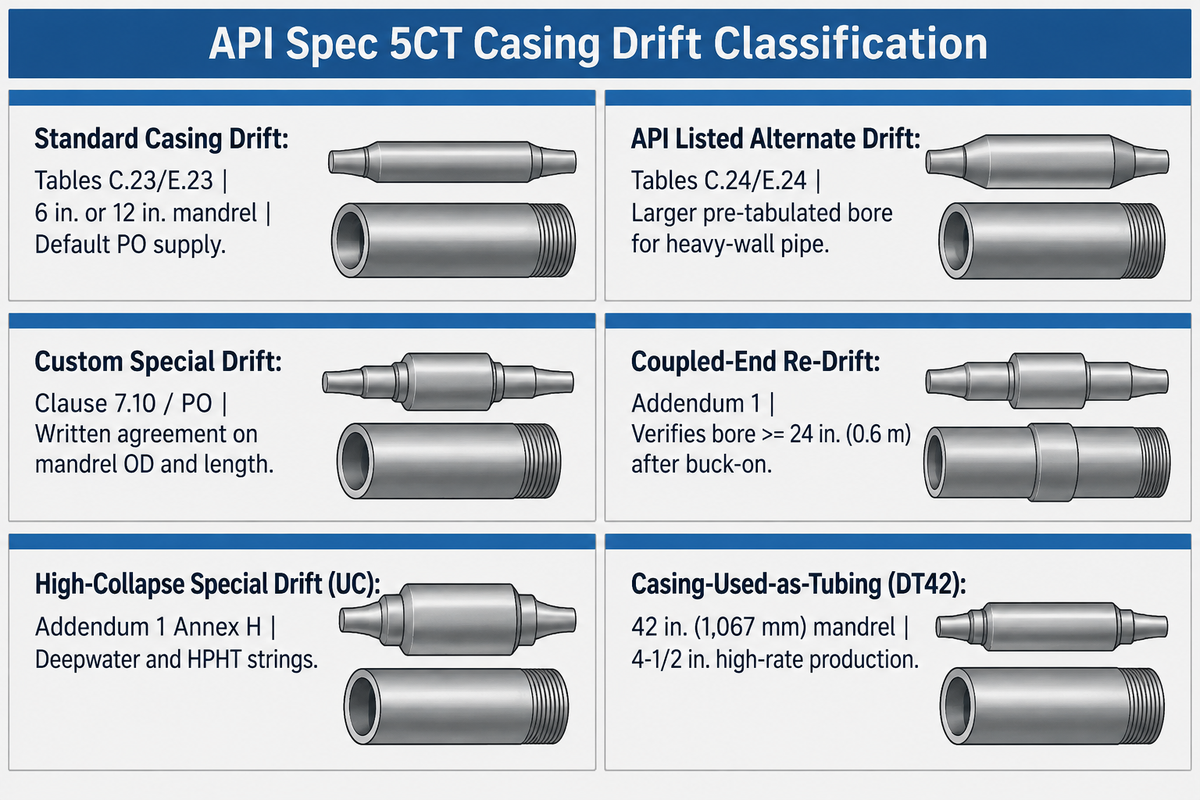
Nine practical OCTG drift classes under API Spec 5CT cover standard casing brackets, Table C.24/E.24 alternate drift, custom special drift, coupled-end re-drift, high-collapse special drift, 42-in. tubing drift, and non-API sizes. Buyers reviewing well casing pipe dimensions and supply options should specify the exact numeric diameter rather than vague labels.
Confusing API-listed alternate drift with custom special drift slows mill quotations.
| Type | Mandrel Length | Diameter Basis | API 5CT Reference | Primary Field Use |
|---|---|---|---|---|
| Standard Casing Drift (< 9-5/8 in.) | 6 in. (152 mm) | d – 1/8 in. (3.18 mm) | Tables C.23 / E.23 | Production strings and liners (4-1/2 in. to 8-5/8 in.) |
| Standard Casing Drift (9-5/8 in. to 13-3/8 in.) | 12 in. (305 mm) | d – 5/32 in. (3.97 mm) | Tables C.23 / E.23 | Intermediate and surface strings with standard bits |
| Standard Casing Drift (> 13-3/8 in.) | 12 in. (305 mm) | d – 3/16 in. (4.76 mm) | Tables C.23 / E.23 | Surface and conductor casing (16 in., 18-5/8 in., 20 in.) |
| API Listed Alternate Drift | 6 in. or 12 in. | Pre-tabulated larger OD | Tables C.24 / E.24 | Clearing standard drill bits in heavy-wall casing |
| Custom Purchaser-Agreed Special Drift | Per PO agreement | Agreed numeric diameter | Clause 7.10 / PO | Tight-tolerance completions and non-standard bit gauges |
| Coupled-End / Processed-End Re-Drift | 6 in. or 12 in. | Matches pipe-body drift | Addendum 1 End-Drifting | Verifying bore ≥ 24 in. (0.6 m) after coupling buck-on |
| High-Collapse Special Drift (UC) | 6 in. or 12 in. | Alternate/custom + HC spec | Addendum 1 Annex H | Deepwater, salt-zone, and HPHT tight-clearance wells |
| Casing-Used-as-Tubing Drift (DT42) | 42 in. (1,067 mm) | d – 1/8 in. (3.18 mm) | Tables C.23 / Marking | 4-1/2 in. casing run as high-rate production tubing |
| Non-API Oversize / Proprietary Drift | Custom length | Mill-qualified tolerance | Outside API 5CT tables | Odd-ball non-API OD strings (e.g., 9-7/8 in., 11-7/8 in.) |
If a P.O. requires standard API 5CT casing or tubing, and there’s no mention of an alternate drift, the mill will supply Table C.23/E.23 casing drifts as standard. If an alternate drift from the API list (Tables C.24/E.24) is specified, the pipe stays in API 5CT standard certification. The mill holds tighter wall thickness and roundness tolerances to fulfill a greater gauge requirement.
Any special drift outside of Tables C.24/E.24 needs written approval on mandrel OD, length of cylinder, and acceptance standards before the mill proceeds to roll.
What Is an Alternate Drift in API 5CT and Is It Always Larger Than Standard Drift?
Yes, API Spec 5CT listed alternate drift dimensions in Tables C.24/E.24 are larger than standard casing drift for every listed OD-and-weight pair. That upgrade gives heavy-wall strings enough bore to pass standard drill bits. For instance, 7 in. 32.00 lb/ft casing moves from 5.969 in. standard drift up to 6.000 in. alternate drift, while 9-5/8 in. 53.50 lb/ft moves from 8.379 in. to 8.500 in.
The alternate drift is only available for the specific casing dimensions and nominal weights as specified in Tables C.24 and E.24. For weights that aren’t listed or for custom non-API dimensions, just stating “special drift” without specifying a numeric mandrel OD and length will mean that there’s no enforceable dimensional target.
Drift Diameter vs. Nominal Inside Diameter and Tubing Drift
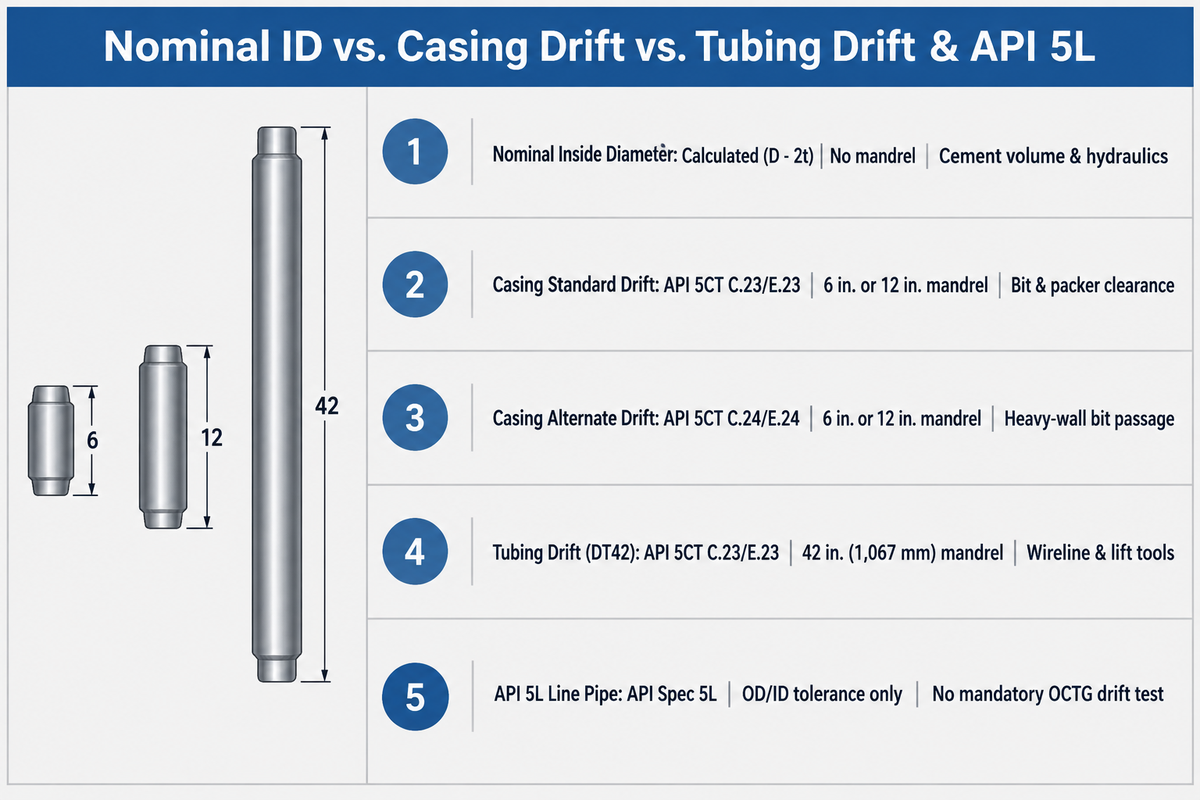
Casing drift diameter verifies short-span bore passage with a 6-in. or 12-in. mandrel, whereas API 5CT tubing drift demands a 42-in. (1,067 mm) mandrel. Nominal inside diameter is strictly an arithmetic reference. Understanding the key differences between oilfield casing and tubing stops buyers from mixing standards. Tubing drift deducts 3/32 in. (2.38 mm) up through 2-7/8 in. OD and 1/8 in. (3.18 mm) above 2-7/8 in., while casing drift deducts 0.125 to 0.1875 in. (3.18 to 4.76 mm).
| Dimensional Term | Governing Standard | Verification Method | Mandrel Length | Engineering Role |
|---|---|---|---|---|
| Nominal Inside Diameter | API 5CT / ISO 11960 | Calculated (D – 2t) | Not applicable | Cement volume, displacement, and hydraulics |
| Casing Standard Drift | API 5CT Tables C.23/E.23 | Every joint, full length | 6 in. or 12 in. | Minimum bore guarantee for bits and packers |
| Casing Alternate / Special Drift | API 5CT Tables C.24/E.24 | Every joint, full length | 6 in. or 12 in. | Passing standard bits through heavy-wall pipe |
| Tubing Drift | API 5CT Tables C.23/E.23 | Every joint, full length | 42 in. (1,067 mm) | Long slickline, wireline, and artificial lift access |
| API 5L Line Pipe | API Spec 5L | OD/ID/end tolerance | Not applicable | Surface flowlines; no mandatory OCTG drift test |
The 42-in. (1,067 mm) tubing drift mandrel catches gentle longitudinal sweep and shallow ovality that a 6-in. casing mandrel slides right past. That matters on 4-1/2 in. casing size orders run as high-rate production tubing. Specifying the 42-in. mandrel (stenciled DT42) verifies adequate clearance for long wireline toolstrings and safety valves. API 5L line pipe follows separate end-diameter checks and never replaces API 5CT pipe drift verification downhole.
What Is the Difference Between Drift Diameter and Inside Diameter in Casing?
Nominal inside diameter equals outside diameter minus twice wall thickness, whereas casing drift diameter is a physically tested minimum bore sitting 0.125 to 0.1875 in. (3.18 to 4.76 mm) smaller across 4-1/2 in. to 20 in. sizes.
An engineer uses nominal ID for calculating cement slurry volumes and mud velocities and then matches downhole tool sizes to drift diameter.
Even a brand-new rotary-pierced joint will seldom maintain its uniform nominal ID across every cross-section. Differences in wall thickness, slight ovality and the coupling make-up compression reduce the diameter of the local circular opening to below nominal ID. Using drift diameter for tool clearance and the nominal ID for your hydraulic calculations keeps both well programs accurate.
What Is Casing Drift Diameter Used For in Drilling and Completion?
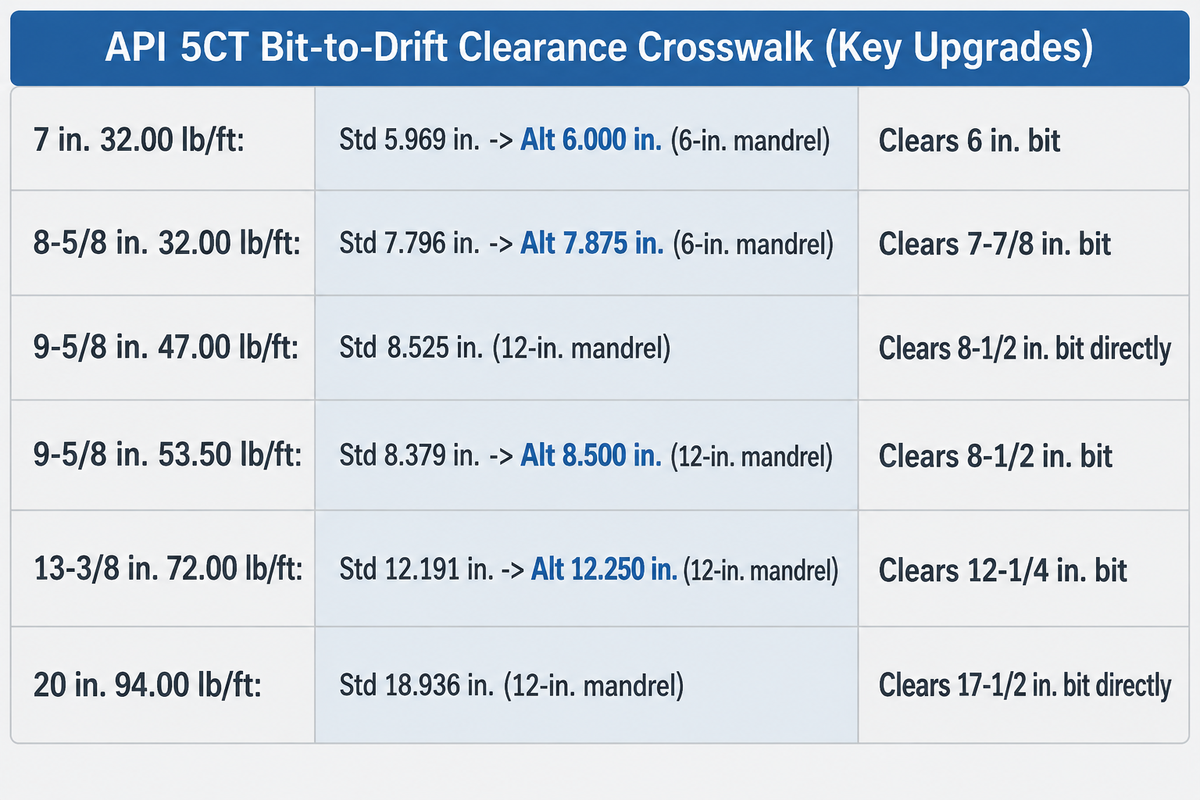
Drilling and completion engineers match casing drift diameter against the maximum outside diameter of drill bits, liners, packers, and completion tools. Upgrading 9-5/8 in. 53.50 lb/ft casing from 8.379 in. standard drift to 8.500 in. alternate drift clears an 8-1/2 in. bit. Similarly, upgrading 13-3/8 in. 72.00 lb/ft from 12.191 in. to 12.250 in. clears a 12-1/4 in. bit.
“The inside drift diameter of the casing is the minimum inside diameter (ID) of the casing and must exceed the major OD of the mandrel or valve.”
The API 5CT Bit-to-Drift Clearance Crosswalk below maps 13 common API 5CT casing sizes and nominal weights from 4-1/2 in. through 20 in. to standard drift, listed alternate drift, mandrel length, and passable bit sizes. Engineers evaluating intermediate strings can cross-check API 5CT N80 seamless casing specifications alongside conductor pipe sizing in multi-string well designs to verify every telescoping clearance step.
| Casing OD & Weight | Wall (in.) | Nominal ID (in.) | Standard Drift | API Alternate Drift | Mandrel | Standard Bit Cleared |
|---|---|---|---|---|---|---|
| 4-1/2 in. 11.60 lb/ft | 0.250 | 4.000 | 3.875 in. (98.42 mm) | Not applicable | 6 in. | 3-7/8 in. (3.875 in.) |
| 5-1/2 in. 17.00 lb/ft | 0.304 | 4.892 | 4.767 in. (121.08 mm) | Not applicable | 6 in. | 4-3/4 in. (4.750 in.) |
| 7 in. 23.00 lb/ft | 0.317 | 6.366 | 6.241 in. (158.52 mm) | 6.250 in. (158.75 mm) | 6 in. | 6-1/4 in. (with alternate) |
| 7 in. 29.00 lb/ft | 0.408 | 6.184 | 6.059 in. (153.90 mm) | Not applicable | 6 in. | 6 in. (6.000 in.) |
| 7 in. 32.00 lb/ft | 0.453 | 6.094 | 5.969 in. (151.61 mm) | 6.000 in. (152.40 mm) | 6 in. | 6 in. (with alternate) |
| 8-5/8 in. 32.00 lb/ft | 0.352 | 7.921 | 7.796 in. (198.02 mm) | 7.875 in. (200.02 mm) | 6 in. | 7-7/8 in. (with alternate) |
| 9-5/8 in. 40.00 lb/ft | 0.395 | 8.835 | 8.679 in. (220.45 mm) | 8.750 in. (222.25 mm) | 12 in. | 8-3/4 in. (with alternate) |
| 9-5/8 in. 47.00 lb/ft | 0.472 | 8.681 | 8.525 in. (216.54 mm) | Not applicable | 12 in. | 8-1/2 in. (standard drift) |
| 9-5/8 in. 53.50 lb/ft | 0.545 | 8.535 | 8.379 in. (212.83 mm) | 8.500 in. (215.90 mm) | 12 in. | 8-1/2 in. (with alternate) |
| 10-3/4 in. 45.50 lb/ft | 0.400 | 9.950 | 9.794 in. (248.77 mm) | 9.875 in. (250.82 mm) | 12 in. | 9-7/8 in. (with alternate) |
| 13-3/8 in. 68.00 lb/ft | 0.480 | 12.415 | 12.259 in. (311.38 mm) | Not applicable | 12 in. | 12-1/4 in. (standard drift) |
| 13-3/8 in. 72.00 lb/ft | 0.514 | 12.347 | 12.191 in. (309.65 mm) | 12.250 in. (311.15 mm) | 12 in. | 12-1/4 in. (with alternate) |
| 20 in. 94.00 lb/ft | 0.438 | 19.124 | 18.936 in. (480.97 mm) | Not applicable | 12 in. | 17-1/2 in. (standard drift) |
In real-life applications, field operations apply drift verification across three different downhole stages:
- Drill bit and nested liner clearance: Heavy-wall intermediate strings often collide with standard bits. In a Gulf of Mexico deepwater well documented by Drilling Contractor, an expanded liner bore was too narrow to run conventional 9-5/8 in. 53.5 lb/ft casing, forcing extra contingency liners. On slim nested liners, crews on Reddit r/oilandgasworkers note that standard 4-1/2 in. couplings exceed 5-1/2 in. casing ID. Even flush-joint connections leave only about 0.2 in. clearance.
- Packer running clearance versus setting ID range: completion equipment must pass two different bore checks. The maximum OD of a packer has to be less than the minimum ID of the bore (casing drift diameter) during run in hole, and when the packer reaches setting depth the bore ID of that casing weight must match the packer’s elastomer and slips.
- Artificial lift and multilateral exit access: Eccentric gas lift mandrels swing wider than concentric tubing. In the World Oil June 2022 gas lift procedure, engineers verify a 9-5/8 in. casing string’s 8.525 in. drift against 2-7/8 in. to 4-1/2 in. eccentric mandrels before workovers. In multilateral wells, Drilling Contractor notes that misaligned kick-off ramps at casing exits restrict lateral drift access. Teams mitigate that risk through full configuration drift testing.
Benefits and Limitations of Standard vs. Special Drift Casing
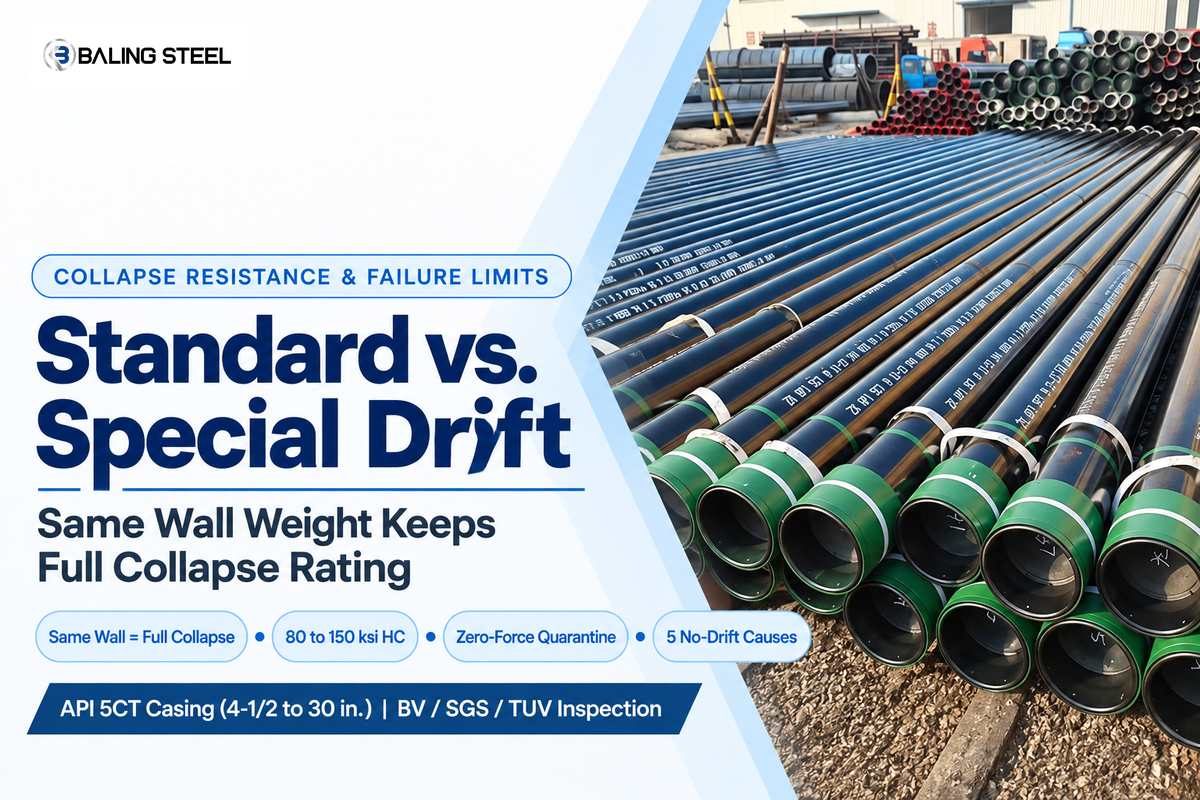
Specifying API 5CT special drift on the same nominal wall thickness and steel grade preserves full collapse resistance. Collapse strength drops only when engineers thin the nominal wall weight or plastically expand pipe downhole. Likewise, passing a straight 6-in. or 12-in. drift mandrel at surface proves bore clearance only; it never verifies wall thickness, hydrostatic pressure integrity, or rigid BHA passage through curved doglegs.
Many buyers hesitate on alternate drift because they equate larger bore with thinner steel. Collapse resistance is governed by D/t ratio, yield strength, wall uniformity, ovality, eccentricity, and residual stress. Vallourec High Collapse technical documentation reports high-collapse casing from 4-1/2 in. to 26 in. OD and 80 to 150 ksi, including special drift diameters. Tighter geometric and ovality limits than API 5CT’s -12.5% minimum wall tolerance lift collapse ratings up to 50% above API 5C3 formulas. By contrast, plastically expanding a solid liner downhole can cut collapse strength up to 50%, per Drilling Contractor, requiring heavier solid-wall pipe like 0.682 in. on an 11-3/4 in. x 13-3/8 in. monobore liner to keep a 12-1/4 in. drift. For lower-pressure surface strings, an API 5CT J55 versus K55 casing grade comparison helps match collapse margins to budget.
Nearly all of the no-drift failures encountered in mills, threading shops, and rig yards can be attributed to five mechanisms:
- Pipe ovality and wall eccentricity: Both rotary piercing and gag straightening can leave an oval cross section behind. The short diameter may seize the drift cylinder, despite the mean OD being within specification.
- Internal weld flash on ERW casing: Uneven or incomplete scarfing of the internal weld bead on the casing creates a longitudinal bump, preventing the mandrel from passing.
- Power tight make-up coupling: High buck-on torque on API BTC, LTC, or premium connections slightly compresses the internal diameter inside the threaded pin end.
- Wellbore dogleg curvature: A straight 12-in. mandrel clears single joints at surface. However, a rigid 30-ft to 60-ft BHA or ESP can bind in high dogleg severity bends where curved effective drift shrinks.
- Handling dents, rust scale, and dirt: forklift impacts, dropped slings, dried thread compound, rust scale, or other contaminants frequently convert certified mill stock into field no-drift rejects.
Common Shop Mistake: Driving a Hung-Up Mandrel
Never hammer or winch a stuck drift mandrel through a tight casing joint. As Galip Equipment’s shop drift rules emphasize, forcing a mandrel turns a clear reject into hidden downhole sticking risk. Quarantine any no-drift joint immediately and mark it visibly. If several consecutive joints fail suddenly, re-gauge the mandrel itself for picked-up metal or burrs.
How to Choose, Specify, and Verify Casing Drift Diameter on a Purchase Order
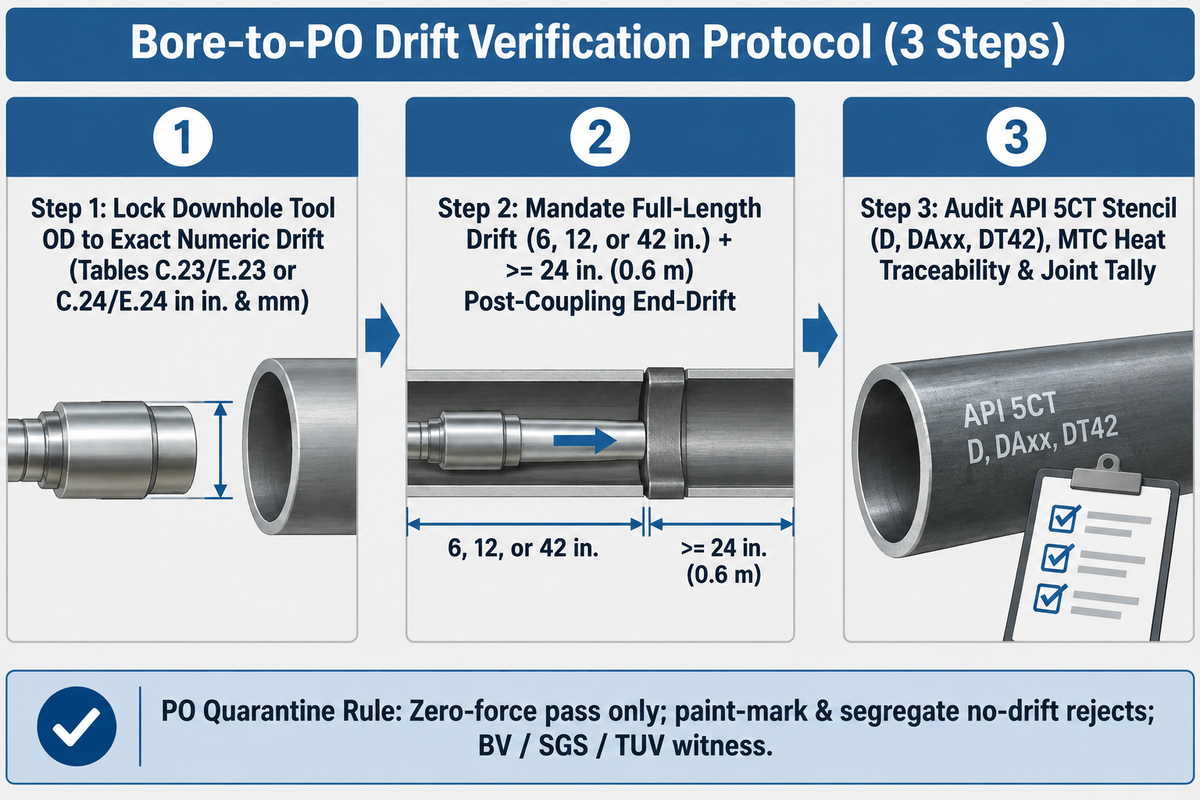
Purchase orders for API 5CT casing must require full-length drift testing on every joint, post-coupling end-drifting over at least 24 in. (0.6 m), exact numeric drift diameter, and heat-traceable records. Those sourcing across an OCTG casing and tubing product range may consult the below nine-row selection matrix to reconcile each well condition before raising RFQs.
| Well / Operation Scenario | Recommended Drift Option | Mandrel Spec | Limitations / When Not to Use |
|---|---|---|---|
| Vertical onshore 7 in. 29 lb/ft production casing | Standard Drift (6.059 in.) | 6 in. x 6.059 in. | Blocks tools > 6.059 in. OD; not for 6-1/8 in. bits |
| 9-5/8 in. 53.5 lb/ft intermediate + 8-1/2 in. bit | API Alternate Drift (8.500 in.) | 12 in. x 8.500 in. | Standard 8.379 in. drift blocks 8-1/2 in. bit completely |
| 13-3/8 in. 72 lb/ft surface + 12-1/4 in. bit | API Alternate Drift (12.250 in.) | 12 in. x 12.250 in. | Standard 12.191 in. drift stops 12-1/4 in. bit gauge |
| 7 in. 32 lb/ft heavy-wall + 6 in. bit | API Alternate Drift (6.000 in.) | 6 in. x 6.000 in. | Standard 5.969 in. drift leaves zero clearance for 6 in. bit |
| Deepwater salt / HPHT collapse-critical zone | High-Collapse UC + Alternate Drift | 6 in. or 12 in. + Annex H | Standard API 5CT -12.50% wall tolerance lacks HC guarantee |
| 4-1/2 in. casing run as high-rate production tubing | 42-in. Tubing Drift (DT42) | 42 in. x (d – 0.125 in.) | 6-in. casing drift misses bow affecting long wireline tools |
| Internally plastic-coated corrosion string | Standard or Alternate + Non-Metallic | Urethane/nylon mandrel | Hard steel mandrels gouge internal holiday-free coatings |
| High-dogleg directional well (> 8 deg/100 ft) | Alternate Drift + 3D BHA Clearance Model | 12 in. + rigid tool check | Straight 12-in. mandrel alone cannot verify curved BHA passage |
| 16 in. to 20 in. large-diameter surface string | Standard Bracket 3 Drift (d – 3/16 in.) | 12 in. x (d – 0.1875 in.) | 6-in. mandrel violates API 5CT for OD > 13-3/8 in. |
Simply follow the three steps of the Bore-to-PO Drift Verification Protocol to transform clearance requirements into a valid purchase order:
- Lock downhole tool OD to numeric drift: note the highest OD of each bit, liner hanger, packer, and artificial lift mandrel, then pick API 5CT Table C.23/E.23 standard drift or Table C.24/E.24 alternate drift in precise decimal inches and mm.
- Mandate post-coupling drift timing and mandrel dimensions: Write the mandrel length (6 in., 12 in., or 42 in.) and mandate full-length inspection on every joint. Require end-drifting after power-tight coupling make-up or end sizing.
- Audit pipe stenciling and MTC heat traceability: Verify the API Spec 5CT stencil sequence on each joint, including manufacturer, monogram, end finish, size, weight per unit length, and grade. Check manufacturing process, hydrotest pressure, thread type, and size of drift (D, DAxx, or DT42) against the mill test certificate and joint tally.
Special drift orders tighten mill yield and inspection time, so commercial premiums and lead times vary by grade, lot volume, and connection. Request an itemized mill quote and review casing pipe pricing factors and cost drivers before finalizing budgets. Copy the checklist table below directly into your next OCTG RFQ.
RFQ checklist — copy these into your quote request:
| Parameter | Recommended range | Why it matters | How to verify |
|---|---|---|---|
| Governing edition | API Spec 5CT 11th Ed. + Addendum 1 + Errata 1–3 | Removes legacy PSL shorthand and enforces current drift and UC clauses | Check edition citation on quotation, PO, and MTC header |
| Drift diameter & length | Exact decimal in./mm + 6 in. (<9-5/8 in.), 12 in. (≥9-5/8 in.), or 42 in. (DT42) | Eliminates mill ambiguity between standard, Table C.24 alternate, and custom drift | Witness calibrated mandrel micrometer check prior to lot run |
| Drift test timing | Every joint full-length + ≥24 in. (0.6 m) end-drift after power-tight coupling make-up | Catches radial bore shrinkage caused by coupling buck-on or end sizing | Require post-buck-on end-drift sign-off on inspection reports |
| Pipe stenciling code | API 5CT sequence including Size of drift (D, DAxx, or DT42) | Prevents rig crews from mixing standard and alternate drift joints in one rack | Photo-audit stenciling against joint tally before vessel loading |
| High-collapse (UC) data | Claimed collapse rating (psi/MPa) + Annex H qualification procedure | Confirms special drift did not compromise external pressure design margin | Verify UC designation and collapse test results on MTC |
| No-drift quarantine rule | Zero force pass; immediate paint marking and physical segregation | Stops hammered or unmarked rejects from slipping into shipped bundles | Include hold point in third-party BV, SGS, or TUV inspection plan |
| Thread & connection check | API 5B gauging for STC/LTC/BTC or licensed premium connection spec | Verifies thread condition and coupling concentricity alongside bore clearance | Review API 5B thread gauge logs and coupling certificates |
Should Casing Pipe Be Drifted Again After Threading and Coupling Make-Up?
Yes, threaded-and-coupled casing must receive end-drift verification after power-tight coupling make-up or end sizing if full-length drifting ran earlier on plain-end pipe. Radial hoop stress during coupling buck-on compresses the pin end inward by several thousandths of an inch. That shrinkage can turn a plain-end pass into a coupled-end no-drift failure.
The API Spec 5CT 11th Edition Addendum 1 clearly states the procedure for performing end-drift testing after power-tight coupling make-up and end sizing. In addition, rig crews are advised to re-drift each joint on the pipe rack before running in hole. This final check catches transportation dents, thread-protector damage, and rust scale that may have hardened during ocean or truck shipping.
What Is Changing in API 5CT Casing Drift Standards (2025–2026)?
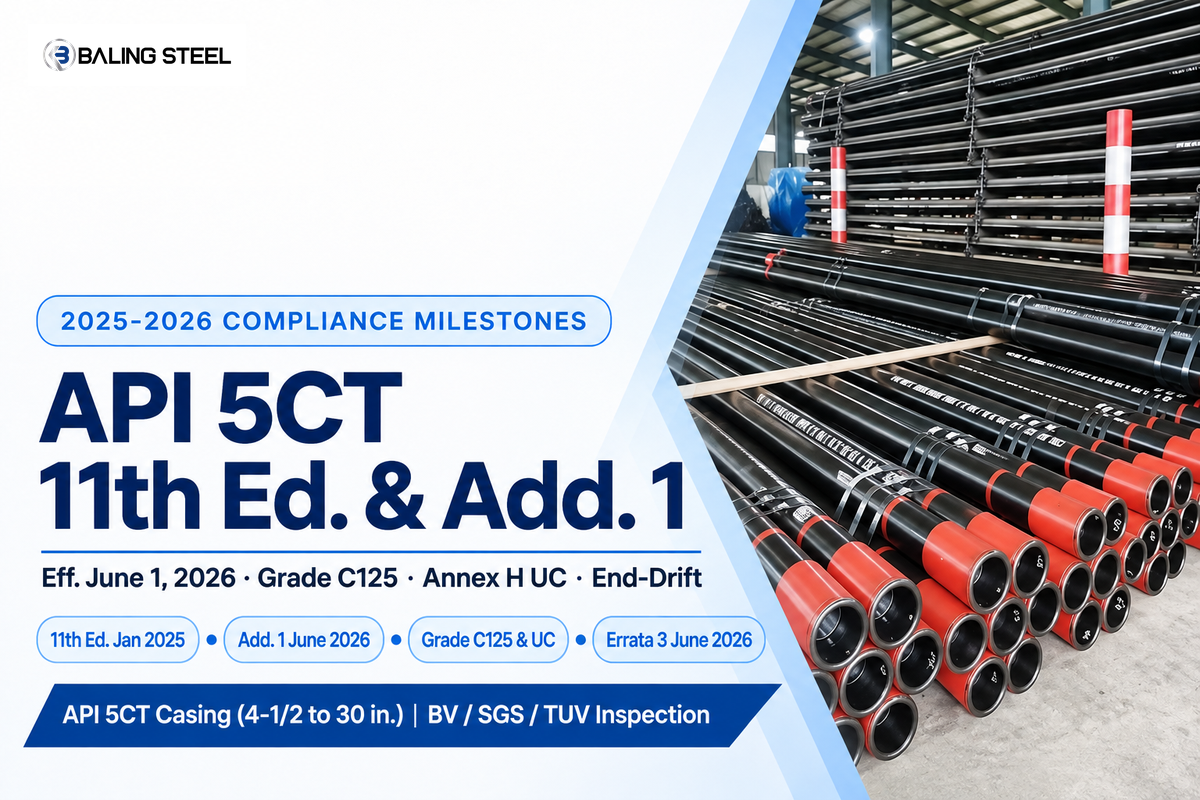
API Spec 5CT 11th Edition (Monogram effective January 1, 2025) and Addendum 1 (published May 20, 2025; effective June 1, 2026) formalize post-coupling end-drifting and normative Annex H for High-Collapse (UC) tubulars. These updates necessitate explicit qualification records corresponding to pipe geometry and drift. Buyers planning 2026 and 2027 drilling programs must retire legacy API Spec 5CT 10th Edition PSL templates to prevent compliance holds.
As API announced when strengthening steel casing and tubing manufacturing requirements, moving from 10th Edition to 11th Edition clauses reshapes metallurgy and inspection records. Per Forever Steels’ API 5CT 11th vs. 10th Edition analysis, the 11th Edition retired Product Specification Level (PSL) shorthand, added L80 3Cr, and expanded automated straightness controls. Addendum 1 introduces Grade C125 (125 to 135 ksi yield, 130 ksi / 896 MPa minimum tensile strength, 34 HRC max, 630 °C minimum tempering). It also defines normative Annex H high-collapse (UC) controls above API 5C3 values and codifies end-sizing and end-drift checks. Errata 3 (June 24, 2026) refined sulfide stress cracking test durations and marking tables.
| API Spec 5CT Milestone | Issue / Effective Date | Drift, Collapse & Procurement Impact |
|---|---|---|
| 10th Edition | 2018 / Monogram July 1, 2019 | Legacy baseline; drift Tables C.28/E.28 & C.29/E.29; PSL 1–3 structure |
| 11th Edition | Dec 2023 / Monogram Jan 1, 2025 | Removed PSLs; drift moved to Tables C.23/E.23 & C.24/E.24; added L80 3Cr |
| Errata 1 & Errata 2 | May 2024 & Aug 2024 | Corrected Monogram effective date, straightening rules, drift headers, and marking tables |
| Addendum 1 | May 20, 2025 / Eff. June 1, 2026 | Added C125, normative Annex H High-Collapse (UC), end-sizing and post-coupling end-drifting |
| Errata 3 | June 24, 2026 (immediate) | Corrected C110/C125 Method D SSC test durations and marking/test-lot items |
Longer horizontal wells drive these tighter rules. Global Market Insights notes that Permian laterals above 10,000 ft and Delaware Basin laterals above 15,000 ft sustain rotary-pierced well casing demand. Well casing represents roughly 51.7% of global OCTG consumption. Before awarding orders to Tier-1 proprietary high-collapse mills such as Vallourec or Nippon Steel, or to audited multi-grade OCTG suppliers, verify four items. Check active API Composite List license scope, Annex H UC collapse records matching exact OD/wall/drift, heat-traceable MTCs tied to the joint tally, and third-party witness release.
Hunan Baling Steel Co., Ltd. (established 2002 with roots in Yueyang, China from 1998) exports to 45 countries and regions across six OCTG lines. Lines 1–2 manufacture API tubing (1.050 to 4-1/2 in.), while Lines 3–6 supply oil casing (4-1/2 in. to 30 in., covering API 5CT 4-1/2 in. to 20 in. plus larger sizes to 30 in., R1/R2/R3, grades H40 through Q125) with STC, LTC, BTC, XL, and project-specified connections.
Our Baling Steel engineering and quality team runs dimensional, chemical, mechanical, and end air-tightness checks and arranges BV, SGS, or TUV third-party witness inspection. Send your casing OD, weight, grade, connection, and numeric drift requirement via our API 5CT casing and tubing supply page for a mill quotation and inspection plan.
Frequently Asked Questions
What is drift in oil and gas drilling?
When talking about oil and gas drilling, drift means the guaranteed minimum clear inside diameter of casing, tubing, or drill pipe as checked by a cylindrical mandrel. It is also used to mean a drift test performed on each pipe joint so drill bits, packers, and wireline tools run through easily.
Does a passed drift test mean a casing joint is completely defect-free?
No, passing the drift test only verifies that the single-joint internal bore clearance is sound at surface. A casing joint can clear a 6-in. or 12-in. straight mandrel while still carrying wall thinning below -12.5%, hairline laminations, thread defects, or hydrostatic leaks. The mill must still perform ultrasonic, magnetic-particle and hydrostatic pressure tests to verify structural integrity.
What are the standard outside diameters for oil well casing under API 5CT?
Standard API Spec 5CT oil well casing covers 14 nominal outside diameters from 4-1/2 in. (114.30 mm) through 20 in. (508.00 mm). Intermediate sizes include 5, 5-1/2, 6-5/8, 7, 7-5/8, 8-5/8, 9-5/8, 10-3/4, 11-3/4, 13-3/8, 16, and 18-5/8 in. Production tubing covers smaller pipe sizes from 1.050 in. to 4-1/2 in. OD.
How does casing weight per foot affect drift diameter?
Heavier nominal weight per foot thickens the pipe wall at a fixed outside diameter, cutting nominal inside diameter and drift diameter. For example, 9-5/8 in. casing drops from 8.679 in. standard drift at 40 lb/ft to 8.379 in. at 53.5 lb/ft.
Can an 8-1/2-inch drill bit pass through standard-drift 9-5/8-inch casing?
Yes, an 8-1/2-inch (8.500 in.) drill bit clears standard-drift 9-5/8-inch casing up through 47.00 lb/ft (8.525 in. / 216.54 mm drift), while 53.50 lb/ft drops to 8.379 in. (212.83 mm) and blocks the bit. Operators running heavy 53.50 lb/ft casing with an 8-1/2-inch bit must specify API 5CT Table C.24/E.24 alternate drift at 8.500 in. (215.90 mm) checked with a 12-in. mandrel on the purchase order.
What does “no-drift” mean on a casing inspection report?
API RP 5A5 defines a “no-drift” as the length of pipe that cannot be traversed by a drift mandrel of specified diameter without the application of abnormal effort. Upon discovery, no-drift pipe is immediately marked and isolated by inspectors so that bent, oval, or dented pipe never reaches the rig floor.
What steel grades are available with special drift under API 5CT?
API Spec 5CT permits listed alternate drifts and agreed custom special drifts in petroleum casing grades H40, J55, K55, N80, L80 (including L80 3Cr), C90, R95, T95, P110, Q125, and Addendum 1 Grade C125. Tier-1 OCTG pipe mills also pair special drifts with proprietary high-collapse grades from 80 to 150 ksi. Actual availability follows each mill’s active rolling schedule, heat-treatment line, and Annex H collapse qualification scope.
References & Sources
- American Petroleum Institute (API), Addendum to the 11th edition of the API 5CT, Casing and Tubing (May 20, 2025).
- American Petroleum Institute, API Spec 5CT 11th Edition, Addendum 1 (Clause 7.10.3) Drift Dimensions, May 2025.
- American Petroleum Institute (API), API Specification 5CT: 10th Edition & API Strengthens Requirements for Steel Casing and Tubing.
- IADC Lexicon / API RP 5A5, No-Drift, Oil and Gas Drilling Glossary & Drift Mandrel, Oil and Gas Drilling Glossary.
- World Oil (June 2022), Operational field procedure for identifying, installing and optimizing a gas lift well.
- IADC Drilling Contractor, Merged multilaterals system cuts time, risk.
- IADC Drilling Contractor, New generation of solid expandable liners help give operators a jump on trouble zones.
- Vallourec Solutions, High Collapse Casing Pipes, Solutions Vallourec.
- Forever Steels, API 5CT 11th vs 10th Edition: Changes & Buyer Guide (2026).
- Octalsteel, API 5CT Casing and Tubing Specification.
- Flowtech Energy, Casing Size And Drift Chart.
- EquipOutlet, API-5CT Markings.
- Galip Equipment, Casing Drift Test: API 5CT Sizes and 6 Shop Rules.
- Global Market Insights, OCTG (Oil Country Tubular Goods) Market Size, Forecasts 2035.