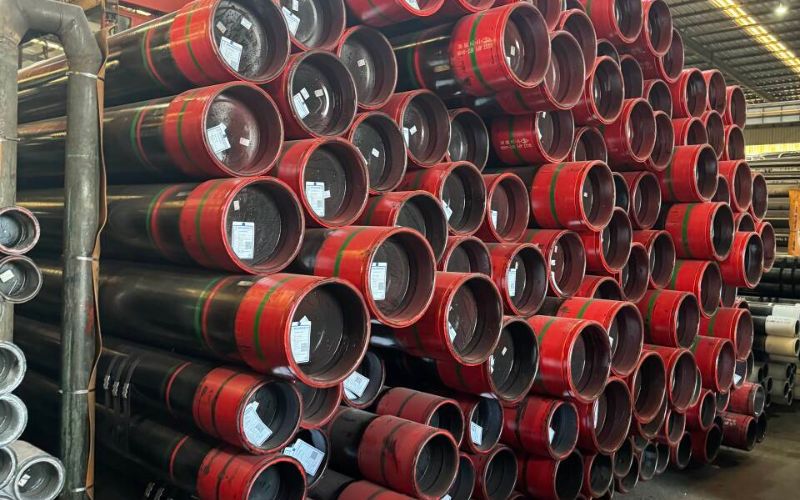
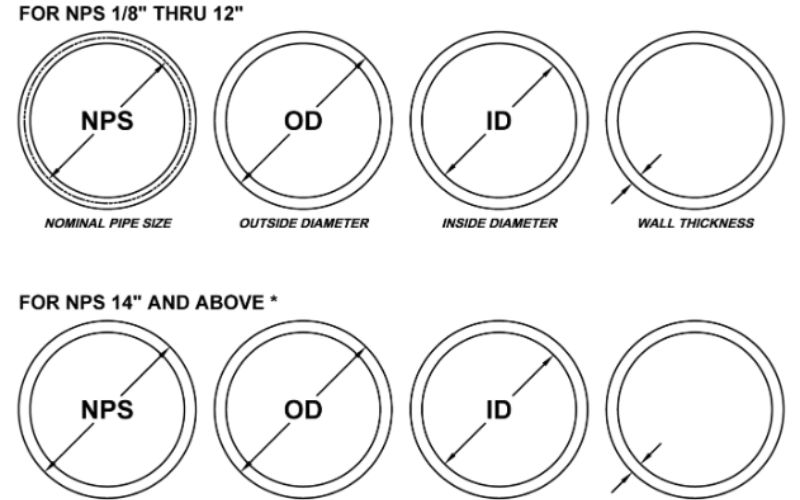
A carbon steel tube is one of the most common metal products in construction, energy, automotive and mechanical engineering applications – yet buyers frequently mi× up tube and pipe, ask for the incorrect ASTM grade, or pay a premium for seamless when drawn-over-mandrel (DOM) tubing is suitable. Here is a guide to carbon steel tube types, shapes, manufacturing processes, ASTM standards and dimensional information, along with a 4-step handy field guide to finding a working need-to-order specification.
Quick Specs: Carbon Steel Tube
| Material | Carbon steel (0.05–0.35% C by weight) |
| Common Standards | ASTM A53, A106, A500, A513, A519 |
| Cross-Section Shapes | Round, Square, Rectangular |
| OD Range | 0.375″ to 24″+ (NPS 1/8″ to 24″ for pipe) |
| Wall Thickness | SCH 5 through SCH 160, XXS |
| Manufacturing Methods | Seamless (SMLS), ERW, DOM, CDS |
| Max Service Temp | 750 °F / 400 °C (A106 Gr B seamless) |
What Is Carbon Steel Tube? Types, Shapes, and How It Differs from Pipe
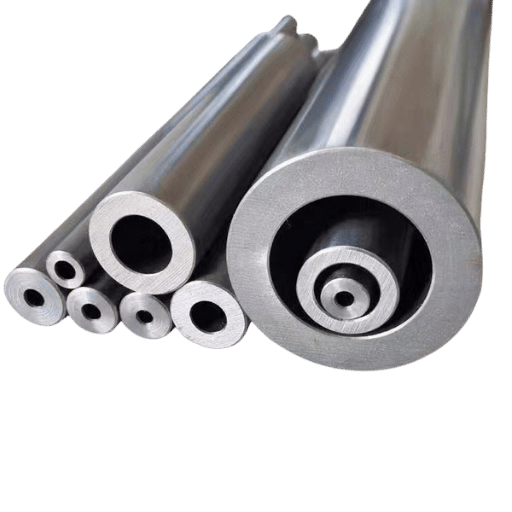
Carbon steel tube is made of steel with a carbon content of 0.05% to 0.35% by weight. Carbon steel is classified as mild (low-carbon, up to 0.26% C), medium-carbon (0.26–0.35% C), or high-carbon (above 0.35% C). Most carbon steel tubing falls in the mild-to-medium range, which provides a balance of strength, ductility, and weldability suited to the bulk of structural and mechanical applications.
One of the biggest sources of confusion is the difference between tube and pipe. They are not interchangeable terms- they use different dimensional standards and different measurement methods:
| Attribute | Tube | Pipe |
|---|---|---|
| Measured by | Actual outside diameter (OD) + wall thickness | Nominal Pipe Size (NPS) + schedule number |
| Primary use | Structural, mechanical, precision applications | Fluid/gas conveyance, pressure systems |
| Shapes | Round, square, rectangular | Round only |
| Tolerance | Tighter OD/wall control | Nominal sizing, actual OD ≠ NPS |
| Key standards | ASTM A500, A513, A519 | ASTM A53, A106 |
For more information on the differences between pipe and tube standards, refer to our guide on differences between tube and pipe.
What Is the Strongest Shape for Steel Tubing?
Round carbon steel tubing provides the highest strength to weight ratio and is the most resistant to torsional loading of all cross-sections. Square and rectangular hollow structural sections (HSS) stress bending loads more evenly across flat surfaces and are thus the most common use in frames, columns, and hardware construction when flat surfaces are desired for ease in welding or bolting. Round tubing dominates in fluid conveyance, hydraulic lines, and heat exchanger applications.
Rectangular tubing best suits trailer frames, equipment guards, and furniture where aesthetics and flat mounting surfaces are important.
How Carbon Steel Tubes Are Made: Seamless, ERW, DOM, and CDS
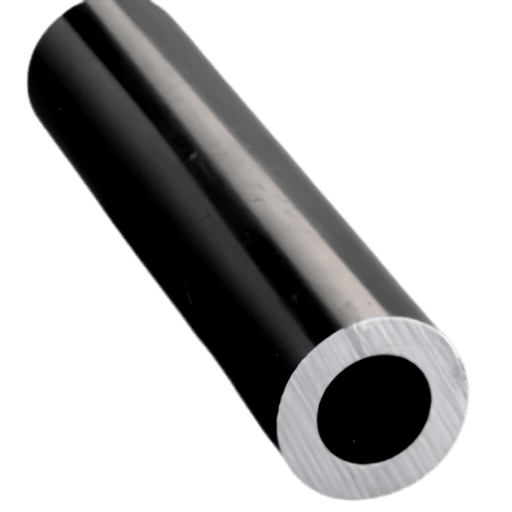
The manufacturing method controls the tube’s tolerance, surface finish, mechanical properties and cost. Four metal processing methods account for nearly all commercial production:
| Method | Process | OD Tolerance | Typical Use | Relative Cost |
|---|---|---|---|---|
| Seamless (SMLS) | Hot-pierced billet, no weld seam | ±1% OD | High-pressure, high-temp (boilers, oil & gas) | $$$$ |
| ERW (Electric Resistance Welded) | Flat strip rolled and seam-welded | ±0.5% OD | Structural, fencing, low-pressure fluid | $ |
| DOM (Drawn Over Mandrel) | ERW tube cold-drawn through die + mandrel | ±0.005″ OD | Hydraulic cylinders, automotive, precision mechanical | $$$ |
| CDS (Cold Drawn Seamless) | Hot-finished seamless tube cold-drawn for precision | ±0.004″ OD | Precision mechanical, instrumentation | $$$$ |
📐 Engineering Note
Per ASTM A513 Type 5 (DOM), wall thickness tolerance is ±10% of nominal, and OD tolerance is ±0.005″ for tubing up to 3.5″ OD. These tolerances make DOM tubing interchangeable with cold-drawn seamless (CDS) in most precision mechanical applications — at roughly 20–30% lower cost.
Specifying seamless when DOM tubing of equal performance is available from stock wastes budget. A machine shop in Ohio replaced the same firing tube, CDS 1026, with a DOM A513 type 5 – same 0.005 OD tolerance, same burst pressure rating with 25% reduction in raw material cost. Except where your application code explicitly requires seamless (ie: ASME B 31.1 boiler piping) supply, DOM should be where you turn first when doing precision mechanical work.
For details on seamless production, see our page on seamless pipe manufacturing. For welded tube production, read about the ERW pipe process.
Carbon Steel Tube Grades: ASTM Standards and Mechanical Properties
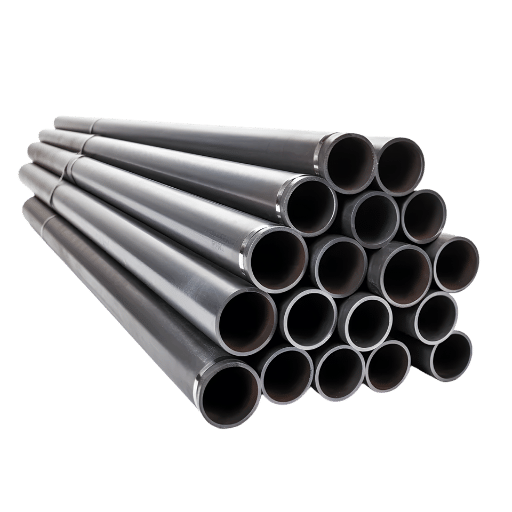
Selecting the proper ASTM grade will provide you with a carbon steel tube that will withstand the temperature, pressure and load requirements of your application. There are five ASTM standards that index most of the commercial carbon steel tube and pipe:
| Standard | Common Grade | Tensile (min) | Yield (min) | C% max | Type | Primary Use |
|---|---|---|---|---|---|---|
| ASTM A53 | Grade B | 60,000 psi (415 MPa) | 35,000 psi (240 MPa) | 0.30% | Seamless or Welded | General-purpose pipe, structural, water/steam |
| ASTM A106 | Grade B | 60,000 psi (415 MPa) | 35,000 psi (240 MPa) | 0.30% | Seamless only | High-temp service (boilers, refineries, power plants) |
| ASTM A500 | Grade B/C | 58,000 psi (400 MPa) | 46,000 psi (317 MPa) | 0.26% | Welded (cold-formed) | Structural HSS columns, frames, guards |
| ASTM A513 | Type 5 (DOM) | varies by grade | varies by grade | varies | Welded + cold-drawn | Mechanical tubing, hydraulic cylinders, automotive parts |
| ASTM A519 | 1026 CD | 70,000 psi (485 MPa) | 50,000 psi (345 MPa) | 0.28% | Seamless (CD or HF) | Precision mechanical, high-stress machinery |
Note that ASTM A53 Grade B and ASTM A106 Grade B pipe have the same minimum ultimate and yield strength —60,000 psi and 35,000 psi respectively. Where they diverge is application: ASTM A106 is required to be seamless-only and more restricted in trace elements (Cr 0.40% Mo 0.15% Ni 0.40%) making it the choice of pipe above 400 F. ASTM A53 is the standard for welded or seamless pipe for structural applications under 400 F.
“When engineers ask grade B pipe specification in my experience I start by asking about service temperature: Below 400 F, A53 will be better and cheaper” due to the option of welded pipe. For service above 400 F, ASTM A106 is the only correct choice ASTM A106 Grade B seamless only—Trace Element limits designed into the specification for a reason.”
What ASTM Standard Covers Carbon Steel Tubes?
Many standards encompass carbon steel tubes, depending on the application. ASTM A513 covers ERW and DOM welded mechanical tubing Types 1–5 while ASTM A519 covers seamless mechanical tubing types. For pipe standards (pressure service), ASTM A53 and ASTM A106 are the most widely referenced. The over-arching API designator specification ASTM A450/A450M specifies requirements for all carbon steel tubes.
If you’re interested in specifications for API 5L Grade B line pipe, used in oil & gas line pipe synthesis, find out in our dedicated specification and datasheet online section.
Carbon Steel Tube Sizes, Wall Thickness, and Schedule Ratings
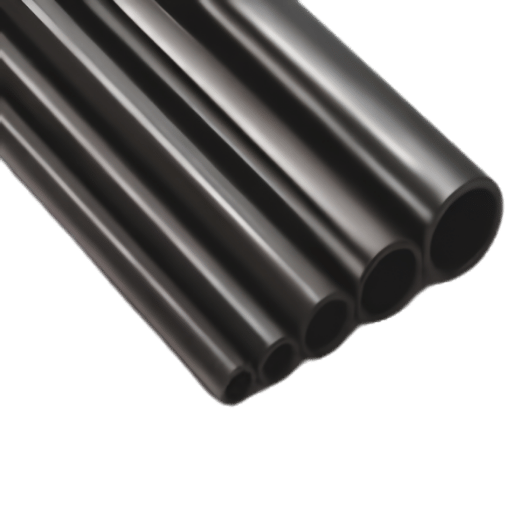
Schedule number indicates pipe wall thickness for given NPS sizes. A pipe with a higher schedule number will tend to be thicker or designed for a higher pressure (boiler tube) service. Typical Schedule 40 dimensions to ASME B36.10M—most common pipe and tube size, with standard length of 20 or 21 feet per mill processing run:
| NPS | OD (in) | Wall (in) | ID (in) | Weight (lb/ft) |
|---|---|---|---|---|
| ½″ | 0.840 | 0.109 | 0.622 | 0.85 |
| ¾″ | 1.050 | 0.113 | 0.824 | 1.13 |
| 1″ | 1.315 | 0.133 | 1.049 | 1.68 |
| 1½″ | 1.900 | 0.145 | 1.610 | 2.72 |
| 2″ | 2.375 | 0.154 | 2.067 | 3.65 |
| 3″ | 3.500 | 0.216 | 3.068 | 7.58 |
| 4″ | 4.500 | 0.237 | 4.026 | 10.79 |
| 6″ | 6.625 | 0.280 | 6.065 | 18.97 |
| 8″ | 8.625 | 0.322 | 7.981 | 28.55 |
| 12″ | 12.750 | 0.406 | 11.938 | 53.60 |
Note that the NPS outside diameter is not always the same as the pipe diameter numbering; the 2 NPS pipe has an outer diameter of 2.375. This numbering convention comes from an era when the bore size was more relevant than the overall outside diameter. To determine weight the rule is: lb/ft = (OD – WT) × WT × 10.69, where OD and WT are in inches.
For a complete reference, see our standard pipe sizing chart and pipe weight per foot calculator.
Where Carbon Steel Tubes Are Used: Applications by Industry
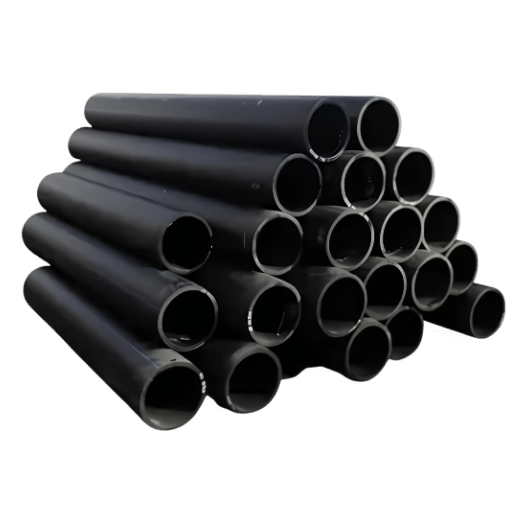
Carbon steel tube and pipe are used across virtually every metal fabrication industry. When choosing a grade, manufacturing method, and schedule to meet your maximum temperature, pressure, and structural loading expectations, select your materials carefully:
| Industry | Application | Recommended Grade | Why |
|---|---|---|---|
| Oil & Gas | Line pipe, process piping | A106 Gr B (seamless) | High-temp/pressure, mandated by ASME B31.3 |
| Power Generation | Boiler tubes, steam lines | A106 Gr B or A192 (seamless) | Continuous high-temp service up to 750 °F |
| Construction | Structural columns, frames | A500 Gr B/C (HSS) | High yield strength + cost-efficient welded production |
| Automotive | Roll cages, chassis, drive shafts | A513 Type 5 DOM (1020/1026) | Precision tolerances + high weld integrity |
| Hydraulics | Cylinder barrels, actuator tubes | A519 1026 CD or A513 T5 DOM | Tight ID tolerance for piston seal performance |
| Fire Protection | Fire sprinkler pipe | A53 Gr A/B (welded or seamless) | NFPA 13 approved, cost-effective for low-pressure systems |
An engineer at a power plant in Texas ordered A53 Grade B welded pipe for a 600 F superheater bypass line—a good choice which saved his power plant money on pipe, but which failed the ASME B31.1 piping code inspection. The line was torn out and replaced with A106 Grade B seamless, doubling the total project cost for $14,800. Lesson learned: Always know what piping code will be applicable before specifying a grade.
Corrosion Behavior and Protection Options
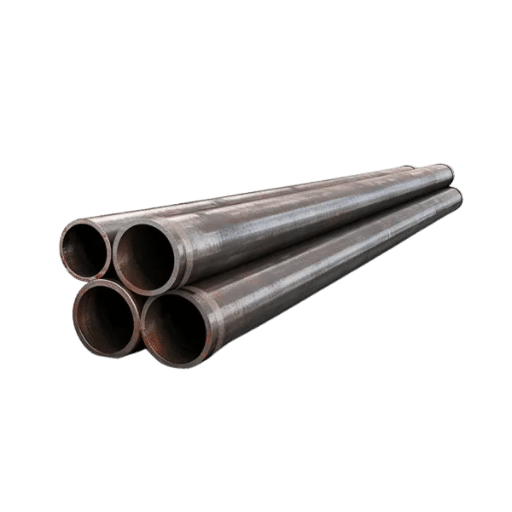
Bare carbon steel metal is a blank canvas – it will rust in the presence of moisture and oxygen- there is no escape from that fundamental chemistry. The decision is not “if” tubes will corrode- only the rate and the cost effective best corrosion protection for your environment:
| Protection | Method | Service Life | Max Temp | Best For |
|---|---|---|---|---|
| Bare (black steel) | Mill scale only | 2–5 years outdoor | N/A | Indoor dry environments, temporary installations |
| Paint/primer | Epoxy or alkyd coating | 5–15 years | 300 °F | Above-ground structural, equipment frames |
| Galvanized (hot-dip) | Sacrificial zinc coating | 20–50 years | 400 °F | Outdoor structural, water pipe, fencing |
| FBE coating | Fusion-bonded epoxy | 30–50 years | 230 °F | Buried pipe lines, water/sewer, oil & gas |
| 3LPE coating | Three-layer polyethylene | 40–60+ years | 175 °F | Long-distance buried pipelines, subsea |
Does Carbon Steel Pipe Rust?
Yes- all bare steel tube will rust when exposed to moisture and oxygen. The ferric iron in the steel reacts to form ferric oxide- which is porous and does not protect the metal beneath from further chemical attack (unlike stainless steel, who protects itself with a layer of chrome oxide). For this reason, coating selection is a primary procurement decision, not an afterthought. Indoor dry conditions may allow for black steel without coating for years, but any outdoor or buried tubular application requires galvanizing, FBE or 3LPE coating to achieve meaningful service life.
Never allow contact between carbon steel tubes and stainless steel or copper without a dielectric barrier. Gaskets, washers or isolators should be utilized at all points of contact; otherwise industry professionals have noted perforation of a tube wall in less than 18 months under humid ambient conditions. Use phenolic or PTFE gasket materials in areas of contact with bimetals.
How to Choose the Right Carbon Steel Tube: The 4-Step Selection Method
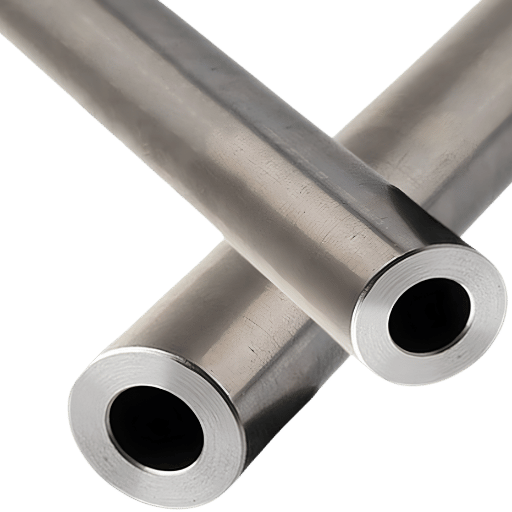
There are dozens of ASTM standards to cover manufacture of high quality carbon steel, and hundreds of size combinations to choose from. Use this simple 4 step approach to arrive at your specifications string- ready to issue as a purchase order.
The 4-Step Carbon Steel Tube Selection Method
- Specify your construction environment- high or low temperature (use seamless above 400 F). Max operating pressure. Moisture, chemical, or underground conditions.
- Pick the grade- A53 for general application below 400 F, A106 seamless for hi-temp service, A500 HSS structural, A51 9, A513 T5 for mechanical precision work. Check your code (ASME B 31.1, B31.3, AISC 360 for example).
- Determine the size- Values for OD and wall thickness from the Barlow formula (P=2S t/D). Select a NPS+SCH standard size that has a wall thickness equal or greater to that calculated.
- Select seamless if code mandated or under pressure. Consider DOM for precision mechanical end use. ERW for structure and/or low pressure: CDS for instrumentation-grade tolerances.
Example string: ASTM A106 Grade B, 4 NPS SCH 40, Seamless, Bevel
- Do you need to verify the applicable code before selecting grade? (ASME, AISC, NFPA) []
- Always request a Mill Certificate of Test. Validates heat number and traceability, and allows you to review chemistry and test data.
- Specify end condition- Plain End or BEvel with face-threading and a sleeve (coupling).
- Order quantity >20 MT from a metal tube and pipe supplier with stock in standard length and direct mill processing capabilities for factory pricing.
Get a Carbon Steel Tube Quote →
OR simply send us a quick WhatsApp message and get a response in less than4 hours.
Carbon Steel Tube Market Trends and Industry Outlook
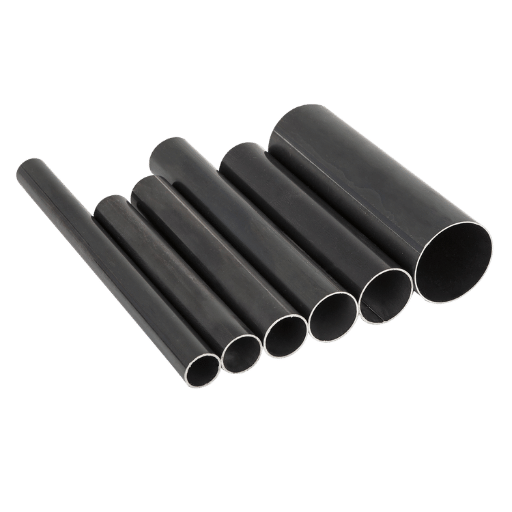
The world steel market got into 2025 at a weak point. S& P Global Market Intelligence reports global steel prices remained subdued through 2025 with a slight upturn forecast for 2026—driven in large part by infrastructure spend in Southeast Asia and the Middle East.
Demand for carbon steel tubing in the oil and gas lift markets remains the most significant factor in the segment. Market research firm Future Market Insights predicts the U.S. carbon steel tubing market for oil and gas was valued at about USD 2.1 billion in 2025 and is estimated to reach USD 2.2 billion in 2026. Longer range forecasts show demand experiencing a CAGR > 10% through 2033 as U.S. energy infrastructure ages and requires replacement.
Lock in pricing now if you are planning an end 2026/early 2027 project while the metal market is still soft. Steel distributors are prepared to hold prices and extend volume discounts during a market downturn. Request quotes referencing ASTM edition dates on your mill certs—publish date for latest ASTM A450/A450M was 2025 (A450/A450M-25a)—buyers should confirm their supplier is providing the current standard.
Frequently Asked Questions About Carbon Steel Tubes
Q: What is the difference between carbon steel tube and carbon steel pipe?
View Answer
Q: Can carbon steel tube be used for potable water systems?
View Answer
Q: How is carbon steel tubing manufactured?
View Answer
Q: Does carbon steel tube bend easily?
View Answer
Q: Is carbon steel tube the same as mild steel tube?
View Answer
Q: What ASTM standard covers carbon steel tubes?
View Answer
Q: How long does carbon steel tube last outdoors?
View Answer
Uncoated carbon steels corrode an average of 0.1-0.5mm/year in open air, depending on climate conditions (humidity and pollution level). An unprotected tube can be eroded before 5-10 years. Hot-dip galvanized carbon steels, between 20-50 years in open air.
FBE or 3LPE buried pipe can have a service life more than 50 years.
About This Analysis
The following carbon steel tube guide was assembled by the BalingSteel technical team based on established ASTM specification documents and ASME dimensional references, along with published market intelligence from S&P Global & Future Market Insights. BalingSteel has four production lines manufacturing and exporting seamless carbon steel pipe, located near Tianjin Port, China, with the main focus on A106 Grade B,API 5L Grade B specifications. The selection guidance framework and tolerances information in this article are based on specifications we provide daily in orders to 40+ markets worldwide.
When source data is sparse, we’ve used qualified messaging over specific figures. Checked and approved by BalingSteel engineering team, April 2026.
References & Sources
- ASTM A450/A450 M-25a – General requirements for carbon and low-alloy steel tubes, ASTM International
- ASTM A513 – Standards Specification for Electric-Resistance-Welded Carbon and Alloy Steel Mechanical Tubing ASTM International
- The ASTM International result is ASTM A106 /A106 M-19a – Seamless carbon steel pipe for high temperature service
- [1]ASME B36.10M – Welded and seamless wrought steel pipe, American Society of Mechanical Engineers.
- Skipe til byggning (Steel Pipe Schedule 40 Chart) – Engineering ToolBox
- Steel Market- 2025-2026: Trends and Outlooks- S & P Global Market Intelligence
- U.S. Carbon Steel Tubes in Oil and Gas Lift Sector Market
Related Articles
- Black Steel Pipe – Characteristics and Applications.
- Mild Steel Pipeif you want to find some selection engineeringGuides for StructuralWorks and Mechanical application.
- Features of Alloy Pipe—Used for high temperature and high pressure service.
- Tubería de acero inoxidable sin juntas – Cuando el acero al carbono no nos sirve
- Steel Pipe Standards Quick Reference Guide