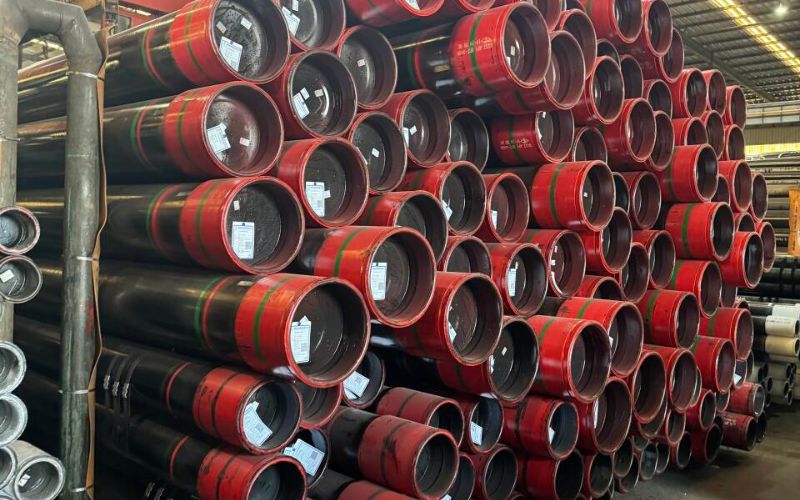
- Product family: pressure pipe fitting or structural pipe connector.
- Size: nominal designation plus the matching pipe and connection dimensions.
- Thread: exact standard and male/female arrangement.
- Duty: fluid, pressure, temperature and installation conditions.
- Order: identified items, quantities, documentation and delivered cost.
Galvanized pipe fittings are zinc-coated components, used in connection, diversion, branching or closing of pipe runs. They may appear to be the same in a catalog, but cause different problems on site. For example, a maintenance crew may require a nominal pipe with a removable joint between fixed pipes. Procurement may be comparing a threaded, malleable iron elbow of a particular class with a structural clamp of similar size. Start with the connection and service requirements of the fitting.
Galvanized pipe fittings connect, redirect, branch or close pipe runs with a zinc-coated component. Select the fitting by material, nominal size, connection standard and pressure-temperature duty, then confirm the coating and service documents.
- Zinc protection and pressure capability are separate specification fields.
- Match the thread form as well as the nominal size.
- Use a union or a suitable mechanical connection where pipe rotation is restricted.
- Compare quotations for the same accepted, delivered fitting basket.
Galvanized Pipe Fitting Types and Uses

Select the fitting based on the job it performs and then specify its construction and connection. An elbow changes direction; a tee creates a branch; a reducer changes nominal size. A galvanized finish describes the coating. It doesn’t choose the base material, joint design or intended application.
Commonly used threaded products include malleable iron fittings. Galvanized steel pipe fittings and galvanized iron fittings appear together in shop categories, so read the material designation rather than relying on the category name. The public scope of ASME B16.3 covers malleable iron threaded fittings in Classes 150 and 300, with limited provisions for small steel caps and couplings.
| Type | Connection task | Order detail to settle |
|---|---|---|
| Coupling | Join two pipe ends in a straight run | Equal or reducing size; thread form and end condition |
| Union | Provide a joint that can be disconnected | Seat design, end connections and space to turn the union nut |
| Elbow or street elbow | Change flow direction | Angle, radius where relevant, and female/female or male/female ends |
| Tee | Create a branch | Size and orientation of every opening |
| Reducer or bushing | Connect different sizes | Both sizes and each end’s gender |
| Nipple | Connect fittings with a short pipe section | Length, pipe specification and end threads |
| Cap or plug | Close an opening | External pipe end versus internal fitting opening |
| Cross | Connect four openings at an intersection | Every opening size and the required branch orientation |
| Threaded flange | Connect a threaded pipe end to a flanged interface | Thread standard plus flange standard, face and bolt pattern |
Imagine a replacement tee next to a wall. The branch may point in the correct direction, but the pipe can’t rotate enough to assemble it. Determine the available movement and then select the fitting style. For change of direction and geometry, the separate guide to steel elbow fittings provides more information.
Maintain structural pipe fittings on a separate purchasing line. Connectors and clamps need to meet their structural requirements as well. For a fluid-carrying line, connectors need to be documented for that pressure service, pipe dimension and sealing arrangement.
Add required loads, strength criteria, and any other design considerations to the structural drawing. Specifying a flange adds another interface; state the face of the flange, the bolt pattern and the standard for the flange as well as the pipe thread. Check the two parts before adding to the order.
Size, Thread and Pressure Class: The Spec-to-RFQ Table
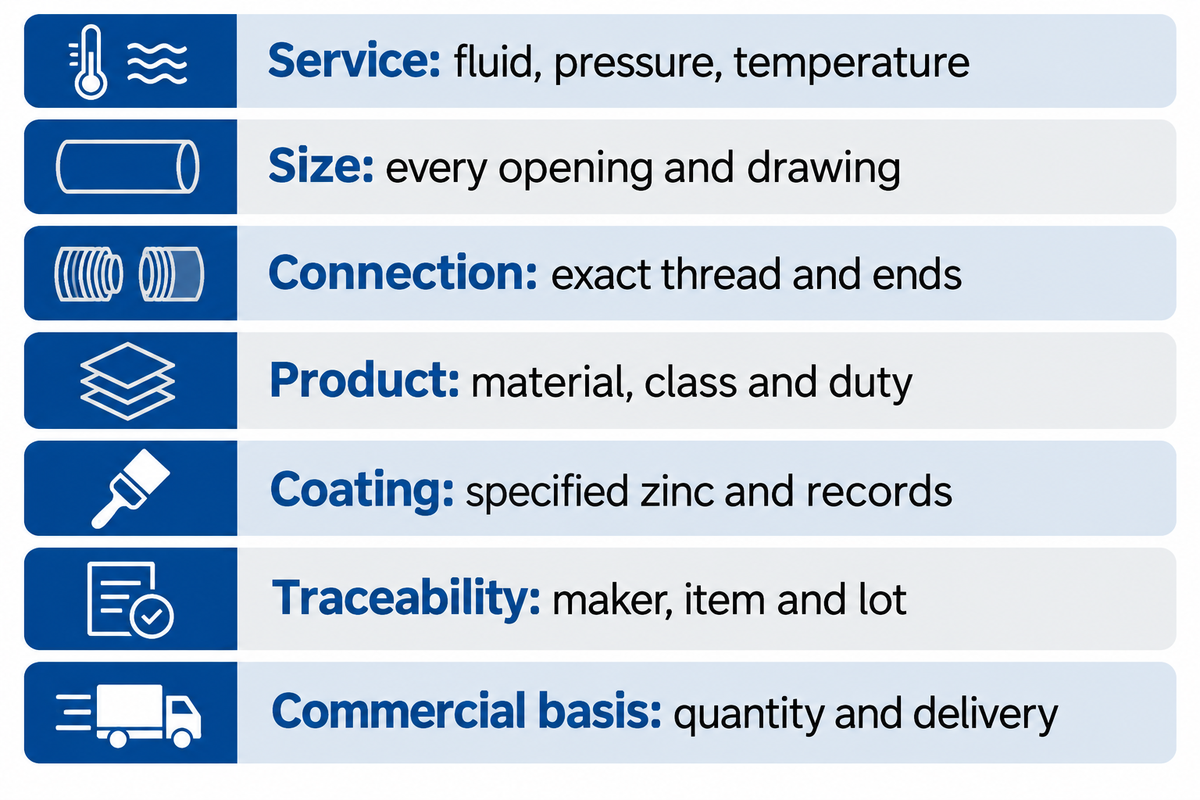
Separate size, thread, class and service on the drawing. This provides sufficient information for the supplier to select the item and provides a basis for receiving inspection. A description such as “one-inch galvanized fitting” leaves the end connection arrangement, material, pressure-temperature limits and required documentation open.
How do I choose the right size, thread and pressure class for galvanized pipe fittings?
Start with the pipe drawing or existing pipe designation, identify the standard and state the operating pressure and temperature. Use the fitting manufacturer’s rating for that size and material. Check the connecting pipe: its wall specification and condition must be separate from the fitting’s pressure class.
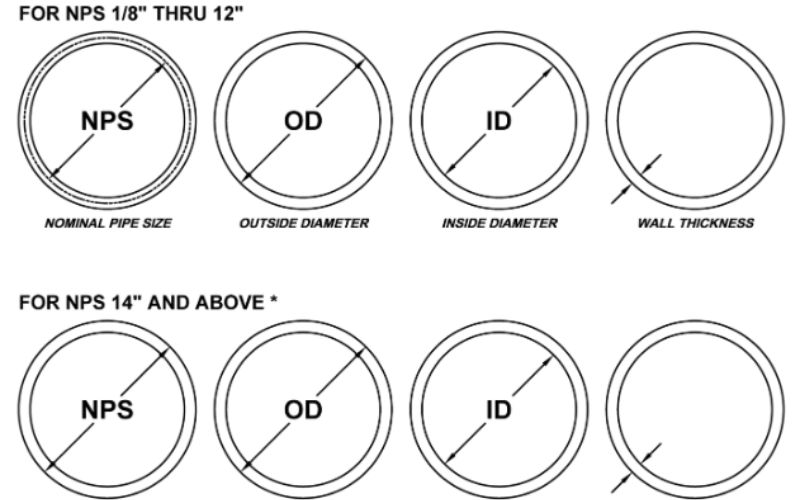
Nominal pipe size is a designation and shouldn’t be interpreted as a ruler across the outside. When replacing an unknown part, measure the pipe and thread, record the pitch and taper, and compare them with the appropriate dimensional reference. BalingSteel’s pipe sizes guide explains wider size terminology. Don’t presume what the wall thickness is and remove it from a measured outside diameter to determine nominal fitting size.
CPC’s pipe-thread guidance describes NPT and BSP forms and advises against their interchangeability. It describes a 60-degree NPT form and a 55-degree BSP form. Matching thread counts at some sizes don’t make the forms equivalent.
| Field | Write on the inquiry | Hold the item when |
|---|---|---|
| 1. Service | Fluid, operating pressure, temperature and installation environment | Only “industrial” or “plumbing” is stated |
| 2. Size | Nominal designation, every opening size and drawing reference | An outside measurement is the only identifier |
| 3. Connection | NPT, BSPT, BSPP or other exact form; male/female arrangement | The quote says only “threaded” |
| 4. Product and class | Shape, base material, class and applicable pressure-temperature table | Pipe schedule has been substituted for fitting class |
| 5. Coating and service documents | Specified zinc coating and documents required for the actual duty | Appearance is the entire acceptance criterion |
| 6. Traceability | Manufacturer or brand, item code, lot identification and required records | Documents cannot be matched to the offered item |
| 7. Commercial basis | Quantity, packaging, delivery basis, lead time and quote validity | Two prices cover different baskets or delivery terms |
This table differentiates the service requests of a plant manager from the ordering requests of procurement and acceptance checks of quality assurance. Run it prior to a price comparison. A thread or duty field that remains unresolved sends the request back for clarification; it shouldn’t dissolve in a vague “equivalent product” description.
Abide by the same identification discipline for residential and commercial plumbing applications. Rather than using the building type to signify actual duty and installation requirements, write the actual requirements in the schedule. This also applies to a minor repair order, which should also be identified by thread. The same also applies to a supply bulk order.
Boshart’s Class 300 technical sheet gives a practical example of a document and separates material, galvanizing, and dimensional references and threads. Those descriptions cover Boshart’s listed products. Use the same field separation when requesting documents from other manufacturers.
Galvanized vs Black Pipe Fittings: Choose by Service and Environment

While selecting galvanized or black fittings, check the fluid, temperature, exposure and installation requirements. Zinc adds corrosion protection to the underlying iron or steel. The service decision also depends on the design and construction material, joint, and product documentation, especially for gas and potable water.
Should I use galvanized or black pipe fittings for my project?
Use the finishes specified for the service and exposure on the project documents. If the specification allows for alternatives, consider their coating, corrosion behavior, and maintenance needs, along with their exact product ratings. For an existing installation, determine its materials and condition and then choose a suitable replacement fitting based on those findings.
| Situation | Check first | Purchasing consequence |
|---|---|---|
| Outdoor or damp exposure | Specified corrosion protection, storage and installation conditions | State the coating requirement explicitly |
| Gas, oil or gasoline service | Applicable service rules, material and seal compatibility | Request the exact product’s service documents |
| Potable-water contact | Applicable drinking-water and lead-free requirements | Match certification records to the supplied product |
| Old galvanized plumbing | Pipe condition, internal deposits and service-line history | Assess the line as well as the replacement fitting |
For products covered by the US lead-free rule, 40 CFR 143.19 assigns certification and record duties to manufacturers or importers. The rule includes exceptions and self-certification provisions. Ask for the applicable certification route and item identification; this is a specific purchasing check for covered drinking-water products.
Old pipe needs another kind of attention. EBMUD’s galvanized-pipe guidance explains internal corrosion deposits and the potential for lead-containing scales in some historical connections. A shiny new elbow doesn’t restore the condition of the connected line. For discolored water, restricted flow or a known former lead connection, seek a water-supplier or qualified plumbing assessment rather than a cosmetic fitting replacement.
The separate black steel pipe guide covers the related pipe family. Maintain the pipe family’s rating distinct from the fitting’s rating.
When you see a quotation describing something as “black iron,” ask for the exact material designation. State the required corrosion resistance through the coating and exposure conditions. Durability also depends on the connected pipe condition and the maintenance plan. A corrosion-resistant finish still requires the correct joint and service selection.
How to Connect Galvanized Pipes: Threaded, Union and Threadless Options

Pick the joint by the pipe-end condition, available movement and service requirements. Matching threaded ends may use a coupling; fixed runs often need a disconnectable arrangement. A mechanical connector for smooth or grooved ends is selected for the pipe dimension, restraint and sealing duties.
How do I connect two galvanized pipes together?
Identify both ends first: nominal size, actual connection dimensions, threads and grooves. Select the corresponding coupling, union or mechanical system for the service. Next, prepare, assemble and test the product according to the instructions provided. Resolve any damage to the pipe or uncertainty about its identity before assembly of the joint.
| What is on site? | Connection to evaluate | Decisive check |
|---|---|---|
| Matching threaded ends with enough assembly movement | Threaded coupling | Exact thread form, condition, engagement and sealant directions |
| A run that must disconnect without rotating the full pipe | Union arrangement | Seat design, accessibility and end connection |
| Plain pipe ends | Suitable plain-end mechanical connector | OD range, surface condition, gasket and restraint |
| Prepared grooved ends | Matching grooved coupling system | Groove specification, housing/gasket combination and rating |
| Railing or frame tubes | Structural connector specified for the structure | Load and attachment requirements; keep separate from pressure piping |
| Different nominal sizes in a threaded run | Reducing fitting | Both opening sizes, orientation and end arrangement |
| A threaded end meeting a flanged equipment connection | Specified threaded flange or transition assembly | Both mating interfaces and the complete assembly rating |
| A transition between different pipe materials | Service-suitable transition component | Material compatibility and the specified connection on each side |
| A threaded opening that must be closed | Matching cap or plug | Male or female closure, size, thread and service rating |
A union has its own sealing-seat requirements. The official ASME B16.39-2025 scope includes malleable iron threaded unions, joints and seats, pressure-temperature ratings and test requirements. Specify the complete assembly, and follow its instructions for the seat and threaded ends.
Threadless is a broad category. ASTM F1476-07(2024) distinguishes gasketed grooved-end and plain-end mechanical couplings. Its public scope limits use temperature to the respective gasket range and addresses component mixing between manufacturers. Order the intended coupling system, rather than combining a convenient housing with an unrelated gasket.
An example is a shutdown repair where both adjoining pipes are fixed. An ordinary threaded coupling may be difficult to assemble even with its size correct. Plan the dismantling arrangement and support access before ordering. The real constraint of the plant is getting the joint into position, not finding the least expensive connector of approximately the same diameter.
Sealant also follows the application. Oatey’s thread-sealant guidance separates material compatibility, chemical compatibility and temperature performance. Use the specified product and its directions; a general rule about tape color or wrench turns is too little information for an industrial joint.
Inspection, Corrosion and Replacement

Inspect incoming fittings against the approved order before sending to the installation crew. Verify the identity of the item (size), connection, condition, records, and other issues. On an existing plumbing system, assess also the connected pipe. A correct replacement fitting can’t make up for deteriorated pipe ends and/or an incorrect/inadequate installation.
In a maintenance stockroom, separate look-alike components in identified bins. They can be used later to solve different geometric problems (e.g. a galvanized bushing instead of a reducing coupling can be used to solve a different geometry problem; a cap and plug can close different openings). Keep manufacturer packaging or durable item labeling until the lot is accepted.
- Match the documents: compare purchase-order line, product code, material, finish, nominal size and thread designation.
- Inspect the joint surfaces: look for damaged threads, distorted openings, cracks and contamination. Protect sealing seats from handling damage.
- Check coating condition: record damage or corrosion that conflicts with the agreed acceptance requirements. Escalate the finding against the specification.
- Confirm records: check that required certificates, inspection reports and lot references describe the supplied items.
- Release or segregate: keep uncertain items apart until the supplier and quality team resolve the discrepancy.
Use an agreed inspection plan for the actual order. BalingSteel’s professional inspection information is useful for discussing the scope of documentation and dimensional checks. Agree sampling, acceptance criteria, and tests if any, to be performed on the shipment before it leaves.
Restricted flow, leakage or corrosion may call for a wider pipe assessment; repeated fitting replacement can leave the underlying problem in place. Record the exposed pipe-end condition and the reason for failure. When making a replacement, avoid choosing a fitting just because the old one has lasted a long time.
Price and Bulk Orders: Normalize the Quote Before Comparing

Compare cost delivered for the same accepted fitting basket. Take the same shapes, sizes, material, thread standard and documentation, then take the same quantities, freight, packing and delivery dates. A low unit price loses its value if the order leaves quality assurance unable to release the parts for the planned job.
How much do galvanized fittings cost, and what changes a bulk-order quotation?
Cost of galvanized fittings is quoted for a specific item and order. Variables such as configuration, nominal diameter, material, coating, quantity and commercial terms impact the price comparison. Inspection and certification requirements can also impact the scope. Please quote one line per item with stated inclusions so that Finance can evaluate the full cost comparison of equivalent products.
| Input | Quote A | Quote B |
|---|---|---|
| Fittings | $2,000 | $2,100 |
| Freight and required inspection | $350 | $200 |
| Accepted pieces assumed | 980 | 1,000 |
| Cost per accepted piece | $2.40 | $2.30 |
The calculation is (fittings + freight + required inspection) ÷ accepted pieces. In this case, A rounds to $2.40 and B rounds to $2.30 per accepted piece. Taxes, duties and installation labor aren’t included. Add costs on the same basis and replace assumed acceptance quantities with agreed purchasing basis.
The possible bottleneck may be document release. If a job requires a certified item and its paperwork arrives after the fitting, the warehouse may have stock while the crew still lacks usable material. Put the document deadline beside the delivery deadline in the comparison sheet.
| Observed condition | Constraint owner | Action before the job date |
|---|---|---|
| Parts in stock; required records missing | Quality assurance and supplier | Obtain matched records and release the lot |
| Accepted parts; pipe ends or clearance unresolved | Maintenance and engineering | Confirm the connection arrangement and required preparation |
| Specification agreed; freight basis or delivery date open | Procurement and logistics | Confirm delivery scope before comparing final costs |
Choosing a Supplier: Manufacturer, Distributor or Import Channel?

Choose the supply route around the order’s constraints. An expedited repair of a mixed-item order may be satisfied by a distributor, while a planned bulk order may require factory coordination and an inspection package. Compare the offered items, available documents and delivery commitments before determining which route satisfies the project.
Which manufacturers supply galvanized pipe fittings in the United States?
Prioritize manufacturers and their authorized supply routes based on the precise product family and service required. For each item offered, request the brand and/or legal manufacturer, seller, country of origin, country of shipment and current delivery commitment. Separate US availability and US manufacturing when domestic origin is part of the requirements.
For applicable drinking-water products, include the manufacturer and/or importer and its certification records. Ask for a written substitution policy and how a rejected or incorrectly documented line will be replaced before the outage or construction date.
There’s an inquiry with a few sizes where line-by-line availability is needed. Break a wide delivery window into confirmed dates for the required items. One available elbow doesn’t set the delivery date for a complete fitting schedule. Mark the items that control the installation and request a confirmed supply response for each of them.
Keep product families distinct when sourcing. A project requiring wrought carbon or alloy steel fittings must have the corresponding material and dimensional requirements. The guide to ASTM A234 steel pipe fittings covers that separate family; select the specified construction instead of substituting it for a threaded malleable iron item, which is also called pipe fittings.
What to Put in a Galvanized Fittings RFQ

Send an itemized fitting schedule with service conditions and acceptance requirements. This allows the supplier to quote a specific product instead of filling the gaps, which could result in a misinterpretation. With a bulk order, keep the acceptance and comparison in the same revision to ensure that a revised price doesn’t quietly change the item.
Let’s say a contractor wants to purchase replacement elbows for a damp plant room. The request should include the existing pipe designation, connection type, operating duty and coating requirement. If the line is to remain accessible for maintenance, include the proposed union location and available clearance. A marked drawing of a silver fitting is better than a picture of a silver fitting with no scale.
- Fitting shape, quantities and all opening sizes.
- Base material, class, connection standard and end arrangement.
- Fluid, pressure, temperature and exposure conditions.
- Required coating, service documentation and inspection criteria.
- Manufacturer/item identification, substitutions and traceability.
- Packaging, delivery destination, required date and quotation validity.
For a steel pipe and fitting request, send this request to BalingSteel with the required project drawings and documents. Request an itemized response including the proposed product, technical scope and commercial terms, to allow your procurement and quality teams to assess the same response package.
Frequently Asked Questions
Are galvanized pipe fittings suitable for every water or gas application?
No. Select them for the specified fluid, pressure, temperature and installation conditions, using the exact product’s technical and service documents. For covered US drinking-water products, include the applicable lead-free certification requirements. For an existing line, assess its material and condition as well. The zinc finish provides corrosion protection, while the complete product and installation determine the suitable application.
Can galvanized and black pipe fittings be mixed?
Use a combination only when it satisfies the system specification and the products’ connection, material and service requirements. Check the exact threads, ratings and exposure conditions rather than matching color alone. On a repair, identify the original pipe and the reason for replacement. Where dissimilar metals or existing corrosion are involved, have the transition arrangement assessed for the actual installation before buying substitute parts.
What is the difference between a coupling and a union?
A coupling joins pipe ends, while a union provides a joint that can be disconnected through its union assembly. That makes a union useful where turning a whole pipe run would be difficult. Its sealing seat and threaded ends have different assembly roles. Choose the complete union for the specified service and follow its manufacturer’s instructions for both the joint surfaces and end connections.
Do galvanized fittings use NPT or BSP threads?
Products are available with different thread forms. Specify the exact standard, size and end arrangement; galvanizing doesn’t choose the thread. Match both connecting components.
How should a supplier document a galvanized fitting quotation?
Ask for an itemized quotation that connects each purchase line to an offered product code and technical description. Include material, finish, size, thread, class and the applicable rating or service documents. Add quantity, inspection scope, packaging, freight basis, delivery timing and quote validity. If the project requires origin or certification records, identify those requirements before ordering and agree when the documents will arrive. A supplier proposing an alternative should list the changed fields explicitly. Your quality team can then review technical acceptance while procurement compares price and delivery on the same revision, without losing a substitution inside a general product description.
When should a galvanized fitting be held during receiving inspection?
Segregate an item when identity, dimensions, connection, visible condition or required records conflict with the approved order. Record the discrepancy and resolve it with the supplier and quality team against the agreed acceptance criteria before releasing the part.
This guide consolidates several public standard scope documents, manufacturer technical guidance and utility company documents reviewed in October 2026. The quote example provided is a methodology example. The acceptance criteria and product ratings for the items and services must be clearly scoped and defined.
References & Sources
- ASME B16.3: Malleable Iron Threaded Fittings public scope and displayed edition.
- ASME B1.20.1: Pipe Threads, General Purpose, Inch dimensional and gaging scope.
- ASME B16.39: Malleable Iron Threaded Pipe Unions union scope and seat requirements.
- ASTM F1476-07(2024) public scope for gasketed mechanical couplings.
- CPC: Understanding NPT and Other Pipe Thread Types thread identification and compatibility.
- Boshart Class 300 technical sheet exact-product documentation example.
- 40 CFR 143.19 certification of covered products.
- EBMUD: Galvanized Iron Pipes existing-pipe condition and water-quality context.
- Oatey: How to Select and Apply Pipe Thread Sealant application compatibility checks.