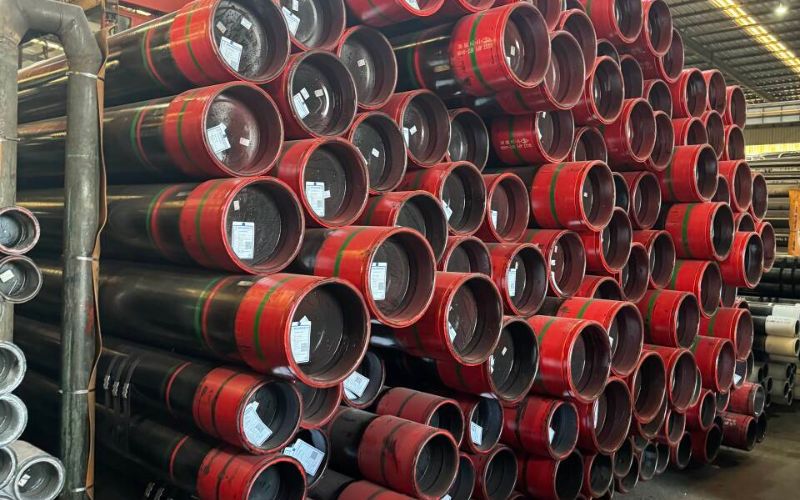
📐 Quick Specs: ASTM A53 Steel Pipe
- Standard: ASTM A53/A53M-24 (latest revision)
- Types: F (furnace-welded), E (ERW), S (hot-formed, no weld seam)
- Grades: Grade A and Grade B
- Size Range: NPS 1/8 to NPS 26 (DN 6 to DN 650)
- Tensile Strength: 48,000–60,000 psi (Grade A–B)
- Yield Strength: 30,000–35,000 psi (Grade A–B)
- Ma× Service Temp: ~400°F (204°C) per ASME B31.1
- Coatings: Black or hot-dipped galvanized (zinc-coated)
ASTM A53 steel pipe is by far the most commonly specified carbon steel pipe specification in North America. ASTM International’s ASTM A53 specification covers black and hot-dipped galvanized steel pipe, in addition to boiler and seam-welded/torch-welded hot-dipped galvanized steel pipe, designed for both mechanical and pressure use; A53 is also suitable for all ordinary uses in steam, water, gas, and air lines.
This short guide focuses on the 3 types, 2 grades, dimensional data, and key decision areas that engineers and purchasing managers must contend with when selecting pipe – when ASTM A53 pipe is enough, and when you need to step up to ASTM A106 Grade B pipe.
What Is ASTM A53 Steel Pipe?
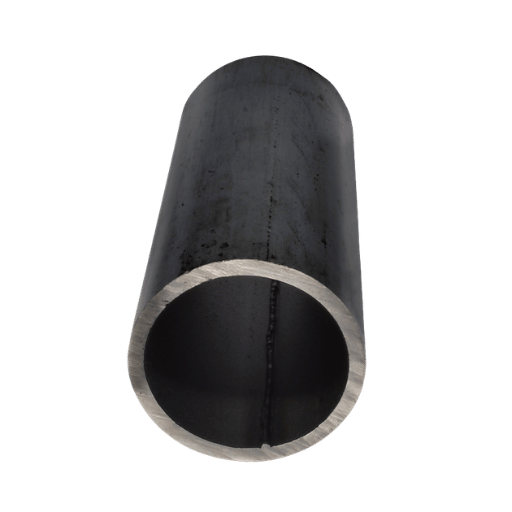
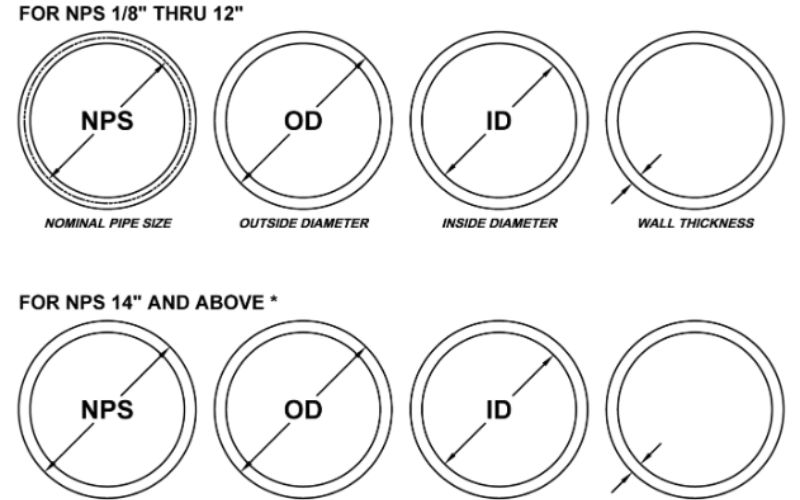
ASTM A53 is a standard specification for pipe, steel, black and hot-dipped, zinc-coated, welded and seamless. It covers seamless and welded black and hot-dipped galvanized steel pipe in NPS 1/8 to NPS 26, inclusive, with nominal wall thickness as given in ASME B36.10 tables.
Steel pipe ordered under this specification is intended for mechanical and pressure applications and is also acceptable for ordinary uses in steam, water, gas, and air lines. It is suitable for welding and suitable for forming operations involving coiling, bending, and flanging. In 2025, the U.S. Pipeline and Hazardous Materials Safety Administration (PHMSA) updated federal pipeline safety regulations to incorporate the A53/A53M-22 revision, reaffirming the specification’s ongoing regulation status.
What Does A53 Pipe Mean?
“”A53″” is the name given to ASTM’s prescribed chemical and mechanical specifications for this group of carbon steel pipe specifications. The “A” in “”A53″” signifies that it is a ferrous standard, while ’53’ is the registered number in the order series assigned when the standard was issued in 1930. If you require “A53 pipe,” you are requesting pipe that was made and tested in accordance with ASTM A53/A53M – which states the chemical and Mechanical properties, hydrostatic testing, dimensional requirements, and test procedures. The current version is ASTM A53/A53M-24.
Three Types of A53 Pipe: Type F, Type E, and Type S
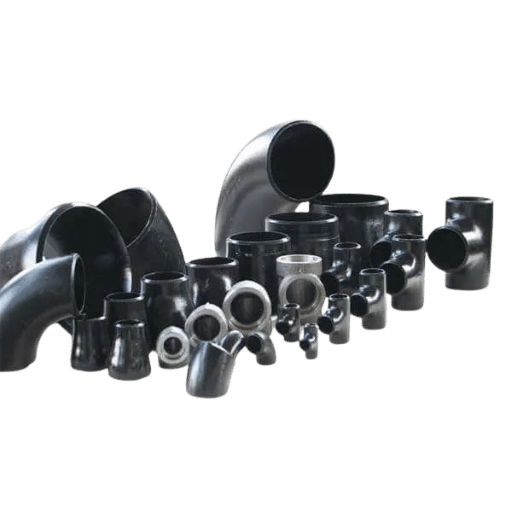
ASTM A53 is divided into 3 types and 2 grades, with each type corresponding to a different process for creation and production, which in turn affects the pipe quality and corresponding suitability of the pipe to different applications. The three types, as described by ASTM specification A53 are: delivery shall be made of steel conforming to one or more of the following processes; open-hearth, electric furnace, or basic-oxygen.
| Feature | Type F | Type E | Type S |
|---|---|---|---|
| Manufacturing | Furnace butt-welded (continuous weld) | Electric resistance welded (ERW) | Seamless (hot-formed, possibly cold-finished) |
| Weld Seam | Furnace-welded longitudinal seam | ERW longitudinal weld seam | None — no weld seam |
| Grades Available | Grade A only | Grade A and Grade B | Grade A and Grade B |
| Heat Treatment (Gr B) | N/A (no Grade B) | Required — min 1000°F (540°C) after welding | Per manufacturer’s process |
| Flanging Suitability | Not intended for flanging | Suitable for flange connections | Suitable for flange connections |
| Typical Use | Low-pressure water and gas lines | General mechanical and pressure service | Higher-integrity pressure applications |
Type E (electric resistance weld pipe/ERW pipe) dominates commercial availability. For Grade B ERW pipe, the weld seam must be heat treated after welding to a minimum of 1000°F (540°C) so that no untempered martensite remains. Type S (seamless steel pipe) is among the premium product types for installation, as it does not include a weld seam – a consideration when structuring an installation for cyclic-pressure and vibrational loadings. For an in-depth guide to ERW manufacturing, please see our guide.
When Type S or E is needed for close coiling or cold bending, then the Grade B should be used. however, Grade A will be the best choice. The lower carbon content in the Grade A (max 0.25% when compare to 0.30% in the Grade B) makes it more ductile.
A53 Grade A vs Grade B — Which Grade to Specify?
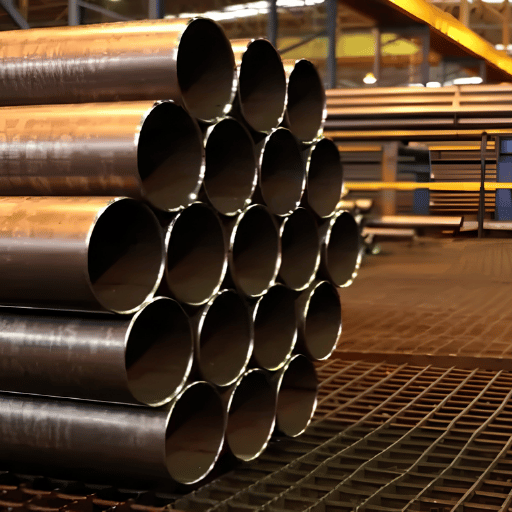
Of course, Grade B is default by the industry for a reason. An old pipline engineer on Eng- Tips said: “The most popular pipe material specification is A53 Grade B.” There is an broader spectrum of pressure and structural considerations that Grade B supports because of the higher yield and tensile strength, and it is supplied as the default item by most suppliers.
| Mechanical Property | Grade A (Type E/S) | Grade B (Type E/S) | Type F (Grade A only) |
|---|---|---|---|
| Min. Tensile Strength | 48,000 psi (330 MPa) | 60,000 psi (415 MPa) | 45,000 psi (310 MPa) |
| Min. Yield Strength | 30,000 psi (205 MPa) | 35,000 psi (240 MPa) | 25,000 psi (170 MPa) |
| Carbon Max % | 0.25% | 0.30% | 0.30% |
| Manganese Max % | 0.95% | 1.20% | 1.20% |
Is A53 Grade B Pipe Seamless?
There are two types of pipe corresponding to the standard type: Type S (Seamless) and Type E (Electric resistance welded).0Mechanical properties and chemical composition define the grade, not manufacturing process. When ordering pipe the exact type (E or S) and grade must be specified, e.g.) ‘A53 Type E Grade B” is ERW pipe with the higher grade mechanical properties of Grade B while ‘A53 Type S Grade B” is seamless pipe with these properties but no weld seam.
Always specify Grade A for the structural columns or for a pressure service when the Grade B can be obtained at negligible cost Premium. With a 17% higher yield strength (35000 as opposed to 30000 psi), then there is a direct increase in the maximum allowable working pressure. Remember unless you require the extra ductility of a Grade A for cold bending or close coiling, always go with Grade B.
A53 Pipe Sizes, Wall Thickness, and Pressure Ratings
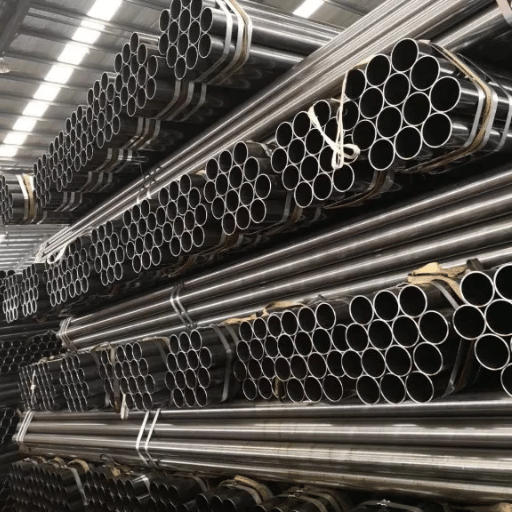
All A53 pipe is sized using the NPS (nominal pipe size) system, with outside diameter and nominal wall thickness defined by ASME B36.10. Minimum wall thickness at any point shall not be more than 12.5% under nominal. Tolerance for weight per foot is 10%.
| NPS | OD (in.) | Sch 40 Wall (in.) | Sch 40 Max Pressure (psi) | Sch 80 Max Pressure (psi) |
|---|---|---|---|---|
| 1/2 | 0.840 | 0.109 | 6,358 | 8,575 |
| 1 | 1.315 | 0.133 | 4,956 | 6,670 |
| 2 | 2.375 | 0.154 | 3,177 | 4,498 |
| 4 | 4.500 | 0.237 | 2,581 | 3,670 |
| 6 | 6.625 | 0.280 | 2,071 | 3,195 |
| 8 | 8.625 | 0.322 | 1,829 | 2,841 |
Pressure of A53 GRADE B at room temperature, derived from Barlow’s formula allowable stress = 24,500 psi (yield 35,000 psi 0.7 design factor). Data source Engineering ToolBox.
Is A53 Pipe Schedule 40?
Keep in mind: A53 is a material specification, not a schedule designation. Schedule 40 is just one of many wall thicknesses available for A53 pipe, as defined by ASME B36.10. Most distributors stock in Schedules 10, 40 (STD), 80 (XS), and XXH. Schedule determines wall thickness and pressure rating — but the material specification stays the same regardless of which schedule you order.
When pipe is cold expanded, it shall not be expanded more than 1.5% of the specified outside diameter. For NPS 1-1/2 and smaller, OD tolerance is 1/64. For NPS 2 and larger, OD tolerance is 1%.′ based upon tolerances per ASTM A53/A53M-24
ASTM A53 vs A106: When to Use Each Standard
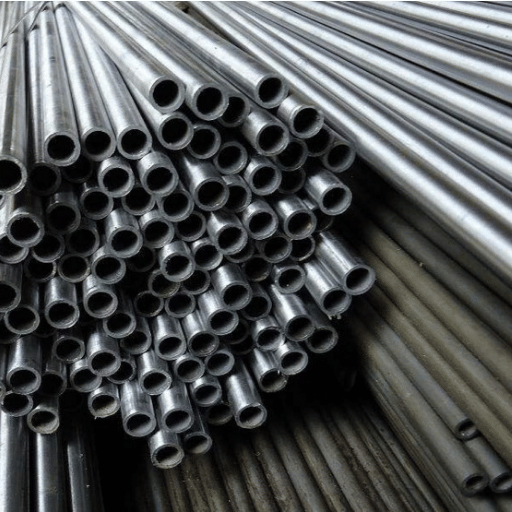
This is the most common question in carbon steel pipe procurement. Both standards share identical minimum tensile strength (60,000 psi) and yield strength (35,000 psi) for Grade B — so the real distinction is not strength. It is temperature capability and manufacturing scope.
| Feature | ASTM A53 | ASTM A106 |
|---|---|---|
| Scope | Seamless + ERW + furnace-welded + galvanized | Seamless carbon steel only |
| Max Service Temp | ~400°F (204°C) | ~750°F (399°C) |
| Grades | A and B | A, B, and C |
| Silicon Content | Not specified | 0.10% minimum required |
| Welded Pipe? | Yes (Type F and Type E) | No — seamless only |
| Galvanized Option? | Yes (hot-dipped zinc-coated) | No |
| Primary Use | General mechanical, structural, low-pressure fluid | High-temperature, high-pressure service |
Critical chemical distinction: A106 call for at least 0.10% silicon content. Silicon as an alloying element enhances high temperature performance as there is no benefit to high temperature exposure without it and weakens over time. Hence A53 is restricted to around 400F service and A106 to 750F
A53 and A106 are the two main types of carbon steel pipe in wide use in industry at present, and they are very similar to each other. However, the differences, though limited, are important as to when and where each type is called up in specifications.
— Shane Russell, American Piping Products
Here is the practical rule: as long as your service temperature stays below 400°F and you don’t need seamless-only pipe, A53 is your cheaper grade. As soon as your system runs over 400F – which is the case in power generation, refinery process lines and boiler connections – specify A106. Baling Steel’s full A106 product range is available on our ASTM A106 Grade B pipe page.
Black vs Galvanized A53 Pipe: Coating Selection
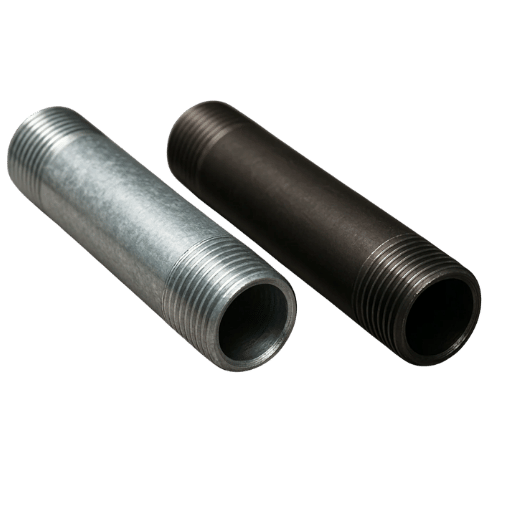
Under A53, pipe comes in two surface conditions: black and hot-dipped galvanized. Black pipe has no protective coating. Galvanized pipe receives a hot-dipped zinc layer, which has corrosion resistance characteristics for use in outdoor or wet-service situations.
| Application | Black | Galvanized | Code Reference |
|---|---|---|---|
| Indoor natural gas line | ✔ | — | IFGC / local code |
| Outdoor water distribution | — | ✔ | IPC / local plumbing code |
| Fire sprinkler system | — | ✔ | NFPA 13 (or ASTM A795) |
| Structural support (dry interior) | ✔ | — | AISC |
| Underground (with external coating) | ✔ + FBE/3LPE | — | AWWA C203 / project spec |
For most galvanized applications, hot-dipped galvanized A53 pipe is the standard specification. For corrosion-prone underground applications black steel pipe with external FBE coating or 3LPE coating can tend to outperform galvanising over a number of decades.
Welding galvanized pipe produces zinc vapors which are inhaled and are hazardous as cause of metal fume fever. Galvanized A53 pipe, if needed in the field, has to have the zinc coating ground down in the weld zone, using appropriate breathing apparatus or or other means of proper ventilation in accordance with OSHA welding safety rules. Re-apply zinc-based paint after welding.
Applications and How to Order A53 Pipe
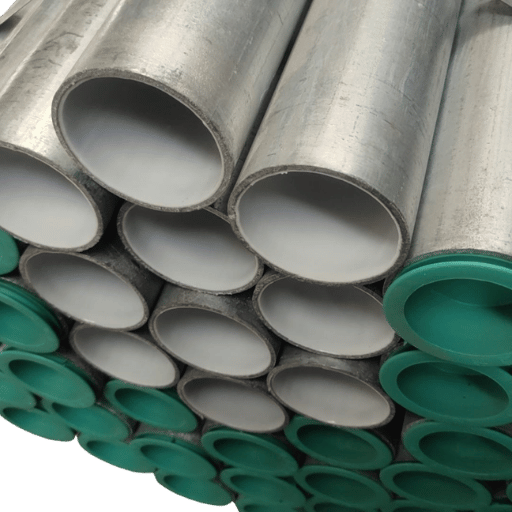
A53 pipe is thought of as structural steel (used in building construction, fencing, scaffolding, etc), or used to carry fluids at low-medium pressure in virtually every industry. A53’s popularity is such that many distributers will assume, by default, that they are stocking “A53 Type E Grade B”.
The A53 Selection Matrix: Application → Specification
| Application | Type | Grade | Coating | Order As |
|---|---|---|---|---|
| Low-pressure water/gas line | E | A or B | Black or Galv | A53 Type E Gr B Galv |
| Structural column / railing | E | B | Black | A53 Type E Gr B BPE |
| Medium-pressure steam line | E or S | B | Black | A53 Type S Gr B |
| Fire sprinkler system | E | B | Galvanized | A53 Type E Gr B Galv |
| High-temp service (>400°F) | → Specify ASTM A106 instead | |||
| Cold bending / close coiling | E or S | A (preferred) | Black | A53 Type E Gr A |
- Type—state the type(F, E, S) and grade (A, B)
- Best Gripgröße und Lieferzeit NPS (z.B. 4″ NPS Sch 40) auch: Notieren Sie die Größe und die Lieferzeit der jeweiligen NPS (z.B. 4″ NPS Sch 40).
- ✔ Specify coating: black or hot-dipped galvanized
- Specifikoni mbarimin dhembje është së fundmi:soqele e thjeshtë (PE/BPE)anjekohëzuar, me fylbotë. mirëfillnazoshqollë avull.
- Spesifier lengde: enkelt tilfeldig (over 16-22 ft) eller dobbelt tilfeldig (over 22 f t, normalt over 35 ft).
- Specify the purpose (mechanical, pressure, structural)
- Insist on test requirements: hydrostatic test certificate, MTR (mill test report)
Frequently Asked Questions
Q: What is the difference between A53 and A36 steel?
View Answer
Q: Is A106 the same as A53?
View Answer
Q: What is the difference between A53 and A500 pipe?
View Answer
Q: How is A53 ERW pipe manufactured?
View Answer
Q: Can A53 pipe be used for fire sprinkler systems?
View Answer
Q: What is the maximum operating temperature for A53 pipe?
View Answer
About This Guide
Baling Steel ships NPS 1/2 through 24 in black or galvanized A53 pipe of all three types and both grades. The info contained in this guide is based on A53/A53M-24, B36.10 and B31.3 code tables. We produce this guide because we find that A53 content on the Internet commonly reproduces the standard with no explanation of how to gauge the quality of pipe across the different types, grades and coatings and how to choose the right combination for your specific project. The most common customer query we encounter is: What specific material should I buy for my application and what options do I have? .
References & Sources
- ASTM A53/A53M-24 Standard Specification for Pipe, Steel, Black and Hot-Dipped, Zinc-Coated, Welded and Seamless – ASTM International
- Pipeline Safety: Standards Update – ASTM A53/A53M (2025) – U. S. Federal Register / PHMSA
- ASTM A53 B Carbon Steel Pipes – Allowable Pressure vs. Schedule and Size – Engineering ToolBox
- ASTM A53 Steel — Wikipedia
- Root Cause Analysis of Fractured ASTM A53 Carbon Steel Pipe – ScienceDirect / Elsevier
- Comparison of Fire Sprinkler Piping Materials – IAPS (International Association of Plumbing and Mechanical Officials)
Related Articles
- The Complete Guide to ERW Steel Pipe
- The Complete Guide to Galvanized Steel Pipe
- The Complete Guide to Black Steel Pipe
- Stainless Steel Pipe: Properties and Applications
- FBE Coated Pipe: Benefits for Underground Use