Atualizado em agosto de 2026
Uma calculadora de volume de tubos é uma ferramenta baseada numa fórmula que converte o diâmetro interno e o comprimento em volume cúbico. A aritmética é simples; escolher o diâmetro certo, manter unidades compatíveis e saber quando o modelo cilíndrico deixa de representar o sistema real são os aspetos mais difíceis. Quando utilizada corretamente, a fórmula seguinte indica quanta água um tubo pode conter quando todo o espaço interno está ocupado; considera a água no tubo como o espaço dentro do tubo, e não como caudal. Este guia apresenta todos os dados de entrada e conversões, para que o resultado possa ser verificado.
Resumo do cálculo
- As designações nominais dos tubos não são valores seguros para o diâmetro.
- Com um erro de 2% no diâmetro interno, o volume calculado varia 4,04% para um comprimento fixo.
- Um galão dos EUA equivale a 231 polegadas cúbicas ou 3.785412 litros.
- Cotovelos, válvulas, depósitos, escoamento com enchimento parcial e gás comprimido exigem dados adicionais ou outro modelo.
Especificações rápidas
| Modelo | Espaço interno circular, reto e totalmente cheio |
| Geometria necessária | Diâmetro interno D e comprimento reto L |
| Forma do diâmetro | V = πD²L/4 |
| Resultados métricos | mm³, cm³, litros, m³ |
| Resultados imperiais | in³, ft³, galões dos EUA |
Calculadora de volume de tubos: comece pelo diâmetro interno real
Um cálculo fiável do volume de um tubo começa pelo diâmetro interno que pode ser ocupado pelo fluido, e não pela designação nominal impressa no tubo. Para um tubo com diâmetro medido, registe o diâmetro do tubo, o comprimento do tubo ou a distância abrangida, a origem de cada valor, o sistema de unidades e a unidade pretendida para o resultado. Se o diâmetro interno não tiver sido medido, identifique o valor deduzido da série como geometria teórica de referência.
A origem do diâmetro é importante porque a fórmula eleva esse valor ao quadrado. Mesmo um pequeno erro aumenta antes da aplicação do comprimento ou do fator de conversão. Registe a base do diâmetro interno, mesmo que uma folha de cálculo o identifique como ID. O guia US EPA Plumbing Volume Estimator considera teóricos os valores baseados em dimensões de normas de conceção e observa que os depósitos podem reduzir o diâmetro interno disponível durante o funcionamento.
Auditoria do diâmetro nominal e real
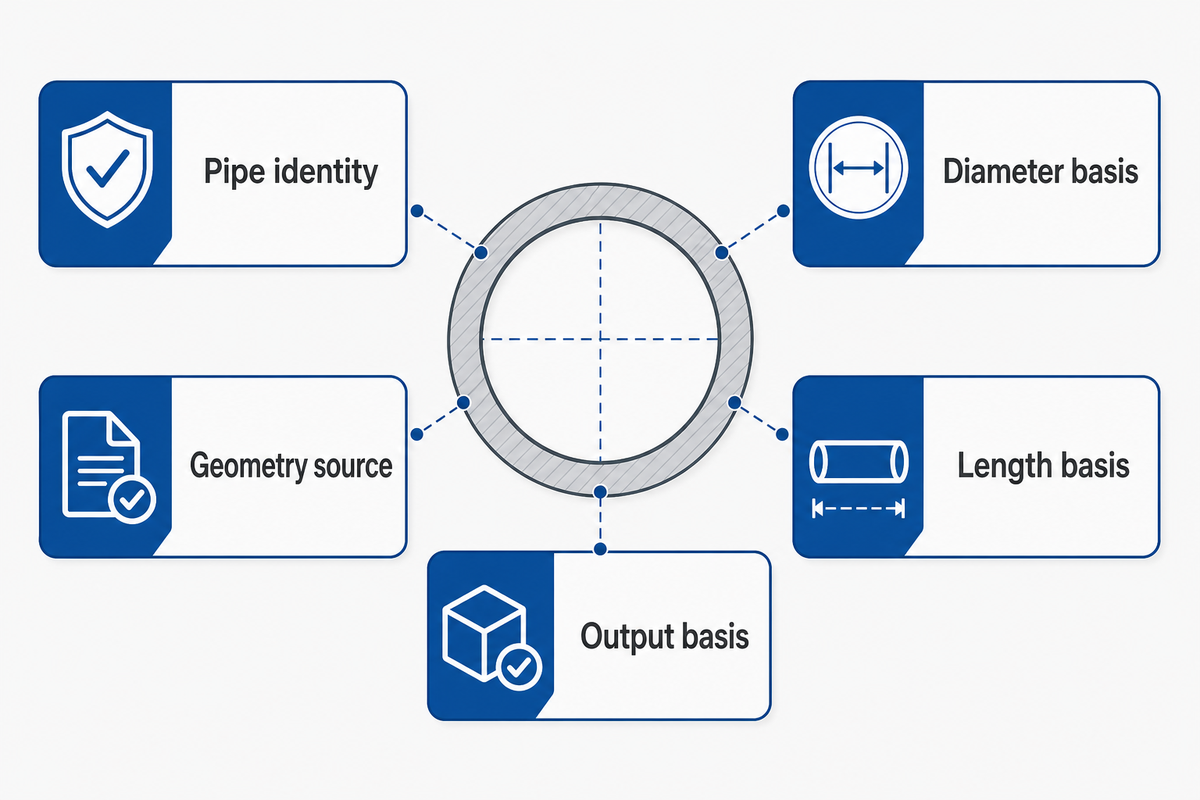
A Auditoria do diâmetro nominal e real é uma verificação de cinco campos que regista como foi obtido o diâmetro usado na calculadora antes de alguém confiar no resultado.
| Campo de auditoria | O que registar | Decisão |
|---|---|---|
| Identificação do tubo | Norma, material, NPS ou DN e série/classe | Identifica a família de referência correta |
| Base do diâmetro | ID medido, desenho certificado ou ID deduzido | Para determinar a capacidade física, prefere-se o ID medido |
| Origem da geometria | Registo de medição, revisão do desenho ou página de dimensões | Permite auditar o resultado |
| Base do comprimento | Comprimento reto pela linha de centro e extremidades incluídas | Evita sobreposições ou troços em falta |
| Base do resultado | Litros, m³, galões dos EUA ou ft³ | Define o percurso de conversão final |
A folha de cálculo deve manter separados os campos do tubo e do comprimento, para que os revisores possam rastrear cada dado de entrada.
Introduzir “2 inches” porque o tubo é NPS 2 ignora tanto a espessura da parede como a convenção de dimensão nominal. Este atalho só pode ser útil numa estimativa preliminar quando a incerteza é claramente indicada.
Fórmula do volume do tubo: V = πD²L/4
A fórmula do volume do tubo é a equação do cilindro expressa com o diâmetro interno: V = πD²L/4. Eleve o diâmetro interno ao quadrado, multiplique pelo comprimento reto e por π e, em seguida, divida por quatro. O diâmetro e o comprimento têm de usar unidades compatíveis; assim, o primeiro resultado é expresso em milímetros cúbicos, metros cúbicos, polegadas cúbicas ou pés cúbicos.
Como orientações do NIST sobre circunferência, área e volume apresentam o volume de um cilindro como 0,7854 × diâmetro × diâmetro × altura e recomendam usar a mesma unidade para todas as dimensões. Para calcular o volume, use a área da secção transversal interna; a área da superfície do tubo responde a outra questão. A expressão πD²L/4 representa a mesma relação, pois π/4 é aproximadamente 0.785398, e o processo passo a passo seguinte explicita a geometria.
| Símbolo | Significado | Regra para os dados de entrada |
|---|---|---|
| V | Volume interno | Começa numa unidade cúbica |
| π | Constante do círculo | Mantenha a precisão da calculadora até ao fim |
| D | Diâmetro interno | Nunca substitua silenciosamente pelo OD ou pelo tamanho nominal |
| L | Comprimento reto do tubo | Use a mesma unidade de base que para D |
| r | Raio interno, D/2 | A forma alternativa é V = πr²L |
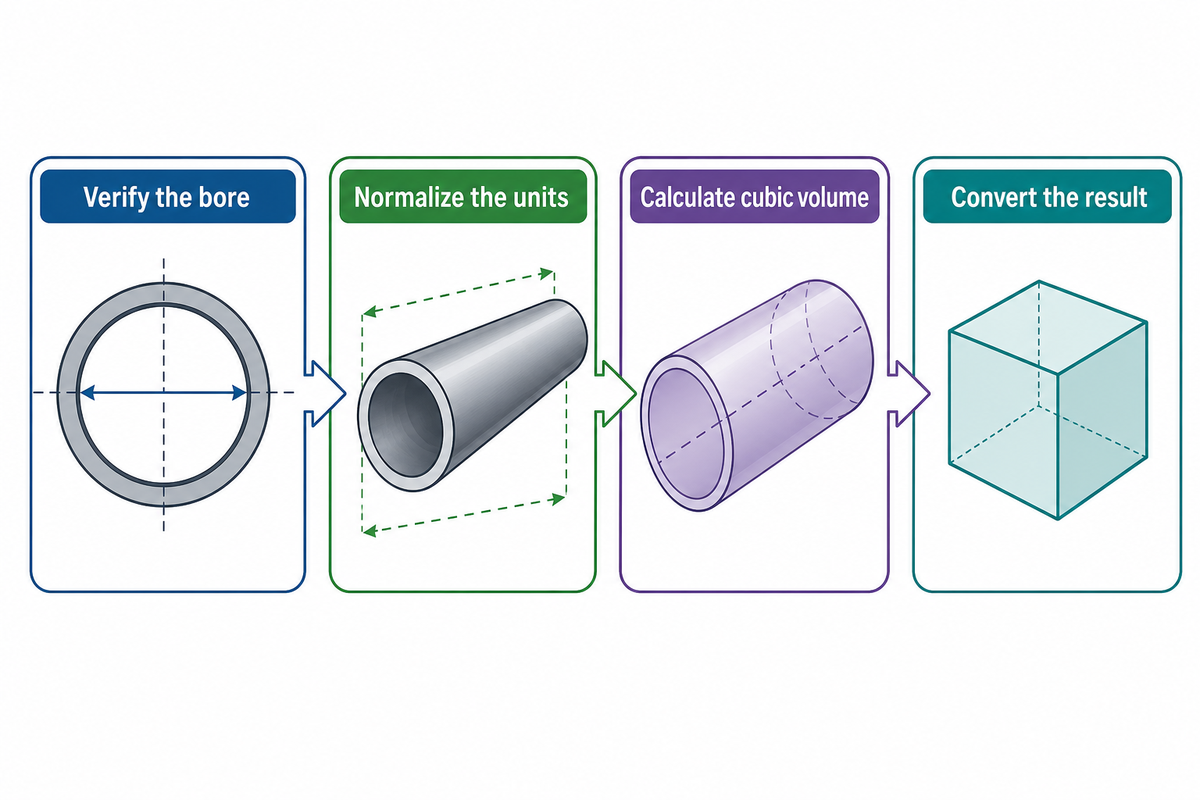
- Verifique o diâmetro interno — registe o ID medido ou identifique claramente um ID teórico associado à respetiva fonte.
- Uniformize as unidades — converta o diâmetro e o comprimento para uma unidade de base compatível.
- Calcule o volume cúbico — calcule πD²L/4 sem arredondamentos intermédios.
- Converta o resultado — converta o valor cúbico final para litros, m³, galões dos EUA ou ft³.
Mantenha pelo menos uma casa decimal a mais do que a necessária para o relatório final. Arredondar um diâmetro em polegadas para pés antes de o elevar ao quadrado pode alterar mais o resultado do que arredondar o volume final.
Dimensão nominal, diâmetro exterior e diâmetro interno do tubo

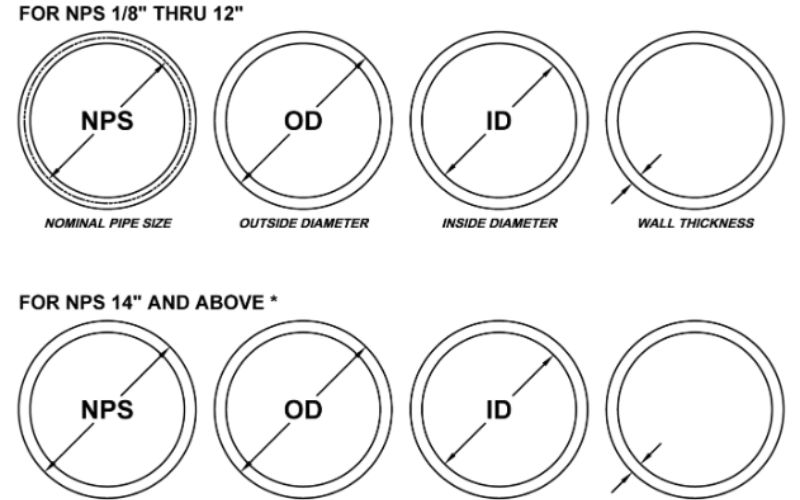
A dimensão nominal do tubo identifica uma família normalizada; não indica diretamente o diâmetro interno. O diâmetro exterior descreve o contorno externo do tubo, a espessura da parede ocupa material dos dois lados e o diâmetro interno resulta de ID = OD − 2t. Um ID obtido a partir de uma tabela continua a ser teórico até o tubo específico ser medido.
Esta distinção explica por que motivo a secção da fórmula tratou D como um valor de entrada do diâmetro interno real ou explicitamente teórico, em vez de uma designação nominal.
O âmbito da norma ASME B36.10 estabelece a normalização dimensional dos tubos de aço trabalhado. A ASTM especifica ainda a variação das dimensões: a Nota de âmbito 2 da A53/A53M-24 indica que a espessura nominal da parede é uma designação e que a espessura real pode ser superior ou inferior.
O estado da edição também deve ser verificado diretamente. A página inicial oficial da B36.10 identifica uma revisão de 2022, enquanto a rotulagem pública dos produtos pode estar desatualizada; o agendamento de uma edição seguinte não prova que tenha sido publicada. Verifique a edição adquirida para o projeto, em vez de presumir que está atualizada com base numa data indicada numa página.
Os cálculos de tubagens falham frequentemente quando se introduz a dimensão nominal do tubo em lugar do diâmetro interno real necessário.
Um procedimento útil consiste em consultar uma tabela de dimensões de tubos atualizada, confirmar a tabela de séries de tubos aplicável, deduzir um ID de referência e, em seguida, substituir essa referência por um desenho aprovado ou por uma medição quando o volume for determinante para lavagem, dosagem de produtos químicos, amostragem ou inventário.
- Registe a norma aplicável ao tubo e a respetiva edição.
- Meça o ID quando a capacidade física for importante.
- Identifique o ID deduzido como geometria teórica.
- Mantenha OD, espessura da parede e ID no mesmo sistema de unidades.
- Introduza NPS como se fosse um ID medido.
- Use o diâmetro exterior na fórmula do volume.
- Transfira dimensões entre normas sem as verificar.
- Use a série como atalho para determinar a pressão nominal.
Conversões de unidades: litros, m³, galões dos EUA e pés cúbicos
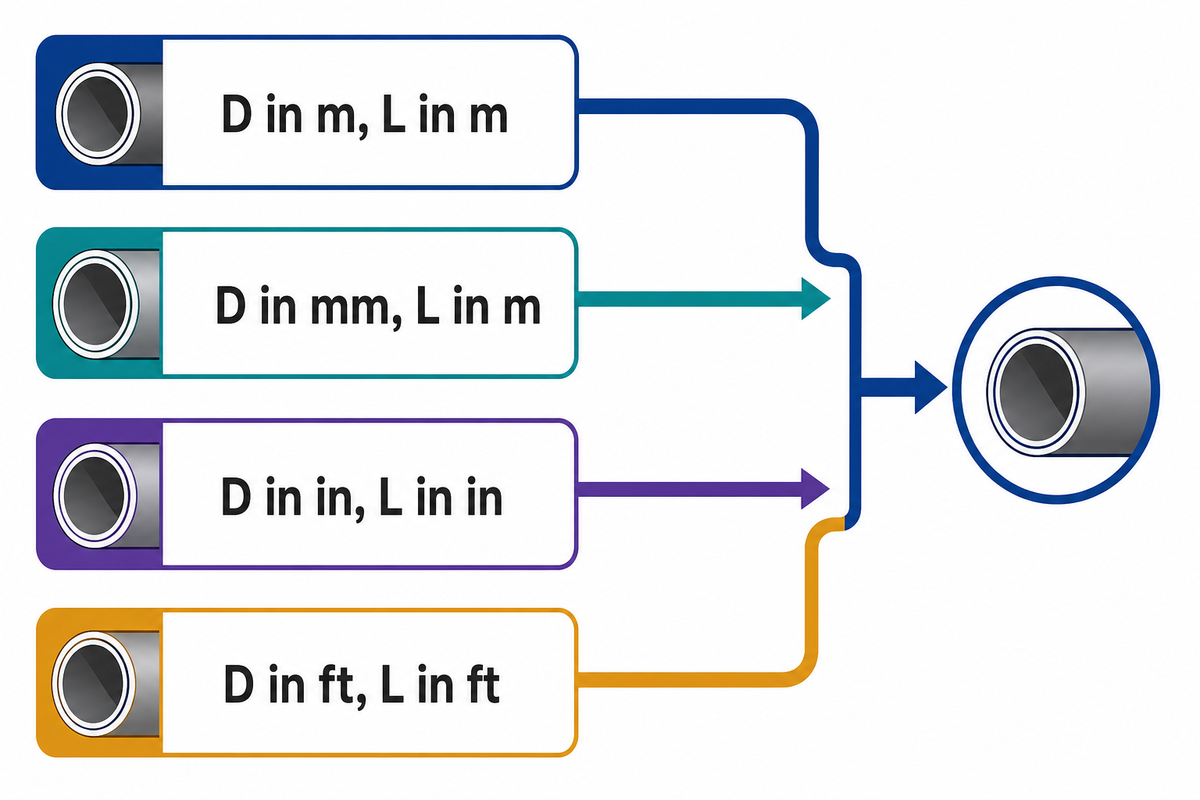
Um percurso de conversão seguro converte primeiro a geometria, calcula um volume numa unidade cúbica e converte o volume final uma única vez. Tanto no sistema métrico como no imperial, cada valor de entrada precisa de uma unidade explícita, e não de uma predefinição do software. Para um tubo medido em polegadas, o comprimento deve estar em polegadas ou ser convertido com exatidão; não se devem misturar polegadas e pés no cálculo D²L do sistema imperial.
A tabela de conversões do Apêndice B.8 do NIST apresenta 1 in³ = 1,638706 × 10⁻⁵ m³, 1 US gal = 3,785412 L e 1 L = exatamente 0,001 m³. Estes fatores são mantidos até à apresentação do resultado final.
Para quem pesquisa “pipe volume calculator in m3”, é necessário converter ambas as dimensões geométricas para metros antes de aplicar a fórmula. Para calcular o volume do tubo em galões, mantenha compatíveis as unidades da geometria imperial e divida o volume final em polegadas cúbicas por 231.
Matriz de conversão de unidades
A matriz de conversão de unidades apresenta um percurso completo de cálculo de cada vez, evitando a mistura de polegadas com pés ou de milímetros com metros no cálculo D²L.
| Unidades de entrada | Resultado cúbico | Resultado final | Limitações / Inadequado para |
|---|---|---|---|
| D em m, L em m | m³ | m³ diretamente | Não introduza D em mm |
| D em m, L em m | m³ | × 1 000 = L | Os litros são apenas uma conversão final |
| D em mm, L em mm | mm³ | ÷ 1 000 000 = L | Pouco adequado para percursos muito longos |
| D em mm, L em m | Use V(L) = πD²L/4,000 | L diretamente | A fórmula inclui o fator de conversão entre unidades |
| D em cm, L em cm | cm³ | ÷ 1 000 = L | Confirme que nenhum dos valores de entrada está em mm |
| D em in, L em in | in³ | ÷ 231 = US gal | Galões dos EUA, não galões imperiais |
| D em in, L em ft | Converta L × 12 para in | in³ ou US gal | Não arredonde D ÷ 12 antes de elevar ao quadrado |
| D em ft, L em ft | ft³ | ft³ diretamente | Converta primeiro o diâmetro com exatidão |
| D em in, L em in | in³ | × 1,638706 × 10−2 = L | Mantenha a precisão da conversão |
O guia de unidades de água da Oklahoma State University também alerta que a substituição de unidades de caudal por unidades de volume pode produzir resultados que não parecem obviamente errados. Por isso, as unidades devem figurar junto de cada valor de entrada e resultado, e não apenas no título de uma folha de cálculo.
Três exemplos resolvidos e verificados, capacidade por unidade de comprimento e vários troços
Os exemplos resolvidos do volume de tubos devem indicar a origem dos dados de entrada, a uniformização das unidades, o cálculo cúbico e a conversão final. Os três exemplos seguintes abrangem um tubo métrico, um percurso em polegadas e pés e uma geometria teórica de referência para um tubo de aço NPS 2. Em cada cálculo, o arredondamento é adiado até ao volume final apresentado.
Os percursos de conversão acima dão agora lugar a três cálculos reproduzíveis, linha a linha.
Exemplo 1: ID de 50 mm ao longo de 12 m
Num exemplo de manutenção resolvido, o volume de água necessário está dentro de um troço reto de 12 m, com um diâmetro interno medido de 50,0 mm. Converta 50,0 mm para 0,0500 m e calcule V = π × 0.0500² × 12 ÷ 4 = 0,0235619 m³. Multiplicando por 1 000, obtém-se 23,56 L.
Exemplo 2: ID de 4 in ao longo de 25 ft
Numa folha de cálculo de lavagem, os dados de entrada são um ID medido de 4.000 in e 25,0 ft de tubo reto. Converta o comprimento para 300 in. Em seguida, V = π × 4.000² × 300 ÷ 4 = 3,769.91 in³. Este é o volume em polegadas cúbicas. Divida por 231 para obter 16.32 US gal ou por 1 728 para obter 2,182 ft³.
Exemplo 3: geometria de referência NPS 2, série 40
A página do tubo ASTM A106 Grade B fornece contexto comercial. Este exemplo utiliza separadamente as dimensões teóricas de referência NPS 2 publicadas para clientes pela Baling Steel: OD de 2.375 in e espessura nominal da parede de 0.154 in, o que resulta em ID = 2.375 − 2 × 0.154 = 2.067 in. Para 20 ft, o resultado calculado é 3.486 US gal ou 13,20 L.
Neste caso, é importante identificar a origem dos dados em cada célula: usam-se as células de dimensões publicadas depois de as verificar, excluindo afirmações não relacionadas sobre pressão, certificação e produção nas páginas comerciais. A verificação também revelou valores de capacidade contraditórios numa página de calculadora bem posicionada; por isso, todos os resultados numéricos deste guia de cálculo do volume de tubos de aço foram recalculados a partir de πD²L/4, em vez de copiados de uma tabela de volume de tubos.
| Exemplo | Geometria | Resultado cúbico | Resultado convertido |
|---|---|---|---|
| Métrico | 50,0 mm ID × 12,0 m | 0,0235619 m³ | 23,56 L |
| Imperial | 4.000 in ID × 25,0 ft | 3,769.91 in³ | 16.32 US gal |
| Referência NPS 2 | 2.067 in ID × 20,0 ft | 805.35 in³ | 3.486 US gal |
Capacidade por pé e folha de cálculo para vários troços
Para troços retos repetidos, calcule um fator de volume por pé para cada ID verificado. A referência NPS 2, série 40, acima contém 40.267 in³/ft, 0.1743 US gal/ft ou 0,6599 L/ft. Este volume de água varia proporcionalmente ao comprimento reto verificado. Doze pés com esse ID de referência, mais oito pés com o ID de referência da série 80, totalizam 12 × 0.174317 + 8 × 0.153396 = 3.319 US gal.
| Troço | ID verificado | Comprimento | Fator de unidade | Volume |
|---|---|---|---|---|
| A | 2.067 in | 12 ft | 0.174317 US gal/ft | 2.092 US gal |
| B | 1.939 in | 8 ft | 0.153396 US gal/ft | 1.227 US gal |
| Total do tubo reto | IDs distintos mantidos | 20 ft | Sem calcular a média | 3.319 US gal |
| Componentes | Cotovelos, tês, válvulas | N/A | Use o volume verificado do componente | Adicione separadamente |
O guia da EPA observa que os componentes pequenos introduzem erros quando não são incluídos num modelo de tubo reto. Não converta o comprimento pela linha de centro de um cotovelo num comprimento equivalente de cilindro reto, exceto quando um método aprovado definir expressamente essa aproximação.
Séries 40 e 80: regra de sensibilidade do valor D²
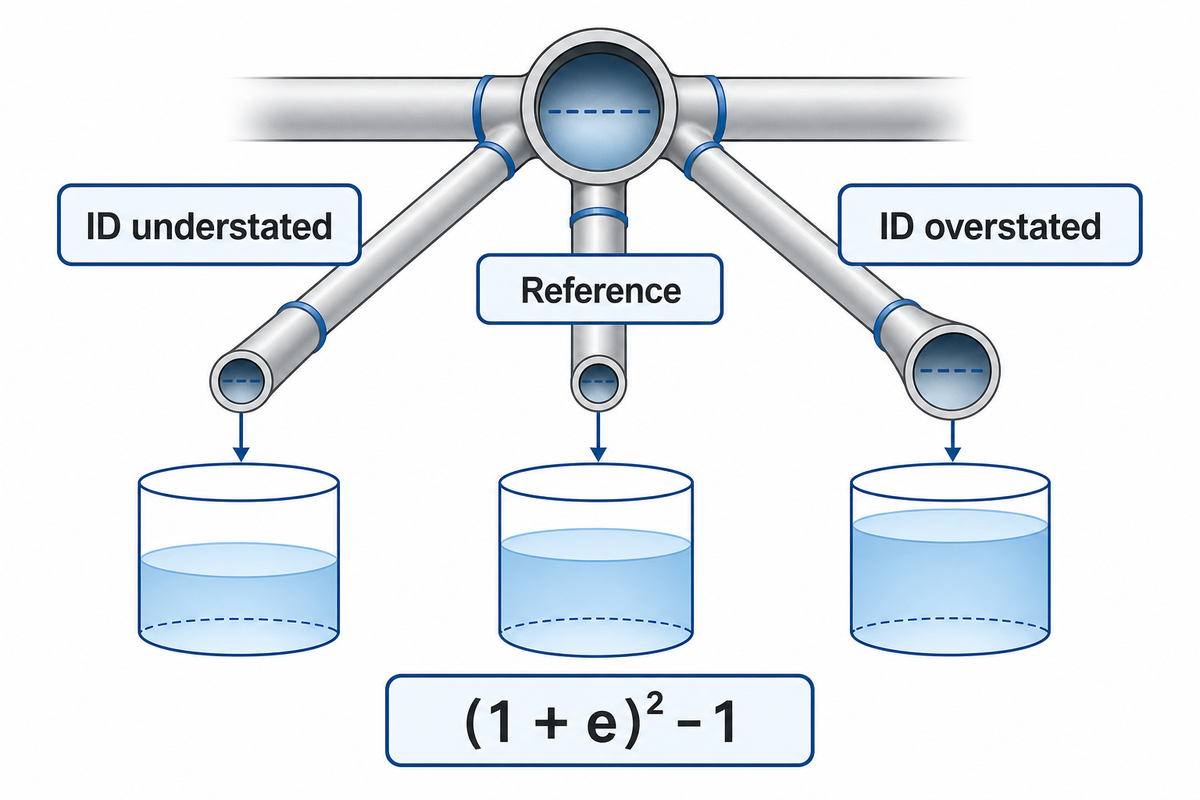
A regra de sensibilidade do valor D² estabelece que o volume calculado varia com o quadrado do valor de diâmetro interno utilizado. Para um comprimento fixo, um erro relativo e no diâmetro altera o volume em (1 + e)² − 1. A regra é exata para o modelo de cilindro do NIST, mas não constitui um certificado de tolerâncias de fabrico.
Usando o mesmo OD de referência NPS 2, o ID da série 40 é 2.067 in e o ID da série 80 é 1.939 in. A razão entre os volumes é (1.939 ÷ 2.067)² = 0.87998; assim, para comprimentos retos iguais, a geometria de referência da série 80 contém aproximadamente 12,00% menos do que a referência da série 40.
| Caso de entrada | Variação do diâmetro | Variação do volume calculado | Limitações / Inadequado para |
|---|---|---|---|
| ID subestimado | −5% | −9.75% | Não representa uma hipótese de tolerância |
| ID subestimado | −2% | −3.96% | Verifique o método de medição |
| ID subestimado | −1% | −1.99% | Apenas para comprimento fixo |
| Referência | 0% | 0% | A fiabilidade depende dos dados de entrada |
| ID sobrestimado | +1% | +2.01% | Não inclui erro no comprimento |
| ID sobrestimado | +2% | +4.04% | Não inclui ovalização |
| ID sobrestimado | +5% | +10.25% | Não inclui depósitos |
| Referência NPS 2, série 40 | 2.067 in ID | 0.1743 US gal/ft | Geometria nominal teórica |
| Referência NPS 2, série 80 | 1.939 in ID | 0.1534 US gal/ft | Geometria nominal teórica |
Cadeia de erros da capacidade
A cadeia de erros da capacidade acompanha a sequência: designação nominal → espessura de referência → ID deduzido → geometria ao quadrado → conversão de unidades → resultado arredondado.
A falsa precisão surge quando o resultado final tem três casas decimais, mas o primeiro elo é apenas uma designação nominal. Audite a cadeia da esquerda para a direita: verifique a identificação e a geometria, calcule sem arredondar prematuramente, converta uma vez e apresente apenas a precisão justificada pelos dados de entrada.
O volume estático do tubo não é caudal, tempo de escoamento nem peso do fluido
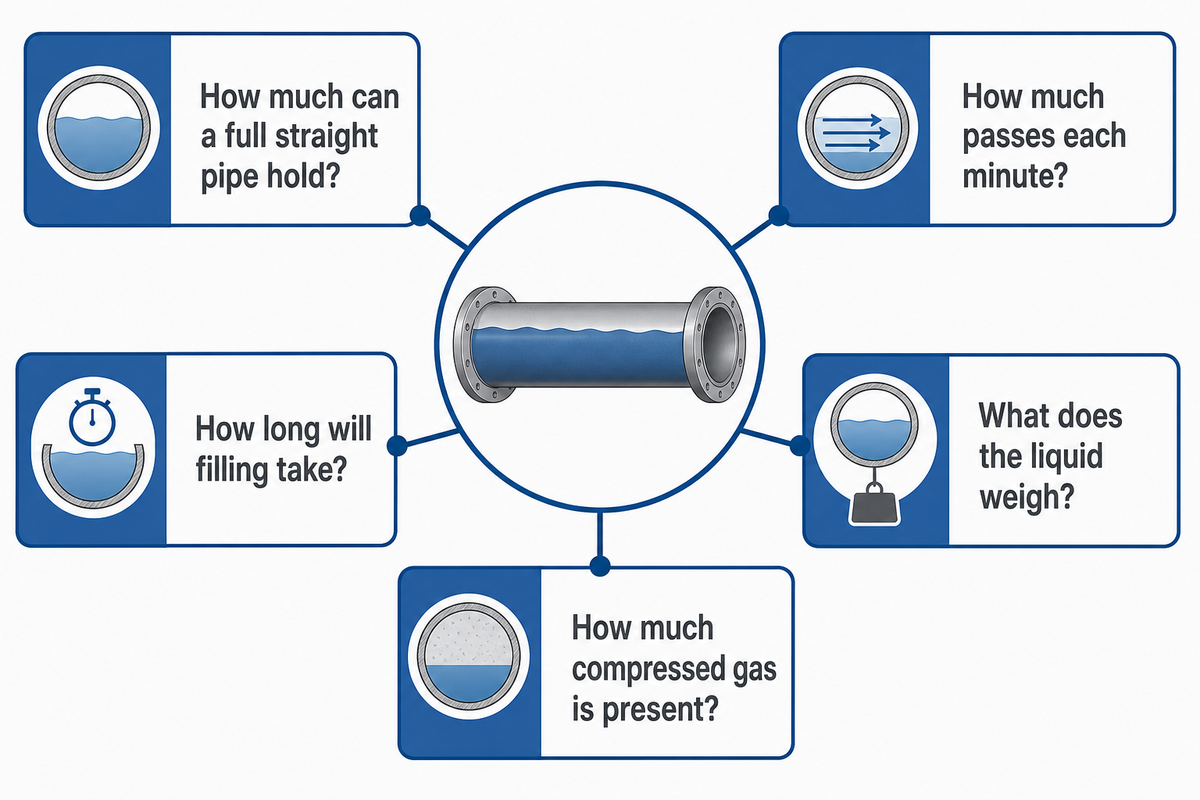
O volume estático de um tubo mede o espaço interno e é expresso em unidades como litros ou galões. O caudal mede a quantidade de fluido por unidade de tempo; para determinar o peso da água é necessária a densidade, e qualquer cálculo do tempo de enchimento ou esvaziamento exige uma relação entre tempo e caudal. O inventário de gás comprimido também requer pressão, temperatura e comportamento do gás.
As orientações da Oklahoma State University sobre medição da água distinguem a água em repouso da água em movimento. Isto evita um erro comum de categoria: dividir galões por um tempo presumido e chamar ao resultado caudal do sistema, sem dados de velocidade, pressão, curva da bomba, posição da válvula, elevação ou perdas. O peso da água exige um cálculo separado com a densidade, e o volume de qualquer torneira ou acessório tem de ser adicionado como componente.
| Questão | Modelo | Dados adicionais |
|---|---|---|
| Quanto pode conter um tubo reto totalmente cheio? | V = πD²L/4 | ID e comprimento verificados |
| Quanto passa em cada minuto? | Q = área × velocidade | Velocidade ou caudal medido |
| Quanto tempo demora o enchimento? | tempo = volume ÷ caudal | Um caudal justificável |
| Qual é o peso do líquido? | massa = densidade × volume | Densidade do fluido nas condições especificadas |
| Qual é a quantidade de gás comprimido presente? | Cálculo do estado do gás | Pressão absoluta, temperatura, modelo do gás |
A discussão de Ray Hardee em Pumps & Systems reforça a lição geral: para prever o desempenho de uma tubagem são necessários o diâmetro real e os dados do sistema, e não apenas uma designação nominal e uma fórmula.
Limites de precisão e casos em que o modelo cilíndrico falha

A geometria cilíndrica permite obter uma estimativa de planeamento para um espaço interno circular, reto e totalmente cheio. Qualifique ou substitua o modelo se o tubo estiver parcialmente cheio, não for circular, estiver deformado, revestido ou incrustado, ou for difícil de medir; se os componentes forem determinantes; ou se o resultado necessário for um volume calibrado nas condições de funcionamento, em vez da capacidade geométrica.
Estes limites complementam a escolha do modelo descrita na secção anterior: a fórmula do cilindro cheio, por si só, não responde a uma questão sobre caudal, inventário de gás comprimido ou capacidade com enchimento parcial.
Matriz de aplicabilidade do cálculo
A matriz de aplicabilidade do cálculo indica se dez condições permitem utilizar o cálculo, exigem ressalvas ou impedem a sua utilização, antes de introduzir o primeiro valor. Pode tratar um circuito hidrónico de climatização com troços retos como geometria segmentada, mas não volumes desconhecidos dos componentes nem situações de enchimento parcial.
| Condição | Decisão | Ação necessária | Limitações / Inadequado para |
|---|---|---|---|
| Reto, cheio, circular, diâmetro interior medido | Utilizar | Aplicar πD²L/4 | Continua a excluir os componentes |
| Vários troços retos | Utilizar por troço | Calcular cada diâmetro interior e somar os resultados | Não calcular a média de diâmetros diferentes |
| Diâmetro interior determinado pela série | Utilizar com ressalvas | Identificar como valor de referência teórico | Não corresponde a uma medição do tubo fornecido |
| Curvas, tês e válvulas | Utilizar com ressalvas | Adicionar os volumes verificados dos componentes | A substituição por comprimento reto pode induzir em erro |
| Incrustações ou depósitos de corrosão | Medir | Determinar o diâmetro interior efetivo | O diâmetro interior de referência pode sobrestimar a capacidade |
| Revestimento interno ou camada interior | Utilizar com ressalvas | Utilizar o diâmetro interior após o revestimento | O diâmetro interior nominal do aço não é suficiente |
| Tubo horizontal parcialmente cheio | Não utilizar isoladamente | Utilizar a geometria de um segmento circular | É necessária a profundidade do líquido e a orientação |
| Diâmetro interior ovalizado, esmagado ou flexível | Não utilizar isoladamente | Medir a secção transversal real | Um único diâmetro não permite descrever a área |
| Inventário de gás comprimido | Modelo inadequado | Aplicar um método baseado no estado do gás | O volume geométrico é apenas um dos dados de entrada |
| Medição calibrada para transferência de custódia ou metrologia | Nível de precisão inadequado | Utilizar medição calibrada e avaliar a incerteza | Pode exigir correção de temperatura/pressão |
As orientações da EPA alertam especificamente para o facto de os depósitos de corrosão poderem reduzir o diâmetro interior e de componentes pequenos não incluídos no modelo aumentarem o erro do volume final. Para trabalhos de maior precisão, um estudo revisto por pares de 2024 sobre um provador de tubos segmentado mede o diâmetro e o comprimento por troço e inclui uma análise formal da incerteza. A incerteza expandida reportada de 0,012% diz respeito a esse equipamento calibrado, não a um cálculo corrente de um artigo.
- Planear o volume de descarga para troços retos verificados
- Comparar capacidades teóricas para um comprimento fixo
- Criar uma folha de cálculo transparente por pé ou por metro
- Transferência de custódia ou medição calibrada
- Análise hidráulica de tubos parcialmente cheios
- Inventário operacional de gás comprimido
- Sistemas dominados por componentes ou depósitos desconhecidos
Mais casas decimais não corrigem um diâmetro interior não verificado: primeiro, estabeleça a origem dos dados de entrada; depois, calcule πD²L/4; e escolha outro modelo se o tubo não for reto, estiver cheio e for circular.
Perguntas frequentes
Estas perguntas frequentes respondem às dúvidas mais comuns sobre a fórmula, os litros, os materiais, o caudal, a precisão e os vários troços, sem alterar os limites do modelo.
Como se calcula o volume de um tubo?
Para um tubo reto, cheio e circular, utilize V = πD²L/4; eleve o diâmetro interior real ao quadrado, multiplique por um comprimento compatível e por π e, antes da conversão, divida por quatro.
Como calculo o volume de um tubo em litros?
Calcule o volume em metros cúbicos e multiplique por 1 000 litros por m³, ou utilize o diâmetro em milímetros e o comprimento em metros na fórmula V(L) = πD²L/4,000, sem arredondar antecipadamente em nenhuma etapa.
O material do tubo altera o volume total?
O material do tubo não entra, por si só, na equação do cilindro; o volume é determinado pela geometria, enquanto o material só altera a capacidade se modificar a espessura da parede ou o diâmetro interior final.
Qual é a diferença entre o volume do tubo e o caudal?
O volume do tubo corresponde ao espaço interior, medido em litros ou galões; o caudal é a quantidade que passa por um ponto por unidade de tempo e exige dados adicionais do sistema.
Qual é a precisão do cálculo do volume de um tubo?
A precisão depende mais do diâmetro interior verificado, do comprimento reto e da validade do modelo do que das casas decimais apresentadas, pois a variação de fabrico, os depósitos, os acessórios e o estado de enchimento podem dominar a incerteza.
Posso calcular em conjunto vários troços de tubo?
Calcule cada troço reto com o respetivo diâmetro interior e comprimento verificados, some os volumes dos troços e, em separado, adicione os volumes verificados de curvas, válvulas, redutores ou medidores.
Transforme a estimativa numa especificação de tubo rastreável
Utilize a verificação dos dados de entrada antes de encomendar o tubo ou confirmar um volume de descarga. As informações publicadas pela Baling Steel sobre a empresa e os projetos podem ajudar as equipas de aprovisionamento a preparar a parte comercial dessa análise.
Consultar referências de projetos →Limites deste guia de cálculo
As afirmações sobre fórmulas e conversões baseiam-se em fontes do NIST, da EPA, de universidades, de organismos de normalização e de publicações revistas por pares. As páginas da Baling Steel fornecem apenas contexto atribuído sobre produtos e sobre a empresa; não são tratadas como prova independente da fórmula, da capacidade medida ou da aptidão para aplicações de engenharia. Saiba mais sobre a Baling Steel e consulte os recursos publicados sobre qualidade e inspeção. Esta estimativa educativa não constitui uma aprovação de engenharia de um projeto nem um certificado de medição calibrada.
Artigos relacionados
- Tabela de dimensões de tubos: relação entre NPS, diâmetro exterior e dimensões da parede
- Tabela de séries de tubos: comparação dos valores de referência da parede e do diâmetro interior
- Recursos de qualidade da Baling Steel: contexto sobre inspeção e fornecimento
- Sobre a Baling Steel: âmbito da empresa e dos produtos
Referências e fontes
- Circunferência, área e volume National Institute of Standards and Technology
- Guia da ferramenta de estimativa do volume de tubagens US Environmental Protection Agency
- Âmbito público da ASME B36.10M American Society of Mechanical Engineers
- Âmbito público da ASTM A53/A53M-24 ASTM International
- Guia do NIST para o SI, apêndice B.8 National Institute of Standards and Technology
- Unidades de medição da água e fatores de conversão Oklahoma State University Extension
- Cálculo da perda de carga numa tubagem Pumps & Systems, Ray Hardee, P.E.
- Medição do volume e incerteza de um provador de tubos segmentado Sensors, 2024